
Math Prerequisites for Reinforcement Learning: What to Learn and When
You don't need a math degree to start reinforcement learning. You need a small, ordered set of concepts—and each one arrives just when the RL idea that…

Key topics
You don't need a math degree to start reinforcement learning. You need a small, ordered set of concepts—and each one arrives just when the RL idea that depends on it shows up.
If you've been delaying RL because the math looks intimidating, here's the reframe: the math needed for RL at the beginner level is mostly arithmetic, averages, and basic algebra. Calculus and linear algebra can wait until you actually need them.
Let me show you exactly what to learn, what it unlocks, and what you can safely defer.
You Don't Need a Math Degree to Start RL
The most common reason beginners stall before writing their first RL agent is the fear that advanced mathematics blocks the door. They imagine a wall of matrix notation, partial derivatives, and probability distributions standing between them and a working agent.
That wall is mostly imaginary.
The agent-environment loop—the core idea you've already met in the foundations of RL—requires almost no math to understand. An agent observes a state, takes an action, receives a reward, and repeats. You can run that loop in code without calculating a single derivative.
Math prerequisites become relevant when you want to understand why an agent makes the choices it does. And even then, the concepts arrive one at a time, each tied to a specific RL idea.
Here's the roadmap we'll follow:
- Probability and expected value — the math behind returns and value
- Algebra and function notation — the language for reading RL formulas
- Derivatives — when you train a parameterized model
- Vectors and matrices — when you represent many states compactly or use neural networks
The principle throughout is just-in-time learning: pick up a math concept when the material you're reading demands it, not before.
Probability and Expected Value: The Math Behind Returns
The single most important math foundation for RL is probability—specifically, the idea of expected value.
Here's why. An RL environment is rarely deterministic. When your agent takes an action, the outcome is often uncertain. Maybe a robot's wheel slips. Maybe a game has random elements. Maybe the environment simply has multiple possible responses to the same action.
Because the agent can't know what will happen for certain, it has to reason about what is likely to happen. That's exactly what probability gives you.
Expected value is the tool that turns a set of possible outcomes into a single useful number. Intuitively, it's a weighted average: multiply each possible outcome by its probability, then add them all up.
Let's make this concrete. Suppose your agent faces a choice between two actions:
- Action A gives a reward of 10 with probability 0.8, and 0 with probability 0.2.
- Action B gives a reward of 6 with certainty (probability 1.0).
Which is better? Calculate the expected value of each:
- Action A: (10 × 0.8) + (0 × 0.2) = 8
- Action B: 6 × 1.0 = 6
Action A has the higher expected value, even though it carries some risk. That's the kind of reasoning an RL agent performs constantly.
Now connect this to what you already know from the rewards and returns material. When we say an agent maximizes return, we mean the sum of future rewards. When we say a state has value, we mean the expected sum of future rewards starting from that state. The word "expected" is doing real work there—it's the same weighted-average idea, applied over time.
Discounting, which you've seen in the rewards article, is just a way of weighting near rewards more heavily inside that expected sum. It's not a separate branch of math. It's a tweak to how you add things up.
Note: Expected value is your first probability anchor, but it's not the whole story. You'll also encounter the probability of an event (like "the chance this action succeeds") and probability distributions (a list of probabilities across all possible actions or outcomes). You don't need to master those now. Just know they're coming—especially when policies become stochastic, meaning they assign probabilities to multiple actions rather than picking one every time.
If you can compute a weighted average, you understand the core math behind value-based RL.
Knowledge check
Check your understanding
Answer this question before you continue.
Algebra and Functions: Reading RL Notation Without Panic
Once you start reading RL tutorials or papers, you'll encounter formulas. Many beginners freeze here, assuming the symbols represent advanced mathematics.
They usually don't. Most RL formulas are built from three ingredients: functions, variables, and summation signs.
A function is just a rule that maps an input to an output. You've already met the most important one in RL: the policy. A policy is a function that takes a state as input and produces an action—or a probability distribution over actions—as output. If you've read the policies material, you already understand this intuitively. The notation is just a compact way of writing it.
Summation notation (the Σ symbol) is another source of unnecessary panic. It simply means "add up a sequence." When you see a formula that sums rewards over time steps, you're looking at the same mental operation you'd use to total a shopping list. The symbol is shorthand, not sorcery.
Here's a practical translation rule I give beginners: when you encounter a formula, don't try to compute anything yet. First, name what each symbol represents. What is the state? What is the action? What is being summed? Once you can say "this is the expected sum of discounted rewards following this policy," the formula stops being a wall of symbols and becomes a sentence in another language.
What about linear algebra? Here's the key distinction: you can start tabular RL—where you store values in simple tables keyed by state or action—with nothing more than scalar arithmetic. But vector and matrix notation becomes useful the moment you want to represent many states or actions compactly, use function approximation, or read deep RL updates. That's not a deep-RL-only concern; it's a representation concern.
If you're following a beginner path through tabular value-based methods, you may not need linear algebra at all for months. When you do reach it, you'll mostly need the idea of vectors as lists of numbers and matrices as grids of numbers—not advanced matrix decompositions.
Knowledge check
Check your understanding
Answer this question before you continue.
Derivatives: When You Train a Parameterized Model
Here's a claim that surprises many beginners: you can understand tabular Q-learning and other value-based methods without calculus.
Tabular value-based methods rely on the expected-value reasoning from earlier. The agent stores estimates of how good each state or action is in a table, then chooses accordingly. No derivatives required.
Calculus enters RL when you train a parameterized model—a function with adjustable numbers (parameters) that you tune to improve performance. This happens in two important places:
- Value approximation: when states are too numerous to store in a table, a neural network estimates values, and training that network uses gradients.
- Policy gradient methods: a family of algorithms that improve a policy directly by adjusting its parameters.
To understand why derivatives matter there, think about what "improving a policy" means. The agent has a policy that assigns probabilities to actions. It wants to nudge those probabilities so that good actions become more likely and bad actions become less likely. But which direction should the nudge go?
That's what a derivative tells you. A derivative is a rate of change: how much does the output shift when the input shifts by a small amount? In policy gradients, the agent uses this rate of change to figure out which direction to adjust its policy parameters to increase expected reward.
You don't need to hand-compute derivatives to understand this. You need to grasp the concept: a derivative tells you the direction and steepness of change, and gradient ascent is the process of repeatedly stepping in the direction that improves your objective.
Common mistake: Beginners often assume calculus is only for policy methods. It's not. Any time a neural network is trained to estimate values or represent a policy, gradient-based optimization is at work. The real decision rule is simpler: no derivatives for tabular updates; learn derivative and gradient intuition when a parameterized model is trained by minimizing or maximizing an objective.
Here's a practical checkpoint: if you can follow tabular value-based intuition and run a first agent, you have not failed by skipping calculus. Many beginner RL paths never require you to calculate a derivative by hand. When you do reach parameterized models, the concept—not the mechanical computation—is what matters.
Knowledge check
Check your understanding
Answer this question before you continue.
A Practical Order to Learn Math for RL
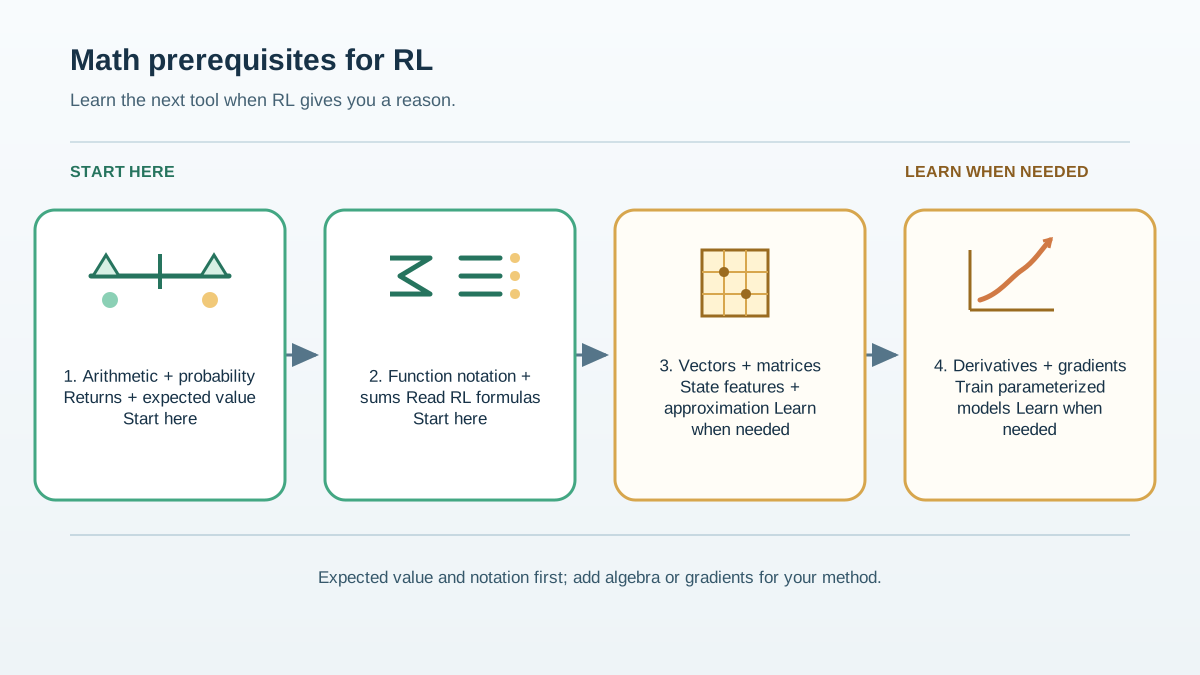
Let me consolidate this into a concrete, staged sequence you can follow.
Stage 1: Arithmetic, averages, and basic probability. This is where you start. You need enough to understand returns and expected value: how to compute an average, how to multiply outcomes by probabilities, how to add up a sequence. If you can do these, you can understand the math behind tabular value-based RL.
Stage 2: Function notation and summation. Once you're comfortable with expected value, learn to read simple RL formulas. Understand what a function is, what a policy function looks like, and what summation notation means. This is enough to follow value-based explanations and implement your first agents.
Stage 3: Vectors and matrices. Defer this until you need to represent many states compactly, use function approximation, or read deep RL material. When states become images or high-dimensional sensor data, you'll need linear algebra to understand how the network processes them. Until then, skip it.
Stage 4: Derivatives and gradients. Defer this until you train a parameterized model—whether that's a neural network estimating values or a policy gradient method. When you need to improve a model by nudging its parameters, you'll need to understand rates of change. Until then, skip it.
Here's a route-based summary to help you decide what to prepare before each milestone:
| Your goal | Math you need now | Math you can defer |
|---|---|---|
| Understand returns and value | Expected value, weighted averages | Everything else |
| Implement tabular Q-learning or value iteration | Arithmetic, simple tables, reading basic formulas | Derivatives, linear algebra |
| Use function approximation or deep value methods | Vectors, matrices, derivative/gradient intuition | Advanced linear algebra, advanced calculus |
| Implement policy gradient methods | Derivatives, gradients, probability distributions over actions | Advanced optimization theory |
The when-to-defer rule needs one qualification: if a math topic doesn't appear in the material you're currently reading, don't study it yet—but do notice when a tutorial assumes background you don't have. That's your signal to pause and fill that specific gap, not to abandon the path. Return to the topic when a formula or algorithm actually demands it. This isn't laziness—it's efficient learning. You'll understand the math better when you have a concrete RL problem that motivates it.
Knowledge check
Check your understanding
Answer this question before you continue.
Your Next Step
Don't go enroll in a full calculus course. Don't spend a month on linear algebra textbooks.
Instead, revisit the rewards and returns material, and try this: construct a simple two-step scenario with your own numbers. Assign probabilities to different outcomes, compute the expected return by hand using the weighted-average intuition from this article, and check that your intuition matches the calculation.
That exercise—not a math course—is the bridge from where you are to where you need to be. The math prerequisites for reinforcement learning are real, but they're smaller than you think, and they arrive just in time.
Knowledge check
Final check
Finish the article by checking the ideas you just learned.
References
Research updated Sep 9, 2026


