
Extrapolation Error in Offline RL: Why Unseen Actions Mislead the Agent
Imagine training an offline agent and watching its Q-values climb steadily. The critic grows more confident. The policy selects actions with increasing…

Key topics
Imagine training an offline agent and watching its Q-values climb steadily. The critic grows more confident. The policy selects actions with increasing certainty. Then you deploy the agent in the real environment, and it collapses—not gradually, but immediately.
The training curve looked like learning. It was actually the agent drifting toward actions the dataset never recorded, while the critic priced them as if they were gold.
This is extrapolation error in offline reinforcement learning: the systematic bias that appears when a value function estimates the worth of state-action pairs outside the fixed dataset's support. The symptom is overconfidence. The mechanism is a function approximator guessing about territory it never saw.
The Symptom: Confident Values on Actions Nobody Took
The telltale sign of extrapolation error is deceptively benign: Q-values rise smoothly while the policy drifts toward actions that never appear in the logged transitions. Training loss looks healthy. Action selection looks decisive. Nothing signals danger until the agent meets the real environment.
Contrast this with the online setting. When an online agent overestimates the value of an action, it can try that action, observe the true outcome, and correct its estimate. The environment acts as a referee that settles disputes between the critic's guesses and reality.
Offline, that referee is absent. The agent trains on a static dataset and never receives another sample. An inflated estimate is never corrected by experience because the experience never arrives. The critic's guess becomes the truth, and the policy optimizes against that guess.
This is the core asymmetry of offline RL: the agent can propose any action, but it can only learn about actions the behavior policy happened to record. When the learned policy queries actions outside that recorded set, the critic must answer anyway. Extrapolation error is what happens when it answers wrong—systematically, and often in the optimistic direction.
Knowledge check
Check your understanding
Answer this question before you continue.
Where the Error Comes From: The Dataset Support Boundary
Every offline dataset defines a support region: the set of state-action pairs actually covered by logged transitions from the behavior policy. Inside that region, the critic has evidence. Outside it, the critic has nothing but the smooth interpolation habits of neural networks.
A function approximator has no memory of absent pairs. When queried about an action the dataset never contains, it cannot recall—it must extend from nearby observed data. Neural networks are smooth functions, which makes this extension feel plausible. The critic produces a value that looks like a measurement but is actually an extrapolation dressed as one.
The danger compounds through smoothness itself. When the critic assigns an inflated value to one out-of-distribution action, that error bleeds into neighboring actions. The overestimation spreads like a stain across the value landscape, widening the region where the policy believes unsupported actions are attractive.
Think of the critic as a mapmaker who has surveyed only part of a terrain. Asked to price a region never visited, the mapmaker draws contours that look consistent with the surveyed area. The map is smooth, confident, and wrong. The policy then plans a route through the unsurveyed region because the map says the terrain is favorable.
The analogy has a limit worth naming: support is not a clean line on a map. Real datasets have dense regions, sparse regions, and gaps. A state-action pair can be well supported, thinly supported, or entirely absent. The boundary is better understood as an evidence gradient than a wall—but the practical warning stays the same. The thinner the evidence, the more the critic is extrapolating, and the less you should trust its answer.
Knowledge check
Check your understanding
Answer this question before you continue.
Why Bootstrapping Turns a Small Error Into a Collapse
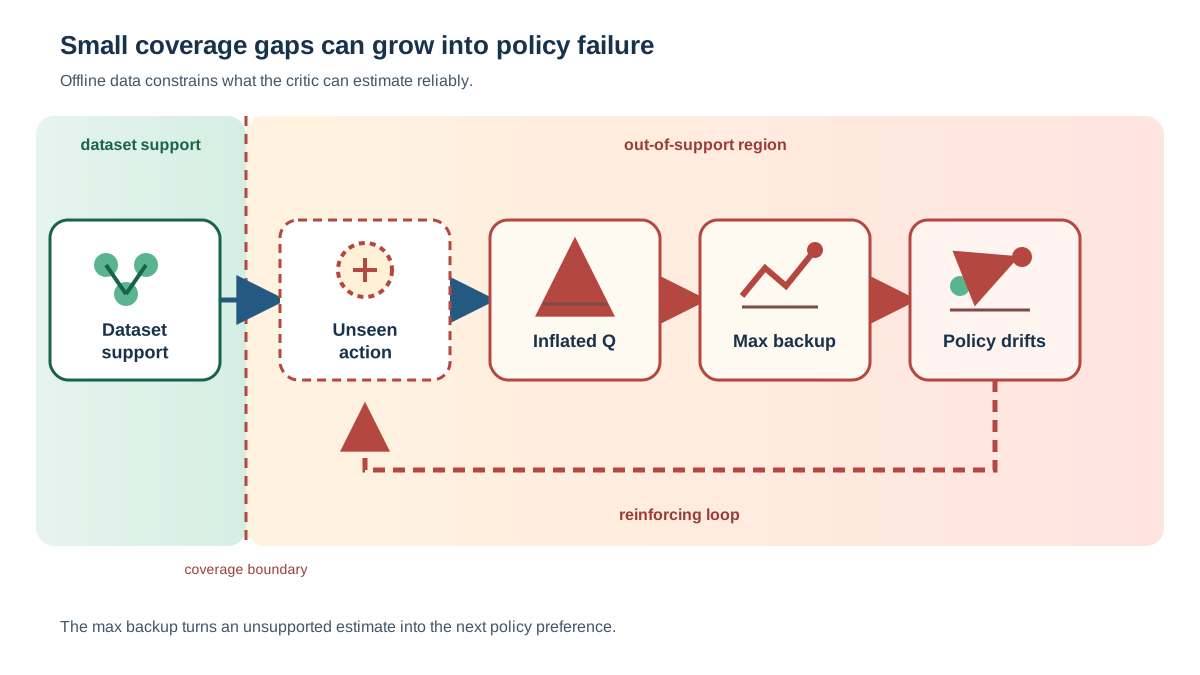
A single overestimated out-of-distribution action would be a minor nuisance if it stayed isolated. It does not stay isolated. Bootstrapping ensures that errors propagate through the value function like a rumor through a network.
Consider the Q-learning target. To update the value of a state-action pair, the critic must evaluate the next state by taking the maximum over all possible actions. That max operator forces the critic to price every action in the next state—including actions the dataset never recorded. The critic cannot decline to answer. It must produce a value for each action, and for out-of-distribution actions, that value is extrapolation.
The max operator then does what it always does: it selects the largest estimate. When some of those estimates are inflated, the max systematically selects the most inflated one. Each backup step passes that inflated value backward to the preceding state. The next backup inflates it further. The error does not add a constant offset; it compounds.
This mechanism shares DNA with the overestimation bias familiar from Q-learning, where noisy estimates interact with maximization to produce optimistic values. But offline RL changes the stakes. Online, the agent can eventually try the overestimated action, observe the true return, and pull the value back down. Offline, no correction loop exists. Errors can propagate until the value function becomes severely overoptimistic—or, in the worst cases, unstable enough to diverge entirely.
The result is not a slightly optimistic critic. It is a value function that has drifted far from reality, with the policy following the drift.
Knowledge check
Check your understanding
Answer this question before you continue.
Why Online Fixes Don't Translate Offline
A natural response is to reach for the standard online remedies for overestimation. Double Q-learning and clipped double-Q targets reduce the bias that comes from maximizing over noisy estimates. They are useful tools—and they do not solve extrapolation error.
The distinction matters. Overestimation bias is a noise-amplification problem: noisy estimates, passed through a max operator, drift upward. Double Q-learning addresses this by decoupling action selection from action evaluation. But extrapolation error is a data-coverage problem. The critic is not misreading noisy evidence; it is inventing values for pairs with no evidence at all. Reducing noise does not create data that was never collected.
Exploration, the natural online correction, is structurally unavailable. An online agent that suspects its critic is wrong can gather new transitions to test the hypothesis. An offline agent cannot. The dataset is fixed. The behavior policy that generated it is unknown and unreachable. No amount of clever training dynamics will produce a transition that does not exist in the logged data.
This is why extrapolation error is not a tuning issue. You cannot adjust it away with a lower learning rate, a different network architecture, or a better exploration schedule. It is a property of asking a model to price what the dataset never showed it. The only real fixes change the learning problem itself.
Knowledge check
Check your understanding
Answer this question before you continue.
How Offline Methods Work Around the Boundary
The field's response to extrapolation error is a set of strategies that all acknowledge the same constraint: the dataset support is a boundary the agent must respect. Each family controls a different part of the learning loop, and each trades away something real.
Batch-constrained approaches restrict the policy to actions near the behavior policy's support. Instead of asking "what is the best action?" they ask "what is the best action among those the behavior policy plausibly took?" This keeps the critic inside its surveyed territory. The cost: the policy can miss genuinely better actions that lie just beyond the behavior policy's typical choices.
Pessimistic value methods take the opposite tack. Rather than constraining the policy, they deliberately lower estimates on uncertain or out-of-distribution regions. If the critic is pessimistic enough about unsupported actions, the max operator no longer rewards the policy for choosing them. The agent can still improve over the behavior policy, but only within regions where the critic's pessimism does not suppress genuinely good actions. The cost: conservatism can bleed into well-supported regions, leaving valid improvements on the table.
Implicit constraint methods avoid querying out-of-distribution actions altogether by changing the learning objective. Instead of learning a Q-function and then extracting a policy, they learn values only for actions the dataset actually contains, sidestepping the need to price unseen actions. The cost: they depend on a reliable estimate of which actions the behavior policy plausibly takes, and that estimate can be wrong.
Model-based approaches learn a dynamics model from the dataset and use it to simulate additional experience. This allows bounded pseudo-exploration, but only in regions where the model is confident. Where the model is uncertain, the agent applies penalties, effectively drawing its own support boundary around the regions it trusts. The cost: the model itself can be wrong, and its errors become a new source of bias.
These families are not mutually exclusive, and modern methods often combine elements of several. The conceptual point is that every serious offline RL method is, at its core, a response to the coverage constraint. The algorithm is the answer to the question: how do we improve over the behavior policy without asking the critic to price the unpriced?
Diagnosing Extrapolation Error in Your Own Agent
When your offline agent fails, extrapolation error should be near the top of your suspect list. Several signals point to it—but they need to be read state-conditionally, not as global summary statistics.
First, check whether the learned policy's action distribution overlaps the dataset's action distribution. Divergence is an early warning sign. But do not stop at a global histogram. A policy can match the dataset's overall action frequencies while still choosing unsupported actions in particular states. The question is not "does the policy resemble the behavior policy overall?" It is "at each state the policy visits, does the dataset contain evidence for the action it chooses?" Use behavior-policy likelihood estimates, nearest-neighbor distances, or density proxies conditioned on state to catch local drift that global overlap hides.
Second, probe the critic with synthetic out-of-distribution actions. Generate actions far from the dataset's distribution, query the critic, and compare the values to those on supported actions. If the critic systematically assigns higher values to unsupported actions, extrapolation error is likely present. This test is cheap—but it is a warning signal, not a verdict. A high critic value on an unsupported action tells you the critic is extrapolating, not that the true environment value is wrong. To confirm the diagnosis, you need a second source of evidence: an uncertainty estimate, a dynamics model's confidence, or an offline policy evaluation method that does not rely on the same critic.
Third, compare policy performance against a behavioral-cloning baseline. Behavioral cloning simply imitates the dataset; it cannot improve over the behavior policy, but it also cannot drift outside the data's support. If your offline RL agent underperforms simple imitation, inflated values are likely steering it wrong. The RL agent is not failing to learn; it is learning the wrong thing from a critic that believes its own extrapolations.
Watch for the signature pattern: training loss looks healthy while evaluation on the true environment collapses. This divergence between estimated value and real return is the fingerprint of extrapolation error. When you see it, suspect the coverage boundary before you suspect the optimizer.
My rule is simple: when value estimates and real returns diverge, ask first whether the policy is asking the critic to price actions the data never supported. If the answer is yes, no amount of hyperparameter tuning will fix it. The problem is not in your training configuration. It is in the boundary between what the dataset contains and what your agent wants to do.
Treat dataset coverage as the practical boundary of what offline RL can learn reliably. The dataset is not just training data; it is the complete record of experiences your agent will ever have. Every action the behavior policy never took is a question your critic must answer without evidence. Extrapolation error is what happens when the critic answers confidently anyway—and the policy believes it.
The next time your offline agent fails, do not reach for the optimizer first. Reach for the dataset. Ask what your policy wants to do, what the data actually supports, and whether your critic is pricing evidence or extrapolation. That single question will tell you whether you have a tuning problem or a coverage problem—and only one of those can be tuned away.
Knowledge check
Final check
Finish the article by checking the ideas you just learned.
References
Research updated Sep 9, 2026


