
The Deadly Triad in Reinforcement Learning: Why Learning Can Become Unstable
Your Q-learning agent trains beautifully for ten thousand steps. The loss curve dips, the reward trend climbs, and you start to believe the hard part is…

Key topics
Your Q-learning agent trains beautifully for ten thousand steps. The loss curve dips, the reward trend climbs, and you start to believe the hard part is over. Then, without any change to the environment, the value estimates inflate like a balloon, the returns collapse, and the loss curve starts oscillating like a seismograph during an earthquake.
The instinct is to reach for the learning rate. Lower it. Shrink the network. Add more exploration. These tweaks might temporarily mask the problem, but they will not fix it. The real culprit is structural: three individually sensible design choices that become dangerous when combined.
This failure mode has a name. Sutton and Barto call it the deadly triad in reinforcement learning, and understanding it will change how you debug unstable value-based agents.
The Symptom: Divergence That Looks Like a Tuning Problem
Divergence has a recognizable signature. Value estimates grow without bound, sometimes into the millions for rewards that never exceed single digits. Returns that looked stable suddenly crater. Or the loss curve enters a regime of wild oscillation that no amount of learning-rate decay seems to tame.
What makes this failure so deceptive is that it does not look like a broken algorithm. It looks like a training run that needs more patience or a smaller step size. Ordinary noise responds to those tweaks. Slow learning responds to a higher learning rate or more exploration. Divergence from the deadly triad does not respond to any of them, because the problem is not in the size of your updates. It is in the structure of what you are updating and where the update targets come from.
Once you can name the triad, you stop guessing and start forming testable hypotheses. That is the payoff: a diagnostic lens instead of a tuning ritual.
The Three Ingredients, Named One at a Time
The deadly triad consists of three mechanisms that each seem reasonable on their own.
Bootstrapping means your update target uses the estimator's own current guess about a future state, rather than a complete observed return. Temporal-difference learning bootstraps. Monte Carlo methods do not. Bootstrapping gives you lower variance and faster learning, but the target moves as you learn. You are chasing a number that shifts every time you update.
Function approximation means a parameterized function—like a neural network—represents values across many states at once. Updating one state's estimate shifts the estimates of nearby states too. The network cannot isolate a single state the way a lookup table can. Every parameter update touches everything that shares those parameters.
Off-policy learning means the data driving your updates comes from a behavior policy that differs from the policy you are learning. Q-learning is the classic example: it updates toward the best estimated next action, even when the behavior policy chose something else. The update chases a target the data never actually produced.
Each of these is a tool you would reach for deliberately. Bootstrapping for sample efficiency. Function approximation for scale. Off-policy learning for data reuse. The danger appears only when all three operate at once.
Knowledge check
Check your understanding
Answer this question before you continue.
Why Removing One Ingredient Often Defuses the Loop
Here is the fact that makes the triad feel almost unfair: remove any one ingredient, and the classic failure mechanism usually disappears.
Tabular off-policy TD combines bootstrapping with off-policy learning but skips function approximation. Each state keeps its own independent estimate in a lookup table, so an error in one state cannot bleed into its neighbors. The estimates may be biased, but they stay bounded.
On-policy TD with function approximation combines bootstrapping with a neural network but stays on-policy. Because the data comes from the same policy being learned, the distribution of experience stays aligned with the values being updated. The system can be noisy, but it does not systematically chase its own tail.
The instability emerges when all three combine. Known divergence examples for TD-style methods involve all three components. This pairwise framing gives you a diagnostic lever: when your agent diverges, ask which ingredient you can remove or weaken to restore stability.
Note: Removing one ingredient removes the classic deadly-triad mechanism, but it does not guarantee good learning. Your agent can still fail for other reasons—poor exploration, badly scaled rewards, or an architecture that cannot represent the value function. The triad explains one specific feedback loop, not every possible source of instability.
Knowledge check
Check your understanding
Answer this question before you continue.
The Mechanism: How the Three Amplify Each Other
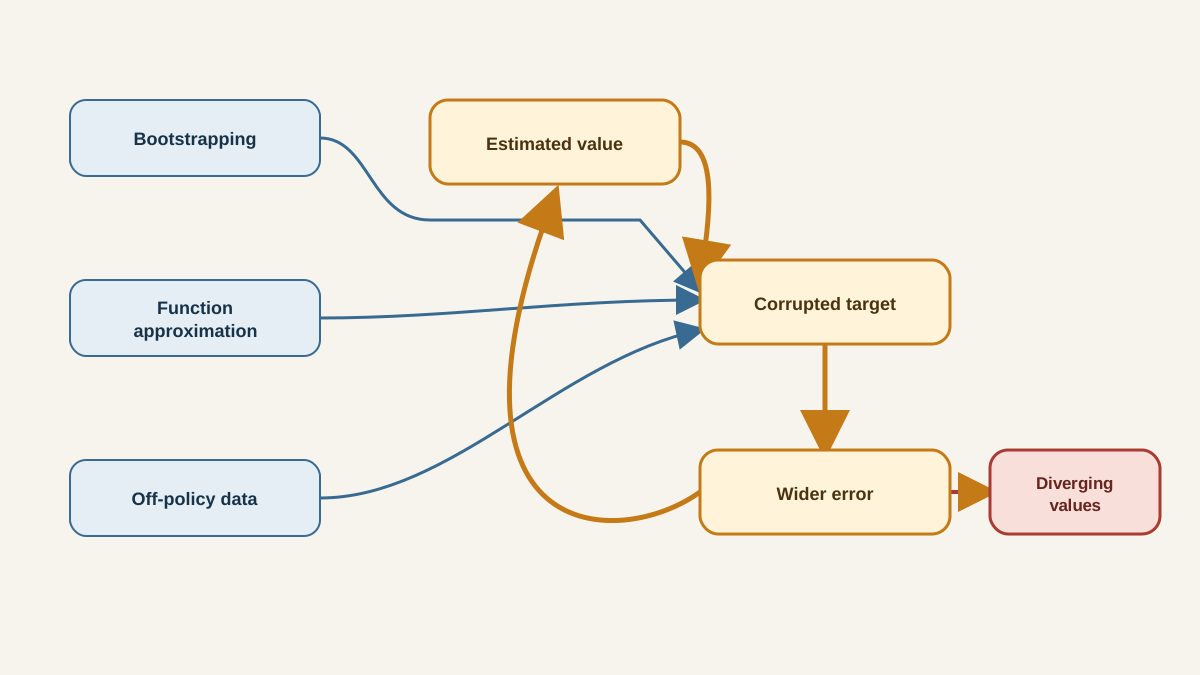
The causal chain is easier to see when you watch the error move through the system.
Function approximation means one parameter update touches many states at once. An approximation error in one region bleeds into neighboring states, corrupting their estimates too. That is the first leak.
Bootstrapping feeds that corrupted estimate back into the update target. The estimator chases a target that already contains its own mistakes. The error does not just persist; it becomes part of the next target. That is the second leak, and it turns a one-time error into a recurring one.
Off-policy data lets the error compound in regions the agent does not actually experience. Because the updates come from states and actions the current policy would rarely visit, nothing checks the growing error. The agent never goes there to discover how wrong the estimate has become.
Each ingredient alone is a tolerable leak. Together they form a feedback loop where the estimate inflates its own target. The network predicts a high value, bootstrapping uses that high value as the target, and off-policy data keeps feeding the loop without correction.
This risk is not caused by environmental randomness or noise. It can appear even in fully known, deterministic settings. The instability lives in the learning algorithm itself, not in the world the agent is trying to model.
Knowledge check
Check your understanding
Answer this question before you continue.
How Deep Q-Learning Manages the Loop: The Target Network
Deep Q-Networks combine all three triad ingredients. Q-learning is off-policy. Neural networks are function approximators. The TD target bootstraps. By the logic above, DQN should be a divergence machine. Yet it works, and the reason is a structural fix that slows the tightest feedback loop.
DQN computes its bootstrapping target from a target network: a slowly-updated copy of the main network. The live network's parameters change every step, but the target network only synchronizes with it periodically. Between synchronizations, the target stays roughly fixed.
This small change slows the self-chasing loop. The update target no longer moves every time the estimator moves. The network chases a target that holds still long enough to be caught.
Common mistake: Do not conclude that DQN has escaped the triad. All three ingredients are still present. The target network does not remove off-policy learning, function approximation, or bootstrapping—it changes how fast the bootstrap target moves. That can substantially improve stability, but it is not a guarantee of convergence. Think of it as managing the risk, not eliminating it.
This is your first concrete debugging hypothesis. If your value estimates diverge, a target network—or a slower synchronization schedule for the one you have—is a structural fix, not a tuning tweak. You are not adjusting the size of the steps. You are changing what the steps aim at.
Knowledge check
Check your understanding
Answer this question before you continue.
Using the Triad as a Debugging Lens
When returns diverge, do not reach for the learning rate first. Walk through the triad and ask which ingredient is amplifying the error in your specific setup.
If bootstrapping is the likely amplifier, slow down the target. Add a target network or increase the synchronization interval. Evidence this is the right test: value estimates grow in step with how fast your target updates, and a slower target flattens the divergence curve.
If the off-policy gap is the problem, reduce it. Mix in more on-policy data, or shorten the replay buffer so stale experiences from older policies do not dominate. Evidence this is the right test: divergence tracks the age of your replay data—the older the samples, the faster estimates grow. Be aware of the tradeoff: a shorter buffer also reduces data diversity and can slow learning.
If function approximation is spreading the error too aggressively, shrink the approximator's reach. Reduce the network's capacity, or simplify the state representation so updates touch fewer unrelated states. Evidence this is the right test: parameter or value estimates grow faster when the network has more capacity, and a smaller network changes the divergence pattern. The tradeoff is that you may be hiding representational failure rather than repairing instability—the smaller network might simply be too weak to express the runaway values.
The common dead end is tweaking the learning rate or network width when the real problem is structural. These changes may mask divergence temporarily, but the feedback loop remains intact. Treat each change as a controlled test, not a blind knob turn. Change one ingredient, observe the effect, and let the result guide your next hypothesis.
The Decision Rule That Sticks
When value-based learning diverges, name the amplifier before you touch the hyperparameters. Ask which of the three ingredients is feeding the error back into itself, then test a structural change: a slower target, a narrower off-policy gap, or a less expressive approximator.
The deadly triad is not a warning to avoid these tools. It is a map of where they become dangerous together. Every modern deep RL system navigates this territory by managing one link in the chain. Your job is to find the link you can afford to weaken.
Run a small experiment to see the dynamics for yourself. Take a tabular Q-learning agent on a simple environment and confirm it converges. Then compare it against a variant that bootstraps with a linear function approximator off-policy, keeping the environment, reward scale, and behavior policy as constant as you can. Watch the value estimates and loss curves rather than waiting for spectacular divergence. What you are looking for is how the failure signals change—where the estimates grow, how fast, and which intervention slows them down. That observation will teach you more about the triad than any diagram can, because you will have watched the feedback loop form with your own eyes.
Knowledge check
Final check
Finish the article by checking the ideas you just learned.
References
Research updated Sep 9, 2026


