
Evaluating Exploration in RL: Did the Agent Discover Useful Information?
A novelty bonus can make your agent look busy without making it look smart. The intrinsic-reward curve climbs, the state-visitation heatmap fills in, and…

Key topics
A novelty bonus can make your agent look busy without making it look smart. The intrinsic-reward curve climbs, the state-visitation heatmap fills in, and the task return stays flat. Before you trust any exploration claim, you need an evaluation that separates wandering from discovery—and that means knowing which kind of evidence actually proves usefulness.
Why Visitation Looks Like Learning (and Isn't)
Here is the trap: you add a novelty bonus, the agent starts visiting states it never touched before, and the intrinsic-reward curve rises exactly as designed. It feels like progress. It is not.
A novelty bonus rewards unfamiliarity, not relevance. The agent has no idea whether a rarely visited state gates task progress or is a decorative dead end. In a large state space, the agent can rack up substantial intrinsic reward by cycling through a pocket of novel-but-irrelevant states, inflating its own exploration signal while learning nothing about the task.
The exploration-exploitation loop only pays off when the information gathered changes what the agent can do. If the agent visits a new room but the visit never alters its value estimates or policy toward the goal, that exploration produced data without discovery.
This is the distinction at the heart of evaluating exploration in reinforcement learning: novelty versus useful exploration. Novelty measures what the agent has not seen. Useful exploration measures what the agent can now reach.
The anchor criterion: useful exploration increases the set of task outcomes the agent can actually reach. Everything else is noise with a reward attached.
Internal signals like novelty bonuses are a means, not the objective. The intrinsic reward is a hypothesis about what information will help. Evaluation is how you test that hypothesis.
The Evidence Ladder: From Visitation to Usefulness
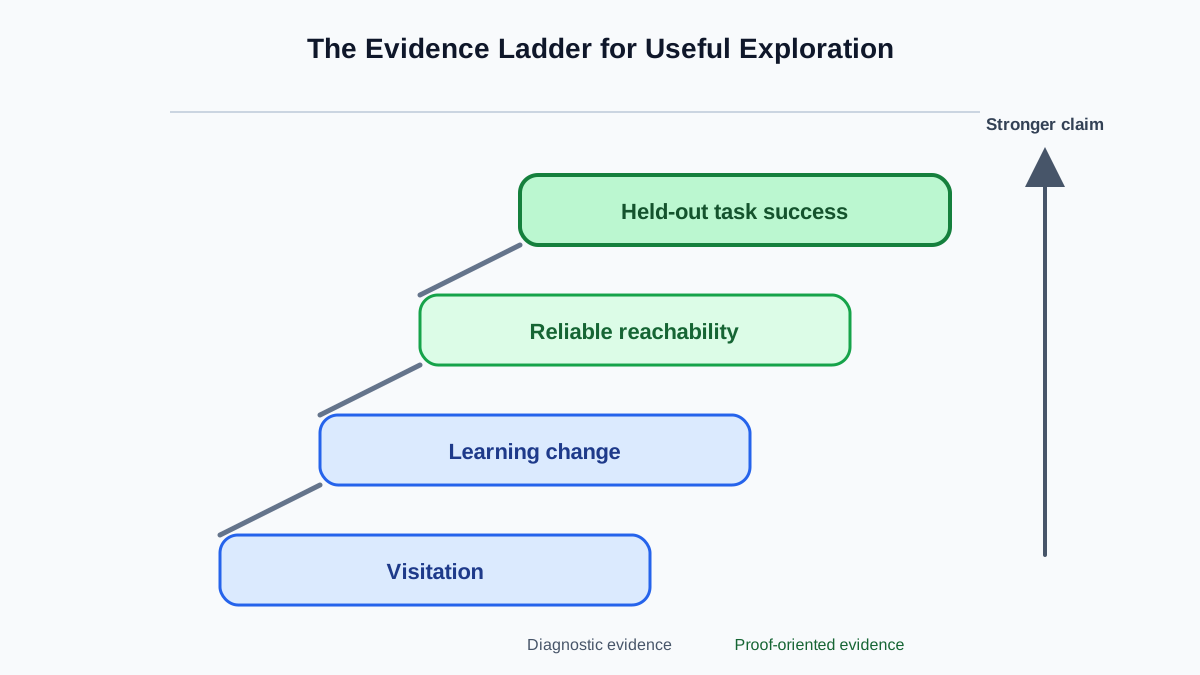
The hardest part of evaluating exploration is that "the agent discovered something useful" can mean several different things, and they are not equally strong claims. Treat them as a ladder. Each rung is a more demanding test, and the claim you can make depends on which rung you actually measured.
Rung 1: Visitation. The agent passed through a state. This is exposure, nothing more. A heatmap showing wide coverage proves the agent saw the space, not that it learned from the space.
Rung 2: Learning change. After visiting a state, the agent's value estimates or policy shifted. This is a signal that the visit carried information. But a changed estimate is not yet improved behavior—the agent can update its beliefs and still fail to act on them.
Rung 3: Reliable reachability. The agent can return to the state under its current policy, not just stumble into it once during exploration noise. This is controllability: the agent has access when it matters.
Rung 4: Held-out task success. The agent reliably completes the task on a clean evaluation with exploration disabled. This is usefulness: the discovered information translated into capability.
Most exploration claims stop at Rung 1 or 2 and conclude Rung 4. The discipline of good evaluation is knowing which rung your evidence actually supports. Visitation and learning change are diagnostic—they tell you where to look. Reachability and task success are proof.
Knowledge check
Check your understanding
Answer this question before you continue.
Separating Exploration Progress from Task Progress
The first mistake is conflating two different curves. Track them separately:
- Intrinsic-reward accumulation: how much internal signal the agent collected
- Task return: how well the agent performs the actual objective
Plot both over training. A rising intrinsic curve with a flat task curve is not a partial win. It is a warning that the bonus is funding activity without demonstrated discovery.
There is a second, subtler problem: training curves lie about performance. Because most algorithms use exploration noise during training, the episodes you see include random actions that depress returns. The standard fix is to evaluate on a separate test environment with exploration disabled and deterministic actions. This is not optional polish; it is the only way to get a comparable measure of what the policy learned.
One qualification matters here. A flat task-return curve during training is a warning, not a verdict. The agent may have gathered useful intermediate information that has not yet propagated into task performance—especially if the evaluation horizon is short or the task is difficult. Before concluding that a bonus is purely distracting, inspect intermediate milestones or give the learning process room to convert discovery into behavior.
Knowledge check
Check your understanding
Answer this question before you continue.
Metrics That Measure Discovery, Not Wandering
Visitation counts answer the wrong question. "Did the agent pass through this state?" is not the same as "Can the agent get here when it matters?" You need metrics tied to task structure.
Coverage of task-relevant regions. Instead of measuring raw state-space coverage, measure whether the agent reaches states that gate task progress. In a maze with a key and a door, the relevant question is whether the agent reaches the key, not whether it has seen every corridor. Raw coverage is a Rung 1 diagnostic; key-reach frequency is a Rung 3 measurement.
First-success timestep. Under sparse rewards, record when the agent first achieves a successful episode. A bonus that accelerates first success is doing exploration work. A bonus that never moves first success is not.
Best-found return. Track the maximum task return achieved at any point during training. This is a discovery indicator: it tells you whether the agent ever found a better trajectory. It does not tell you whether the agent can reproduce that trajectory. A single lucky episode under sparse rewards is common, so pair this metric with repeated evaluation after discovery. Success rate across clean evaluation episodes distinguishes finding a trajectory from retaining a policy that can execute it.
Policy or value shift after novel visits. The strongest diagnostic signal: does visiting a new region change the agent's subsequent behavior toward the goal? If the agent reaches the key region and its value estimates or policy shift toward the door, the visit carried information. If nothing changes, the visit was novelty without value. This is a Rung 2 measurement—useful for diagnosis, not sufficient for proof.
The distinction between reachability and visitation matters throughout. Reachability metrics ask whether the agent can get somewhere under its current policy. Visitation metrics only record that it passed through, possibly by luck during exploration noise. When you evaluate exploration, you want reachability: can the agent reliably access the states that matter?
Designing the Experiment: Isolating the Exploration Change
You cannot evaluate exploration quality from a single run. You need a controlled comparison.
Run the same algorithm with and without the intrinsic bonus. That is the only difference. Change the exploration mechanism, the reward structure, the environment, or the seed count simultaneously, and you can no longer attribute any observed gain to exploration.
The experimental design:
- One ablation. Baseline algorithm without the bonus, same algorithm with the bonus. Nothing else differs.
- Multiple seeds. Results in RL vary from run to run when only the seed changes. A single lucky run proves nothing. Run enough seeds to see the distribution, not one point.
- Separate test environment. Evaluate with exploration disabled and deterministic actions. Use enough test episodes to get a stable estimate; the right number depends on the variance of your task, so check whether the estimate stops moving as you add episodes.
- Track both curves. Record intrinsic-reward accumulation and task return separately throughout training.
Watch for the failure mode where the intrinsic bonus changes behavior only by adding noise that happens to help one seed. The bonus might inject randomness that accidentally pushes the agent toward the goal, without teaching anything about which states matter. Multiple seeds expose this: if the gain only appears in one seed, you are looking at luck, not mechanism.
Knowledge check
Check your understanding
Answer this question before you continue.
Reading the Results: Four Outcomes to Interpret
Once the controlled experiment is done, the curves tell you which of four situations you are in.
Outcome A: task return improves and reachable outcomes expand. Exploration is doing real work. The bonus helped the agent discover states that gate task progress. Keep it, and consider tuning the bonus weight to see if more helps.
Outcome B: intrinsic reward rises but task return stays flat. This is novelty without demonstrated discovery. The agent is collecting internal reward for visiting unfamiliar states, but none of those visits expand what it can achieve. The bonus is a distraction. Reduce its weight, or abandon it and look elsewhere.
Outcome C: task return improves, but only because the bonus adds beneficial noise. The mechanism is masking a different problem. The agent is not learning to explore intelligently; it is being randomly pushed toward success. This often indicates the base policy needs better exploration on its own, or the environment needs a different reward structure.
Outcome D: both curves are flat. Exploration is not the bottleneck. The agent cannot make progress even with the bonus, which means the problem is elsewhere: reward design, environment structure, or the base algorithm. Adding more intrinsic motivation will not fix a task the agent cannot learn.
The decision rule: tune the bonus when it shows Outcome A. Abandon it when you see Outcome B. Investigate the base algorithm when you see Outcome C. Stop blaming exploration when you see Outcome D.
Knowledge check
Check your understanding
Answer this question before you continue.
The Counterfactual Test: Learned Exploration or Beneficial Noise?
Outcome A and Outcome C can look identical on a training curve. Both show task return improving. The difference is whether the improvement comes from learned capability or from stochastic assistance. You need one explicit counterfactual check to tell them apart.
Evaluate the trained policy with exploration noise removed and the intrinsic bonus disabled. If the gain persists under clean evaluation, the agent learned something it can execute on its own. If the gain collapses when the noise or bonus disappears, the improvement was training assistance, not learned exploration.
Apply the same test across seeds. A gain that survives clean evaluation in most seeds is learned exploration. A gain that only appears during noisy training, or only in one seed, is stochastic discovery wearing a costume.
Common Mistakes When Judging Exploration
Several recurring errors make exploration look better or worse than it is.
Trusting a single seed or one good episode. A single successful trajectory can come from luck. The question is whether the agent can reliably reproduce the discovery.
Reading intrinsic-reward totals as evidence of learning. High intrinsic reward only means the agent found unfamiliar states. It says nothing about whether those states matter.
Evaluating on the training environment. Exploration noise inflates scores and hides what the policy actually learned. Always test with exploration disabled.
Confusing acceleration with expansion. A bonus that helps the agent solve a task it could already solve faster is useful, but it is not the same as expanding the set of reachable outcomes. The first improves speed; the second improves capability.
Attributing gains to exploration when something else moved. If you changed reward shaping, environment structure, or hyperparameters at the same time, you cannot isolate the exploration mechanism. The ablation has to be clean.
A Practice Exercise: Diagnose the Exploration Claim
The scenario. You add a count-based novelty bonus to a sparse-reward navigation task. After training, the intrinsic-reward curve has climbed steadily. The task-return curve, measured on a clean test environment with exploration disabled, is flat. The state-visitation heatmap shows the agent has covered a wide area. Your collaborator says the exploration is working because the agent is clearly exploring more.
What does the evidence actually support?
Hint. Apply the anchor criterion. Ask whether the agent's visits expanded the set of task outcomes it can reach, and remember which rung of the evidence ladder each measurement occupies.
The interpretation. The evidence supports one conclusion: the bonus produced novelty without demonstrated discovery. The agent explored more, but the exploration did not translate into task progress. The rising intrinsic curve is a Rung 1 measurement—it records unfamiliarity, not usefulness. The wide heatmap is also Rung 1: visitation without reachability. The flat task-return curve, measured under clean evaluation, tells you the agent never learned to reliably reach the outcomes that matter.
The next experiment is not to tune the bonus harder. It is to test whether the bottleneck is elsewhere. Run the baseline without the bonus. If the task curve is equally flat, exploration was never the problem; the issue is in the reward design or environment structure. If the baseline is worse, the bonus is helping but insufficient, and the task structure itself may need revision.
The durable rule: exploration is only as good as the reachable task outcomes it buys. When you evaluate exploration in reinforcement learning, do not ask whether the agent saw more. Ask whether it can do more. Run the controlled ablation, plot intrinsic and task curves separately, and evaluate on a deterministic test environment before you trust any exploration claim.
Knowledge check
Final check
Finish the article by checking the ideas you just learned.
References
Research updated Sep 9, 2026


