
A Reinforcement Learning Learning Path: From Agent Loop to Deep RL
Most people start reinforcement learning the wrong way. They install a deep RL library, copy a DQN or PPO example, watch the agent fail—or worse, behave…

Key topics
Most people start reinforcement learning the wrong way. They install a deep RL library, copy a DQN or PPO example, watch the agent fail—or worse, behave unpredictably—and have no idea why. The problem isn't the algorithm. It's that they skipped the mental model that makes every algorithm debuggable.
This reinforcement learning learning path is ordered for a reason. Each stage gives you a mental object and a checkpoint experiment that the next stage assumes. Skip stages and you'll pay for it later in confusion, wasted compute, and agents that fail for reasons you can't name.
Why Most RL Learning Paths Fail
Here's the visible symptom: someone opens a tutorial for Deep Q-Networks, runs the code, and the agent either learns nothing, collapses after initial progress, or succeeds once and then fails forever. They tweak hyperparameters randomly. Nothing helps. They conclude RL is fragile and mysterious.
The weak model underneath is treating reinforcement learning as a collection of algorithms to memorize rather than a decision loop plus a learning mechanism.
Every modern method—DQN, PPO, actor-critic, all of them—is a variation on one loop:
- Observe the current state.
- Choose an action.
- Receive a reward and observe the next state.
- Update a prediction based on what happened.
That's it. Master that loop first, and every later algorithm becomes a specific answer to a specific question about the loop. When you understand the mechanism, a failed run becomes evidence about which part of the loop is broken. When you don't, a failed run is just a mystery.
Stage 1: Speak the Decision Loop Fluently
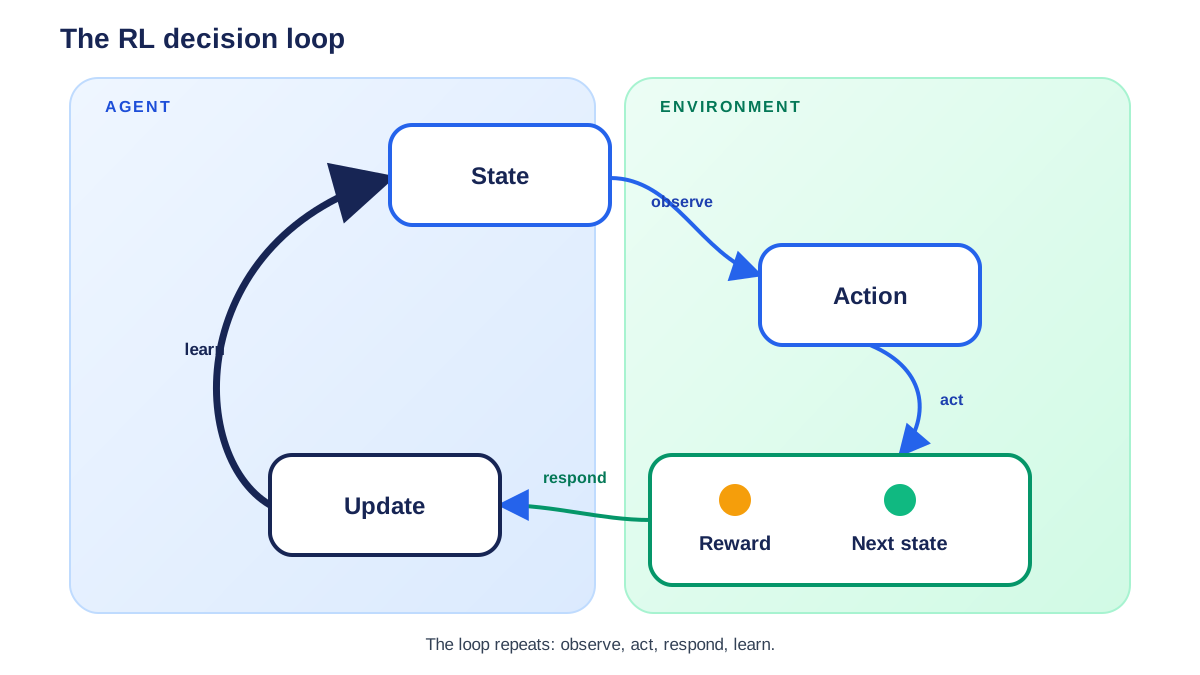
If you've read an introduction to RL, you've met the agent-environment loop. Let's recap it briefly because everything else builds on this vocabulary.
An agent exists in an environment. At each step, it observes a state, picks an action, and the environment responds with a reward and the next state. The agent's goal is to maximize the total reward it collects over time.
The key difference from supervised learning: the agent doesn't learn from a labeled dataset. It learns from the consequences of its own choices. There's no teacher saying "that action was correct." There's only the reward signal arriving after the fact—often delayed many steps from the choice that caused it.
That delay is the whole reason RL is hard. If every action produced immediate feedback, you could just try everything and keep what worked. Instead, the agent must learn to credit actions for rewards that arrive later.
Three terms you'll reuse constantly:
- Episode: one complete run from start to finish, like one game of chess or one trip through a maze.
- Return: the total accumulated reward over an episode or horizon.
- Discounting: a way of valuing future rewards slightly less than immediate ones, usually controlled by a factor called gamma.
Checkpoint experiment: Run a tiny gridworld or cart-pole environment and let the agent take random actions. Watch states, actions, and rewards stream by. Don't try to learn anything yet. Just observe the loop in motion.
Move on when: you can look at any RL diagram and name each arrow in the loop.
Knowledge check
Check your understanding
Answer this question before you continue.
Stage 2: Learn What Value Means Before You Chase It
Once you can see the loop, the next question is: how does an agent decide which action to take?
The answer is value. The agent needs a way to judge states and actions before it has experienced every possible future. That judgment is a prediction: "If I'm in this state and take this action, how much total reward should I expect?"
The Bellman relationship is the core insight here, and it's simpler than it sounds. The value of being in a state is the reward you get now plus the discounted value of wherever you end up next. One-step reward plus discounted continuation. That's not a magic formula—it's a recursive definition that the agent can use to improve its own estimates.
Two value functions matter:
- V(s): the value of being in a state, assuming you follow some policy.
- Q(s, a): the value of taking a specific action in a specific state.
Q is the one you'll see most often because it directly tells the agent what to do: pick the action with the highest Q-value.
There's a catch. If the agent always picks the action it currently believes is best, it never discovers whether a different action might be better. This is the exploration-exploitation tradeoff: the agent must try actions it's unsure about to gather evidence, even when a seemingly good option exists.
Checkpoint experiment: Implement a small tabular value update on a gridworld. Watch the value estimates converge over episodes. Then change the discount factor and watch what the agent starts to care about.
Move on when: you can predict how changing the discount factor changes what the agent values.
Knowledge check
Check your understanding
Answer this question before you continue.
Stage 3: Meet the Two Families—Value Methods and Policy Methods
All RL algorithms belong to one of two families. Knowing which family you're looking at tells you what the algorithm learns and how it chooses actions.
Value methods learn a score for states or actions, then pick the best one. Q-learning is the classic example: it learns a lookup table of "how good is this action in this state" and chooses the highest score.
Policy methods skip the score and learn the action-selection rule directly. The agent learns a distribution over actions and samples from it. This matters for continuous control—like steering a robot or controlling torque—where enumerating every possible action isn't feasible.
| Value Methods | Policy Methods | |
|---|---|---|
| What they learn | A score for states or actions | A direct rule for choosing actions |
| How they choose | Pick the highest score | Sample from a learned distribution |
| Typical use cases | Discrete actions, games, navigation | Continuous control, stochastic policies |
| Example | Q-learning, DQN | Policy gradient, PPO |
Checkpoint experiment: Run a basic Q-learning agent on a small environment. Then run a simple policy-gradient agent on the same task. Compare how they behave, not just their final scores.
Move on when: you can look at any algorithm name and guess which family it belongs to.
Knowledge check
Check your understanding
Answer this question before you continue.
Stage 4: Make Experiments Honest Before You Trust Results
Here's a trap almost every beginner falls into: the agent produces one impressive episode, and you conclude it learned something.
One good episode proves nothing. The agent may have stumbled into a lucky run. Real learning shows up in learning curves across many seeds—repeated training runs with different random initializations.
Two kinds of measurement matter:
- Training curves show whether the agent is learning over time.
- Evaluation runs show capability under controlled conditions, separate from the training process.
The distinction matters because an agent can look great during training and fail during evaluation, or vice versa. Training curves show learning; evaluation shows capability.
Common failure signatures you'll encounter: no learning at all, returns that rise then collapse, and reward hacking—where the agent finds a way to game the reward signal without actually solving the task. Each points to a different part of the loop being broken.
Checkpoint experiment: Train the same agent twice with different random seeds. Compare the learning curves. You'll see variance firsthand, and you'll start to understand why single runs are meaningless.
Move on when: you can look at a learning curve and state whether the agent is learning, stuck, or unstable.
Knowledge check
Check your understanding
Answer this question before you continue.
Stage 5: Bridge to Deep RL Without Drowning
Here's where most people start, and here's why you shouldn't have.
Deep RL swaps the Q-table or explicit policy for a neural network that approximates the same function. The learning loop doesn't change. The Bellman relationship doesn't change. The exploration problem doesn't change. Only the representation changes.
Why does function approximation matter? High-dimensional states—like images from a camera—can't fit in a lookup table. A neural network generalizes across similar states, so the agent can make reasonable decisions about states it has never seen before.
The modern methods you've heard of are members of the two families you already know:
- DQN extends value methods. It learns Q-values, but a neural network computes them instead of a table.
- PPO and actor-critic methods extend policy methods. They learn action-selection rules directly, with a neural network as the policy.
What to postpone: distributed training, large-scale infrastructure, and cutting-edge research methods. Those are later bridges, not prerequisites. You don't need a GPU cluster to understand deep RL. You need a small environment and a clear mental model.
Checkpoint experiment: Run a DQN agent on a classic environment and watch the learning curve rise. Then break something—change the reward structure, remove exploration—and watch it fail. That failure is the lesson.
Deep RL is sample-hungry and finicky. The fundamentals you built are what let you debug it.
A Suggested Order and What to Skip for Now
Here's the compact roadmap:
- Decision loop vocabulary — states, actions, rewards, episodes, discounting.
- Value functions and the Bellman relationship — what value means and how it's computed.
- The two algorithm families — value methods and policy methods.
- Honest evaluation — learning curves, seeds, and the difference between training and evaluation.
- One deep RL bridge — DQN or PPO on a small environment.
What to skip for now: model-based RL, multi-agent RL, imitation learning, and large-scale distributed training. They're fascinating, but they're later topics, not early detours.
The principle behind this order: each stage gives you a mental object that the next stage assumes. You can't debug a DQN if you don't understand Q-values. You can't understand Q-values if you don't understand the decision loop.
Depth on the fundamentals beats breadth across many algorithms. One environment you understand deeply is worth more than five tutorials you skimmed.
Your next step: pick one small environment—gridworld or cart-pole works well. Finish the Stage 1 and Stage 2 checkpoints. Only then open a deep RL tutorial.
The fundamentals aren't a hurdle to rush past. They're the asset that makes every later algorithm debuggable. Build them first, and the deep RL code you couldn't understand before will start looking like variations on a loop you already know.
Knowledge check
Final check
Finish the article by checking the ideas you just learned.
References
Research updated Sep 9, 2026


