
How to Evaluate Reinforcement Learning Agents Beyond One Good Episode
Your agent just nailed an episode. It reached the goal, collected a beautiful stream of rewards, and you felt that rush of validation. Then you rerun it,…

Key topics
Your agent just nailed an episode. It reached the goal, collected a beautiful stream of rewards, and you felt that rush of validation. Then you rerun it, and the agent wanders aimlessly like it never learned a thing.
That rerun is not bad luck. It is the natural shape of reinforcement learning, and it exposes a weak mental model: treating a single high-return trajectory as proof of learning. A lucky episode can look exactly like mastery when the underlying policy is still unstable or merely average. Real reinforcement learning evaluation is not about reading one point off a curve. It is about estimating a distribution of outcomes under controlled conditions—and knowing whether your result would survive another run.
Why One Good Episode Lies to You
Reinforcement learning is stochastic at nearly every level. Random seeds initialize your networks differently. Exploration noise makes the agent try actions it would not normally choose. Stochastic environments add their own randomness to transitions and rewards. All of that means returns vary from episode to episode and from run to run.
A single trajectory is one sample from that noisy distribution. It can be an outlier in your favor—the lucky roll where every random choice happened to work. If you evaluate on that episode, you are measuring noise, not skill.
The fix is a reframe: evaluation is an estimation problem. You are trying to estimate what the agent's policy is worth on average under controlled conditions. That requires repeated sampling, careful separation of training from testing, and enough runs to distinguish signal from luck.
If you worked through a small tabular experiment before, you have already seen this. The learning curves wobbled, some episodes looked great, others collapsed, and the agent's behavior only made sense when you watched the pattern across many episodes rather than any single one. Evaluation is that same lesson, formalized into a procedure.
Separate Training from Testing
Most algorithms use exploration noise during training. That noise is essential for learning—the agent needs to try suboptimal actions to discover better ones—but it corrupts your performance measurements. Training curves mix exploration noise into returns, which means they understate what the learned policy can actually do.
The standard practice is to pause training periodically and run the agent in a clean test environment with exploration disabled. Where your algorithm supports deterministic action selection, use it. This gives you a measurement of the policy itself, not the policy plus its training-time noise.
Think of it this way: training is practice with noise; testing is the exam without the noise. You would not judge a student's knowledge by watching them practice with distractions. The same logic applies to agents.
One trap deserves special attention: environment wrappers. Wrappers that modify rewards or episode lengths during training can silently distort evaluation results if you leave them on during testing. If you added a wrapper to shape rewards or reshape episodes, verify whether it should be active when you measure true performance. A wrapper that helps learning can hide how the agent actually behaves on the raw task.
Knowledge check
Check your understanding
Answer this question before you continue.
Average Return Across Repeated Episodes
The core evaluation metric is simple: run the agent for a batch of test episodes and average the return per episode. A batch of 5 to 20 episodes is the common range, and the right size depends on how noisy your task is.
Why not fewer? Because high-variance episodes dominate small samples. One catastrophic episode or one lucky outlier can swing the average of five episodes dramatically. More episodes shrink that variance, but they cost compute. If your environment is relatively deterministic, a smaller batch may suffice. If episodes vary wildly, lean toward the larger end.
Mean return is the default, but it is worth checking whether outliers are telling you something. If rare catastrophic episodes occur—say, the agent occasionally crashes in a way that destroys the episode—the mean will quietly absorb that failure. Reporting the median alongside the mean, or noting the worst-case episodes separately, can reveal failure modes that averages hide.
Knowledge check
Check your understanding
Answer this question before you continue.
Repeat Runs Across Seeds
Averaging over test episodes tells you about one training run. But one training run is itself a single sample from a distribution of possible outcomes. Change the seed, and the agent might converge faster, slower, or not at all. This is not a corner case; it is a well-documented reality of deep RL.
The standard practice is to run several independent training runs with different seeds and report the spread, not just the best run. If you report only the seed that worked, you are cherry-picking. If results flip dramatically between seeds—one converges, another collapses—you are measuring luck, not learning.
A useful decision rule: if your conclusion changes depending on which seed you look at, you do not have a result yet. You have a hypothesis that needs more runs.
Point estimates hide this entirely. A single number—even an averaged one—does not tell you whether a fresh run would reproduce it. When you report results, report the spread across seeds: the range, the variance, or at minimum the individual run values. Uncertainty is not a weakness in your report; it is the honest description of what your experiment actually showed.
Knowledge check
Check your understanding
Answer this question before you continue.
Read the Learning Curve, Not Just the Final Score
A final score is a snapshot. The learning curve shows the movie. It tells you whether the agent improved steadily, plateaued early, improved late, or collapsed after seeming to learn.
Different curve shapes diagnose different problems:
- Steady climb: the agent is learning consistently.
- Plateau: the agent stopped improving; the question is whether it hit a fundamental limit or a fixable one.
- Late improvement: learning happened, but slowly; the agent may need more training time.
- Instability: performance rises then drops. This suggests the training process is fragile, possibly due to hyperparameters, reward design, or algorithm choice.
Compare training curves against periodic clean evaluations. Training curves underestimate true performance because of exploration noise, so a training curve that looks flat might hide a policy that is actually solid. Conversely, a training curve that looks great might be inflated by lucky exploration episodes that the deterministic policy cannot reproduce.
A flat curve means the agent is not extracting a learning signal from the environment. A collapsing curve suggests instability or a reward trap—the agent found a behavior that maximizes reward in the short term but destroys long-term performance.
Knowledge check
Check your understanding
Answer this question before you continue.
Choose Metrics That Match the Task
Raw return is the default metric, but it is not always the right yardstick. The metric should reflect what you actually want the agent to accomplish, not just what the reward function happened to encourage.
Consider what matters for different task types:
| Task type | Metric that matters |
|---|---|
| Navigation | Success rate at reaching the goal |
| Control | Stability, time before failure |
| Resource management | Constraint violations |
| Portfolio or economic tasks | Growth rate, bankruptcy count |
Sometimes you need multiple metrics. A navigation agent might reach the goal reliably but take wildly inefficient paths. Return captures the tradeoff; success rate alone does not. A control agent might stay stable on average but occasionally fail catastrophically—mean return hides that, while worst-case reporting exposes it.
The warning here is against cherry-picking. Decide which metrics matter before you run the experiment, not after you see which one makes the agent look best. If the reward function does not align with what you actually want, no evaluation metric can rescue it. This connects back to environment design: evaluation measures whether the agent solved the task you defined, and if the task was defined poorly, the measurement will faithfully report success at the wrong thing.
A Practical Evaluation Checklist
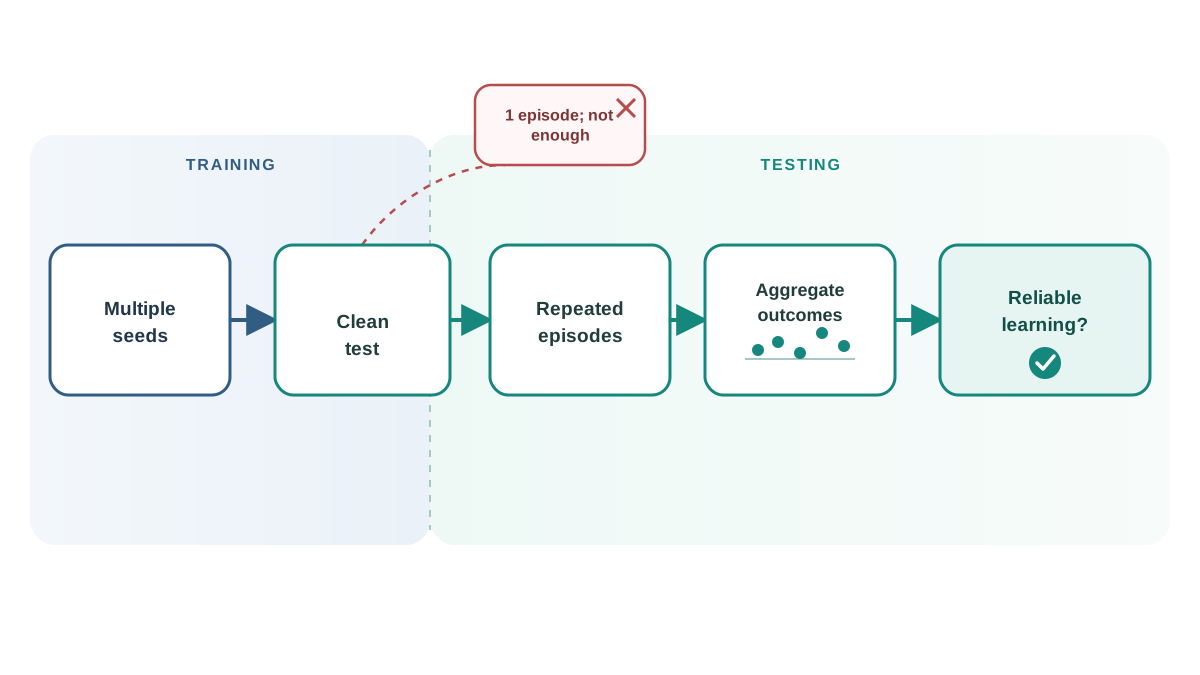
Here is the minimum bar for claiming an agent learned anything:
- Define the test environment. Use the raw task, not the training setup with wrappers that modify rewards or episode lengths.
- Disable exploration. Run the policy deterministically where supported.
- Run a batch of episodes. Use 5 to 20, scaled to the noise level of your task.
- Average the return. Report the mean, and note outliers or catastrophic episodes separately when they occur.
- Repeat across seeds. Run several independent training runs and report the spread, not just the best run.
- Plot the learning curve. Compare periodic clean evaluations against training curves to see real progress.
- Report task-specific outcomes. Success rate, stability, constraint violations, or other metrics that match what you actually want.
Common mistakes to avoid: evaluating on training data, trusting one episode, reporting only the best seed, and ignoring wrapper effects. Each one inflates your apparent results and hides the true reliability of your agent.
The Decision Rule
If your result survives multiple seeds, a clean test environment, and a batch of episodes, it is learning. If it only survives one lucky run, it is noise.
Treat evaluation as part of the build loop, not a final ceremony. Every time you change the environment, the reward function, or the algorithm, you need to re-run the evaluation procedure. The discipline is not glamorous, but it is what separates agents that actually learned from agents that got lucky once.
Run your next experiment with this checklist in hand. Watch the learning curve, check the spread across seeds, and let the distribution of outcomes—not a single beautiful episode—tell you whether your agent really learned.
Knowledge check
Final check
Finish the article by checking the ideas you just learned.
References
Research updated Sep 9, 2026


