
Generalization in Reinforcement Learning: Does the Policy Transfer?
Your agent crushes its training level. Every episode, the same flawless path, the same high score, the same satisfying convergence curve. Then you move one…

Key topics
Your agent crushes its training level. Every episode, the same flawless path, the same high score, the same satisfying convergence curve. Then you move one wall, change the starting position, or swap in a slightly different layout—and the policy collapses into something that looks like it never learned anything at all.
This is the moment when generalization stops being an abstract research topic and becomes your problem. A great training score can hide a policy that memorized the layout instead of learning the strategy. And ordinary evaluation—training and testing in the same environment—will never catch it.
Before we go further, let me set some terminology boundaries, because these words get blurred constantly. Generalization means performing well on unseen instances or contexts within the same task family. Transfer means applying learned behavior to a different but related task or environment. Adaptation means the policy gets additional interaction in the new setting and improves from it. This article is mostly about the first one, with transfer and adaptation as important boundary cases.
Why a Great Training Score Can Lie
In supervised learning, generalization has a familiar shape: train on a dataset, test on held-out data drawn from the same distribution, and hope the model learned patterns rather than memorized examples. The test set is your honest referee.
Reinforcement learning breaks this comfortable setup. When you train and evaluate an agent in the same environment, you are grading it on the practice exam. There is no held-out data, no unseen variation, no referee. The agent can exploit the specific layout, visual cues, or dynamics of that one environment and still produce a beautiful learning curve.
The research community formalizes this problem with the idea of a Contextual MDP. Think of it as a family of related tasks that share the same underlying decision problem but differ in a hidden context—a seed, a layout, a physics parameter—that changes between episodes. The agent sees the state, but it may never directly observe which context it is in. One episode might drop it into maze layout A; the next, maze layout B. The goal stays the same. The walls do not.
This framing exposes the real question behind generalization in reinforcement learning: did the agent learn a reusable strategy for the task family, or did it learn the specific features of the training contexts? A policy that memorized wall positions will ace layout A and fail layout B. A policy that learned to navigate mazes will handle both.
The danger is that these two policies look identical during training. Both achieve high returns. Both converge. Only a test on environments the agent never saw can tell them apart.
What a Fair Generalization Test Actually Requires
Designing a fair generalization test comes down to one principle: evaluate on environments from the same task family that the policy never encountered during training.
That sounds straightforward, but the details matter. A meaningful test needs four properties:
Same task family, different instances. The held-out environments must come from the same distribution of tasks you trained on. If you trained on maze layouts and test on a completely different game, you are not measuring generalization—you are measuring whether the agent can solve an unrelated problem.
Fixed observation and action spaces. If the observation dimensions change or the action set grows between training and testing, a performance drop could come from a mismatched interface, not a weak strategy. Keep the interface identical so the gap is attributable to the policy itself.
Changed context, preserved semantics. Vary the layout, the seed, or the dynamics parameter. Do not vary the goal, the reward structure, or what the actions mean. When you change the reward function, you have defined a new task, not a generalization test.
Multiple held-out instances. One held-out environment tells you almost nothing. A policy might fail on layout B for reasons unrelated to generalization—bad luck, an unlucky seed, a pathological configuration. You need a distribution of results across many held-out instances.
This is where the train/test split idea from supervised learning finds its RL equivalent. In procedural environments, you generate many distinct instances from one task family, train on one subset, and hold out the rest. The held-out set is your referee.
Knowledge check
Check your understanding
Answer this question before you continue.
The Variation Axis Determines the Claim
The hardest part of a generalization test is choosing what to vary. The variation axis must test the skill you actually care about—and different axes support different claims.
| Variation type | What stays fixed | What it tests | What a failure means |
|---|---|---|---|
| New instances (layout, seed, level) | Rules, dynamics, objective | Whether the policy learned a reusable strategy for the task family | Context overfitting or memorization |
| Parameter shift (mass, friction, lighting) | Objective, action semantics | Whether the policy handles changed dynamics or appearance | Brittleness to dynamics/domain shift, or a genuinely different optimal behavior |
| Rule or objective change | Observation/action interface | Transfer to a related task | Task mismatch—not ordinary generalization failure |
| Test-time interaction allowed | Task family | Adaptation speed, not zero-shot reusability | The policy can improve, but may not transfer immediately |
Let me anchor this in one concrete example we will carry through the rest of the article. You train a navigation agent on maze layouts. The goal is always the same: reach the target. The actions always mean the same thing: move in four directions. What changes between episodes is the wall arrangement.
Now consider what each variation axis claims. Varying wall arrangements tests whether the agent learned navigation as a strategy. Varying the maze size tests whether the strategy scales. Varying wall color tests visual robustness—useful, but a different claim. Changing the goal from "reach the target" to "collect all keys first" is not a generalization test at all. It is a new task.
The most common trap here is varying the wrong thing. Changing the reward semantics, the action effects, or the termination conditions turns your generalization test into a task mismatch. Your agent is not failing to generalize; it is being asked to solve a different problem while you call it the same problem. Keep the goal fixed. Change the scenery.
One nuance worth naming: some parameter shifts, like mass or friction, can change the optimal behavior rather than just the scenery. A robot pushing a feather and a robot pushing a boulder may need different policies, even though the objective is identical. If you vary dynamics parameters, ask whether the optimal strategy actually stays the same across the range you test. If it does not, you have crossed from generalization into transfer.
Procedural generation is the cleanest way to build a meaningful held-out set because it gives you many distinct instances from one controlled task family. Each seed produces a new layout while the underlying rules stay constant. Train on a subset of seeds, hold out the rest, and you have a natural generalization test.
Knowledge check
Check your understanding
Answer this question before you continue.
Reading the Results: A Diagnostic, Not a Verdict
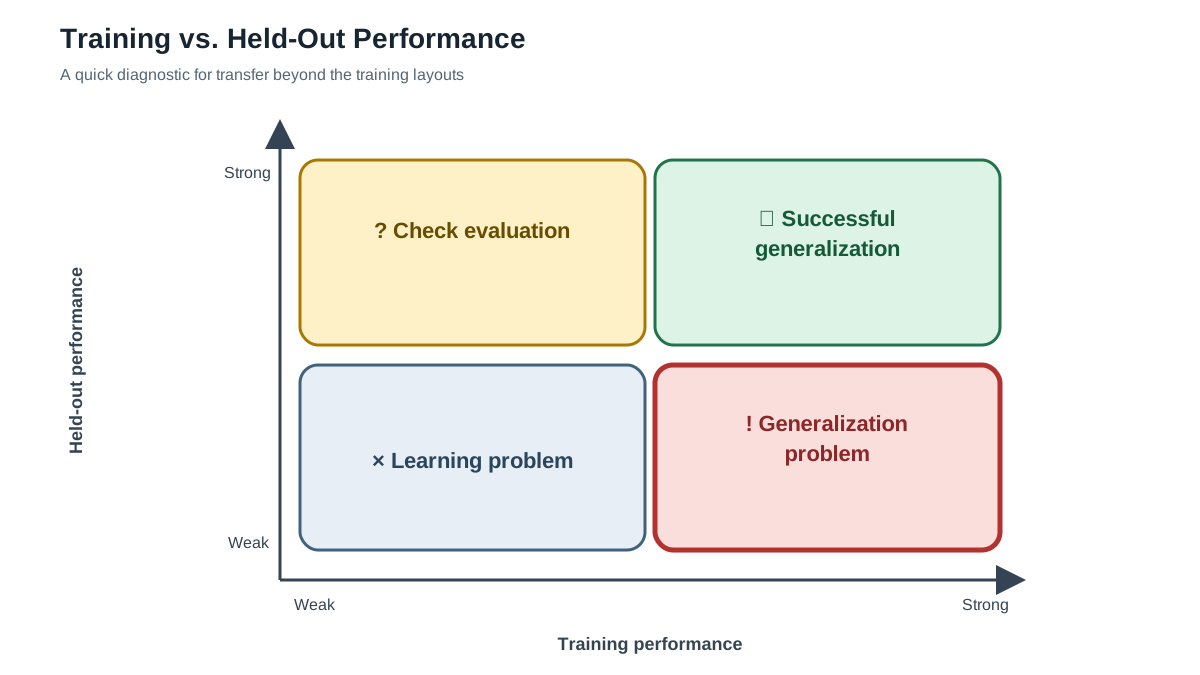
Once you have held-out results, the interpretation follows a diagnostic pattern. But I want to be careful here: a train/test gap is a signal, not a confession. It tells you the policy did not transfer. It does not, by itself, tell you why.
Start with the two-by-two:
Strong training performance, weak held-out performance. This is the classic signature of context overfitting. The policy found features that work on the training instances but do not transfer. This is a generalization problem—but the cause could be memorization, reliance on spurious cues, or a variation axis the policy was never equipped to handle.
Weak training performance, weak held-out performance. The policy never mastered the training task in the first place. Poor held-out results are not evidence of a transfer failure—they are evidence of a learning failure. Fix the training before you diagnose the generalization.
The compact rule: strong train plus weak held-out points to a generalization problem; weak train plus weak held-out points to a learning problem. But treat that as your first hypothesis, not your final verdict.
When you see a large gap, run these next checks before concluding the agent memorized the layout:
Check absolute held-out performance, not just the gap. A small gap at uniformly poor performance is not successful generalization. If training performance is mediocre and held-out performance is equally mediocre, the policy learned something weak that transfers—not something strong. High held-out performance matters more than a small gap when training is already near ceiling.
Look at the distribution, not the average. A small average gap can hide catastrophic failures on a subset of layouts. A large average gap can be driven by a few pathological instances. Plot per-instance returns for training and held-out sets. If the held-out failures cluster in one region of variation space, you have learned something specific: the policy handles some variation but not others.
Check observability. If the agent cannot tell which context it is in from its observations, it may be facing a fundamentally harder problem. A policy that must infer the wall layout from partial observations may fail not because it memorized, but because the task demands inference it was never given the tools to perform.
Replicate across seeds. Held-out evaluation in RL is noisy. A single run across a few instances can produce unstable rankings, especially when the task family has high variance. The gap between training and held-out performance needs to be larger than the noise in your measurement before you trust it.
You also need to be clear about what kind of transfer you are measuring. Zero-shot transfer means the policy is evaluated on held-out environments with no further interaction allowed. The agent gets what it got from training and must perform immediately. Fine-tuning or adaptation allows the policy to interact with the test environment and improve. These measure different capabilities. Zero-shot transfer tests whether the learned strategy is genuinely reusable. Fine-tuning tests whether the policy can adapt quickly—a useful property, but not the same claim.
Knowledge check
Check your understanding
Answer this question before you continue.
Common Mistakes That Invalidate Your Generalization Test
A generalization test is only as good as its hygiene. Several practical errors can quietly invalidate everything you measured.
Leaking training instances into the held-out set. If your procedural generator reuses seeds, or if your held-out layouts accidentally share structural features with training layouts, your test is contaminated. The policy may have seen the answer before. Audit your seed management and your instance generation to ensure the held-out set is genuinely unseen.
Testing on one or two instances. A policy that fails on held-out layout B might have succeeded on layouts C, D, and E. A policy that succeeds on B might have failed everywhere else. Single-instance evaluation is anecdote, not evidence.
Changing the task between train and test. Different reward function, different action space, different goal semantics—any of these converts your generalization test into a task mismatch. You are no longer measuring transfer. You are measuring whether the agent can solve a different problem with no additional training.
Comparing policies across different training budgets. If policy A trained for 1 million steps and policy B trained for 500,000, a held-out performance gap might reflect learning progress, not transfer ability. Hold the training budget constant across the policies you compare.
Reporting a single best episode. The best held-out episode is the one where luck smiled. Report the distribution—mean, variance, spread across instances—not the highlight reel.
Knowledge check
Check your understanding
Answer this question before you continue.
When to Push for Generalization and When Not To
Not every RL project needs a generalization test. The decision comes down to deployment.
If your policy will face variations it never saw during training—a robot moving from simulation to the real world, a game agent encountering procedurally generated levels, a control system operating under changing conditions—generalization testing is not optional. It is the only honest measure of whether the policy will survive contact with reality.
If your environment is fixed and the agent will always face the same layout, a strong training score is the honest metric. A warehouse robot that navigates the same aisle configuration every day does not need to generalize to novel warehouses. It needs to master the one warehouse it has. Spending effort on held-out variations would be wasted engineering.
The cost of generalization testing is real: designing meaningful variations, running more seeds, replicating across instances, and interpreting noisy results. Spend that effort where deployment demands it, not where a fixed environment makes it irrelevant.
The Diagnostic That Separates Strategy from Memorization
Here is your next step. Return to the maze navigation example. Generate a family of layouts from one procedural generator. Train on a subset of seeds. Hold out the rest. Then run the policy on both sets across multiple evaluation seeds, and build a simple comparison: per-layout returns for training instances, per-layout returns for held-out instances, and the gap between them.
If held-out performance stays high in absolute terms and the gap is small, your policy learned something reusable. If the gap is large, you have caught a transfer failure—and your next question is which of the causes above explains it. Check whether the failures cluster in a region of variation space. Check whether the policy had enough information to infer the context. Check whether your variation axis changed the optimal behavior without you noticing.
That last step is the one most people skip. A large gap is not the end of the investigation. It is the beginning of a sharper one.
Knowledge check
Final check
Finish the article by checking the ideas you just learned.
References
- Generalisation in Reinforcement Learning | Robert Kirk
- [PDF] On the Power of Pre-training for Generalization in RL
- Generalization in Reinforcement Learning with Selective Noise Injection and Information Bottleneck
- TAPE: A Cellular Automata Benchmark for Evaluating Rule-Shift Generalization in Reinforcement Learning
Research updated Sep 9, 2026


