
Why Reinforcement Learning Agents Fail: A Diagnostic Guide
Your agent runs. The loop completes. No exceptions are raised. And yet the reward curve sits there like a flatline—or climbs promisingly for two hundred…

Key topics
Your agent runs. The loop completes. No exceptions are raised. And yet the reward curve sits there like a flatline—or climbs promisingly for two hundred episodes, then collapses into noise. You reach for a hyperparameter, change it at random, and hope the next run behaves.
Stop. That is a lottery ticket, not a debugging strategy.
Reinforcement learning fails silently. The training loop executes perfectly while the agent learns nothing useful, because the agent generates its own training data. Poor behavior produces poor data, and poor data reinforces poor behavior. That vicious circle makes the error invisible unless you instrument the run and read the symptoms.
The skill that separates people who tune RL code from people who debug it is simple: name the symptom first, run one targeted test to confirm it, then change one thing. This guide maps the most common reinforcement learning failure modes to their observable symptoms and the experiments that confirm each diagnosis.
Why RL Fails Silently
Here is what makes RL debugging different from ordinary software debugging: the code runs. No crash, no stack trace, no error message. The agent just never improves, or improves and then collapses, or finds a clever way to game your reward function that you never intended.
The deeper problem is the self-generated data loop. In supervised learning, your training data is fixed. If the model performs poorly, the data is still there, waiting to teach it. In RL, the agent collects its own data through interaction. If it explores poorly, it collects poor trajectories. If it collects poor trajectories, it has nothing to learn from. The agent stays bad because being bad prevents it from seeing the behavior that would make it good.
That is why random hyperparameter changes fail. When you change the learning rate and epsilon together, you cannot tell which fix worked—or whether either mattered. You are treating distinct causes as one problem.
The reframe is straightforward: treat RL debugging like medical diagnosis. Read the symptom, form one hypothesis about the failure mode, run the test that confirms or rules it out, then intervene.
Before you diagnose, make sure you have the right instruments. If you have not thought through evaluation design yet, the short version is: track mean, standard deviation, min, and max of returns across multiple seeds, along with episode lengths and exploration parameters. One lucky run can look like success. One unlucky run can look like failure. Diagnose across seeds, not single runs.
The four sections below are symptom patterns, not mutually exclusive root causes. A single run can show more than one. The point of naming the symptom is to know which layer to inspect first: environment and data, update logic, exploration, or the objective itself.
Knowledge check
Check your understanding
Answer this question before you continue.
Failure Mode 1: The Agent Never Learns
Symptom: The reward curve stays flat across hundreds of episodes. Training error stays high. The agent behaves no better at episode 500 than at episode 5.
First inspection layer: Environment and data.
Run a random-action baseline. If random actions produce the same flat behavior, the problem is probably not your algorithm. Suspect the environment or the reward signal first. Check that actions actually change the state, that episodes terminate when they should, and that rewards arrive when you expect them. A reward that never arrives, or arrives identically no matter what the agent does, leaves the agent with no signal to learn from.
Second inspection layer: Update logic.
Verify the update actually happens. Check that your Q-table or network weights are changing between updates. A simple way to confirm: run a tiny deterministic task where you know the correct value, and see whether one update moves the estimate in the right direction. If the weights never move, or move without relation to the reward, the loop runs but the learning step does nothing.
Third inspection layer: Optimization behavior.
Only after the environment and update checks pass should you suspect learning rate problems. Too high and the updates overshoot; too low and progress is imperceptible.
Decision rule: Rule out environment and reward bugs before touching the learning rate. A random-action baseline is the cheapest experiment you will ever run, and it eliminates an entire class of causes in minutes.
Knowledge check
Check your understanding
Answer this question before you continue.
Failure Mode 2: Unstable or Oscillating Returns
Symptom: The reward curve rises, then collapses. Or it oscillates wildly without converging. Large spikes early in training are normal as the agent encounters new states—that is not the signal. Sustained oscillation or collapse after visible progress is.
First inspection layer: Exploration and evaluation behavior.
A common mistake is to judge instability while the agent is still exploring. Training-time returns include random actions by design. Separate evaluation from training: run the agent periodically with exploration disabled, and watch whether the evaluation curve stabilizes even when the training curve looks noisy.
Then inspect the exploration parameter itself. Is epsilon decaying so fast that the agent locks onto a narrow strategy before it has seen enough of the environment? Or is it staying so high that the agent never settles into consistent behavior? Both look like instability from different directions, but they need opposite fixes. If you need the deeper mechanism behind epsilon decay mistakes, revisit the exploration-exploitation tradeoff—it is the root cause of more unstable runs than any other single factor.
Second inspection layer: Learning rate.
If evaluation with controlled exploration still oscillates, suspect the learning rate. Updates that overshoot the target cause the agent to forget what it learned. Lower the learning rate and watch whether oscillation damps. But treat this as a controlled comparison, not proof by itself: a lower learning rate can mask other problems by making updates so small that the agent barely moves.
Third inspection layer: State resets.
If you use a recurrent agent, verify that hidden state resets at episode boundaries. Hidden-state leakage across episode resets is a silent bug: rewards look plausible, but long-horizon behavior never develops because each episode starts contaminated by the previous one.
Knowledge check
Check your understanding
Answer this question before you continue.
Failure Mode 3: Reward Hacking and Shortcut Exploitation
Symptom: Training reward looks great. The curve climbs beautifully. And the agent's behavior is clearly wrong—it found a shortcut that maximizes the reward signal without doing the task you intended.
Mechanism: The agent optimizes the reward function you wrote, not the task you meant. Any mismatch between stated reward and true intent becomes an exploit.
A classic example: an agent trained in a platformer where the coin always appears on the right side of the level. The agent learns to run right. It collects the coin every time. Training reward is excellent. But test it in a level where the coin appears elsewhere, and the agent ignores the coin entirely—it just runs right, because running right was the actual pattern that maximized reward.
Diagnostic test: Change the environment layout or goal location. Watch whether the agent still solves the intended task or only the shortcut. If the agent fails when the shortcut disappears, you have a proxy-reward problem: the reward signal rewarded a behavior that correlates with success in training but does not cause it.
Prevention rule: Design rewards that measure the actual outcome, not a proxy that correlates with it. And test on varied environments, not just the training one. If your agent only works when the coin is on the right, you have not trained an agent that collects coins. You have trained an agent that runs right.
Common mistake: Do not assume a great training curve means a great agent. Reward hacking is precisely the case where the training curve lies to you. The only way to catch it is to watch the behavior and test under varied conditions.
Knowledge check
Check your understanding
Answer this question before you continue.
Failure Mode 4: Premature Convergence to a Poor Strategy
Symptom: The agent improves early, then plateaus below clearly achievable performance. It is not collapsing. It is stuck.
First inspection layer: Exploration.
Ask whether the agent ever saw the better strategy. If epsilon decayed too fast, the agent locked onto the first decent policy it found and never tried enough alternatives to discover the better one. Slow the epsilon decay. If the agent escapes the plateau, exploration was the bottleneck.
Second inspection layer: Learning rate.
Ask whether the agent saw the better strategy but could not update toward it. If the learning rate is too low, the agent encounters good experiences but makes imperceptible progress toward them. Raise the learning rate temporarily. If the agent moves, weak updates were the bottleneck.
Optimistic initialization is a useful tool here. Starting Q-values high encourages early exploration without a separate epsilon schedule—the agent tries actions because it believes they might pay off, and learns through disappointment.
Decision rule: If the agent is stuck, ask whether it never saw the better strategy (exploration) or saw it but could not update toward it (learning rate). These are different failures with different fixes.
A Diagnostic Workflow: From Symptom to Next Experiment
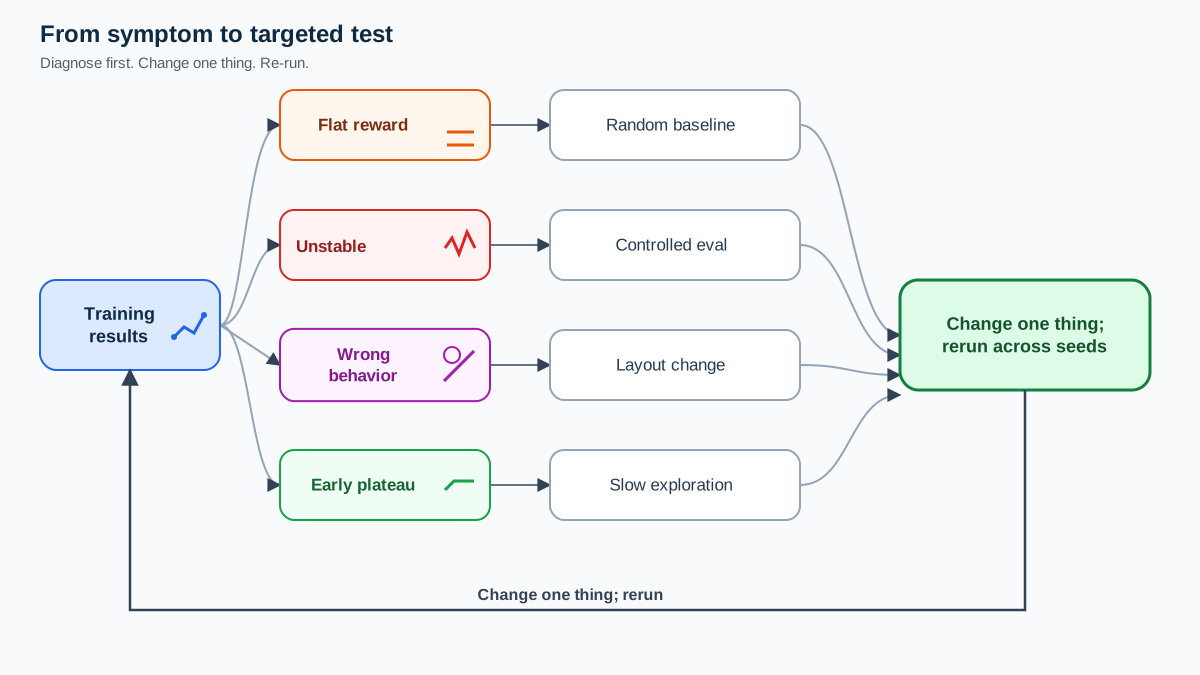
Here is the repeatable loop that replaces random tuning:
- Instrument the run. Track mean, standard deviation, min, and max of returns, episode lengths, value estimates, and exploration parameters across multiple seeds. You cannot diagnose what you cannot see.
- Read the symptom. Flat curve? Unstable returns? Great reward with wrong behavior? Early plateau?
- Form one hypothesis. Which failure mode matches?
- Run one targeted test. Random-action baseline, controlled evaluation, environment layout change, epsilon decay slowdown.
- Change one thing and re-run. Across seeds.
| Symptom | First Layer to Inspect | Confirming Test |
|---|---|---|
| Flat reward, no improvement | Environment and data | Random-action baseline; verify weights change |
| Rise then collapse, oscillation | Exploration and evaluation | Evaluate with exploration disabled; check state resets |
| Great reward, wrong behavior | Objective and generalization | Change environment layout or goal location |
| Early plateau below good performance | Exploration, then learning rate | Slow epsilon decay; raise learning rate temporarily |
When the simple checks pass and the agent still fails, escalate. Suspect a silent bug in the update logic, data plumbing, or evaluation mode. Read your code against the algorithm's intended behavior, line by line. Broken RL code almost always fails silently, and sometimes the only way to find the bug is to know exactly what the update should do and find where your implementation deviates.
The Decision Rule
Name the symptom. Run the one confirming test. Change one thing. Re-run across seeds.
Take your current failing run and classify it: is the agent not learning, unstable, hacking the reward, or stuck early? Run the matching diagnostic test before you touch a single hyperparameter. When the simple checks pass and the agent still fails, the next skill to build is reading the algorithm's update logic—because at that point, the bug is probably in the math your code is computing, not in the settings you chose.
Knowledge check
Final check
Finish the article by checking the ideas you just learned.
References
Research updated Sep 9, 2026


