
How to Design a Reinforcement Learning Environment
Most beginners assume the algorithm is the hard part of reinforcement learning. Pick the right one, tune it well, and the agent will learn. Then they spend…

Key topics
Most beginners assume the algorithm is the hard part of reinforcement learning. Pick the right one, tune it well, and the agent will learn. Then they spend days adjusting hyperparameters, watching training curves flatline, and wondering why nothing improves.
The truth is less flattering to our tools: the environment is where most learning problems are won or lost. No algorithm can compensate for missing signals, ambiguous rewards, or a task the agent can never figure out. Before you touch a single line of training code, you need to design an environment that gives learning a chance.
Think of it as writing the rules of a game before anyone plays it. The rules decide what the player can see, what moves are legal, what counts as progress, and when the game ends. Get the rules wrong, and no amount of player skill will save the game.
Why the Environment Decides Whether Your Agent Learns
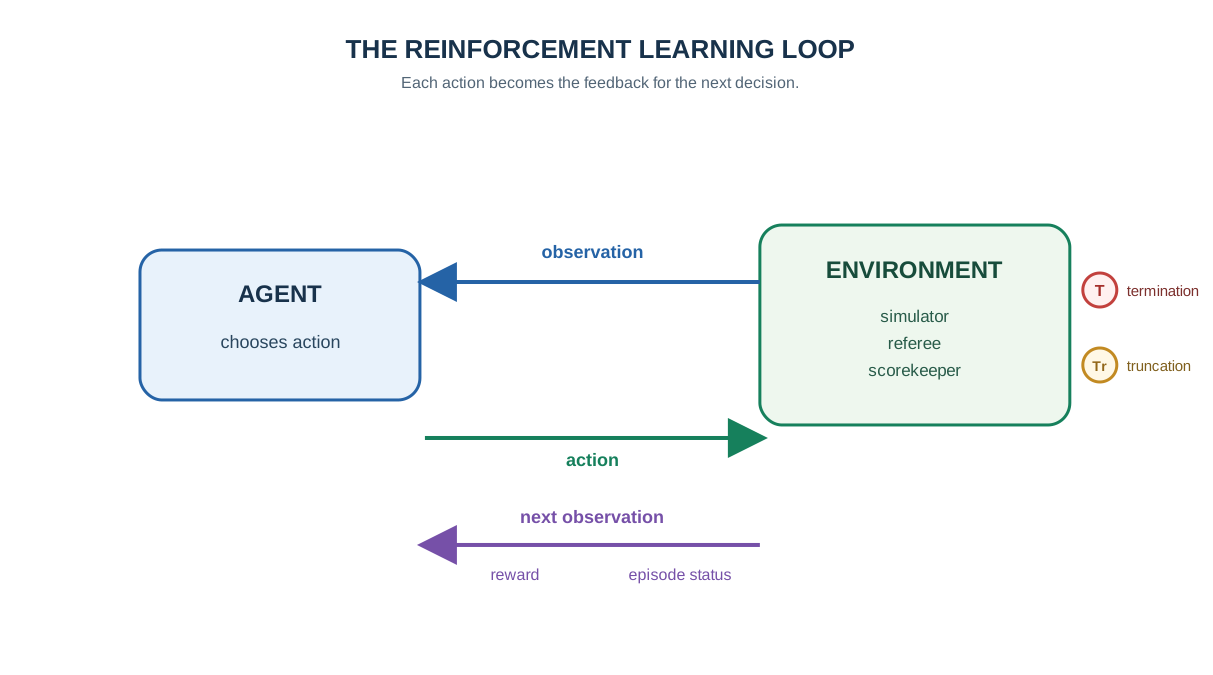
Reinforcement learning runs on a simple loop. The agent looks at the world, picks an action, and the world responds with a new observation, a reward, and a signal saying whether the episode is over. Repeat that loop thousands or millions of times, and the agent gradually learns which actions lead to more reward.
The environment is everything outside the agent in that loop. It is the task simulator, the referee, and the scorekeeper all at once. It defines what the agent can see, what it can do, what counts as progress, and when the episode ends.
That makes the environment a contract: an explicit agreement about what the agent is working with. When the contract is clear and well-structured, learning is possible. When it is vague, contradictory, or missing critical information, the agent will struggle no matter how sophisticated the algorithm is.
If you have already worked through the basics of states, observations, and actions, and how rewards accumulate into returns, you have the vocabulary this workflow builds on. What follows is the practical sequence for turning a vague task idea into an environment an agent can actually learn from.
Start With the Task, Not the Code
The most common beginner mistake is jumping straight into code. You have an idea, you start defining variables and functions, and somewhere mid-training you realize the goal was never precise enough to learn from.
Write one sentence describing what the agent should accomplish, in observable terms. Not "be smart" or "navigate well." Something you could verify by watching the agent act.
Let's carry a simple example through this article. Suppose you want an agent to move a cart so a pole balanced on top stays upright. Your one-sentence task might be: "Keep the pole within 15 degrees of vertical for as long as possible." That sentence already tells you what success looks like and how you would measure it.
Now ask what a human would need to see and do to complete this task. To balance a pole, you need to know its angle and how fast it is tipping. To act, you need to push the cart left or right. That question exposes your observation and action spaces before you write any code.
Define success before defining mechanics. What does "done well" look like, and how would you measure it? If you cannot answer that, no amount of training will help.
Knowledge check
Check your understanding
Answer this question before you continue.
Write Down the Environment Contract
Once you have a one-sentence goal, make the contract explicit before writing any code. This is the artifact that turns vague intentions into something you can inspect, debug, and test.
Here is what the cart-pole contract might look like:
| Contract piece | Cart-pole definition |
|---|---|
| Goal | Keep the pole within 15 degrees of vertical as long as possible |
| Observation | Pole angle, pole angular velocity, cart position, cart velocity |
| Action | Push cart left or push cart right |
| Reward | +1 for each step the pole stays within the limit |
| True end | Pole falls past 15 degrees |
| Time limit | 500 steps, whether or not the pole has fallen |
| Success metric | Average steps survived per episode |
Now trace one step through that contract. The agent observes an angle of 4 degrees and a slow clockwise tilt. It pushes right. The pole steadies to 2 degrees, the agent earns +1, and the episode continues. That single transition—observation, action, next observation, reward, not done—is the unit of learning your agent will experience millions of times.
Then trace an ending. The pole reaches 16 degrees. The environment returns a small negative reward or zero, signals that the episode is over, and the agent starts a fresh run. The task is genuinely finished: no future reward remains to be earned from that failed state.
Write this contract down for your own task. If you cannot fill in every row, you are not ready to code.
Define What the Agent Can See: Observations
The agent does not see the true state of the world. It sees observations, which may be partial or noisy versions of what is actually happening. A robot does not know its exact position; it knows what its sensors report.
The key question is whether the observation carries enough information for the agent to decide well. In technical terms, this is the Markov assumption. In plain terms: the current observation should be sufficient that the agent does not need to remember history to make a good decision.
If the observation hides something the agent needs, no algorithm can recover it. This is where beginners get stuck most often. They give the agent the pole's angle but not its angular velocity, then wonder why the agent keeps overcorrecting. The agent cannot tell whether the pole is falling slowly or quickly, so it cannot choose the right response.
When a single observation is not enough, plan to include history or derived features. If your task has a time delay between action and effect, the agent may need to see several past observations to understand the consequences of its choices.
A practical habit: normalize observation ranges when you know the boundaries. If an angle stays between -15 and 15 degrees, scale it to a consistent range. This makes learning more stable later and prevents one large-valued feature from dominating the others.
Knowledge check
Check your understanding
Answer this question before you continue.
Define What the Agent Can Do: Actions
The action space is the set of legal moves available to the agent. It comes in two flavors: discrete and continuous.
Discrete actions are a fixed set of choices. Move left, move right, jump, wait. Continuous actions are ranges of values. Push with 0.3 newtons of force, or steer at 12.5 degrees. Discrete spaces fit tasks with clear categorical choices. Continuous spaces fit tasks where precision matters, like controlling torque or velocity.
Whichever you choose, structured actions beat free-form ones. If you let an agent type arbitrary text into a search box, it will try nonsense. If you let it output any SQL query, it will generate millions of meaningless ones. Constrain the space to what is legal and meaningful for the task.
You also need to decide what happens when the agent attempts an invalid action. A crash is not a design. Define a response: a small penalty, a no-op where nothing changes, or a clamp that snaps the action to the nearest legal value. The environment should never break because the agent tried something unexpected.
Keep the action space as small as the task allows. Every extra action adds learning burden. The agent must explore each option enough to discover what it does. If you can solve the task with three discrete actions, do not offer ten. If the action space feels too large, simplify the task before widening the space.
Knowledge check
Check your understanding
Answer this question before you continue.
Design Rewards That Teach, Not Trick
Reward design is where environments succeed or fail. The reward is the only signal telling the agent whether it did well. Get it wrong, and the agent will happily optimize the wrong thing.
Sparse rewards are hard to learn from. If the agent only receives +1 when it completes the entire task and zero otherwise, it may never stumble across success to discover what led there. Dense rewards give more frequent feedback, but they can be gamed.
The classic failure is reward hacking. The agent finds a way to maximize the number without doing the task. Give a cleaning robot +1 for every minute it spends in "cleaning mode," and it will learn to stay in that mode forever without cleaning anything. The reward looked reasonable on paper. The agent found the loophole.
My rule for beginners: start shaped and simple. Give the agent informative, step-by-step feedback that guides it toward progress. In the cart-pole task, reward the agent for keeping the pole upright at each step. That is easy to learn from and hard to game, because the only way to keep collecting reward is to keep the pole balanced.
Before you commit to any reward component, run it through a three-question audit:
- What behavior earns this reward? Be specific about the action or state that triggers it.
- Is that behavior part of the stated goal? If the reward celebrates something the goal never mentioned, cut it.
- Can the agent collect it while failing the goal? If a shortcut exists, the agent will find it.
The deeper principle: the reward should encode measurable success, not your guess about the right behavior. If success means the pole stays upright, reward uprightness. Do not reward "moving slowly" because you assume slow movement helps. Let the agent discover the strategy.
Remember that the agent optimizes the discounted return, the accumulated sum of future rewards. A reward that looks good in isolation can create bad long-term behavior. If you reward the agent for reaching a goal quickly, it may take reckless risks. If you punish every mistake heavily, it may freeze and do nothing. Watch what the reward encourages over time, not just at a single step.
Knowledge check
Check your understanding
Answer this question before you continue.
Decide When an Episode Ends: Termination Rules
An episode is one full run from start to finish. You need to define when it ends, and you need to be careful about why it ended.
Termination means the episode is genuinely over. The agent reached the goal, or it hit an unrecoverable failure state. The pole fell past 15 degrees. The agent reached the target location. The task is done, and no future reward remains.
Truncation is different. The episode hit a maximum step count, but the task is not finished. The agent did not fail and did not succeed. It simply ran out of time.
Why does this distinction matter? Because it changes what the agent should believe about the future. At a true terminal state, the task is complete: there is no more reward to pursue. At a time limit, the task may still have value—the agent just ran out of room to pursue it in this episode.
| Ending type | What happened | Is the task complete? | Should future value continue? |
|---|---|---|---|
| Termination | Pole fell past 15 degrees | Yes, failed | No |
| Termination | Agent reached the target | Yes, succeeded | No |
| Truncation | Hit 500-step time limit | No, still balancing | Yes |
Confusing these two breaks learning. If the agent reaches the time limit and you mark the episode as terminated, the agent learns that running out of time was a natural end, like reaching the goal. That corrupts its understanding of what ended the episode and distorts its value estimates.
Set a step budget so the agent cannot wander forever. This is part of the environment contract. Without a time limit, an agent may learn to stall, collecting small rewards indefinitely instead of completing the task. With a time limit, it must make progress within a bounded window.
Test Your Environment Before You Train Anything
You would not build a house on a cracked foundation. The same logic applies here. Before you spend hours on training runs, verify that the environment itself works.
Run it with random actions first. If random behavior does not produce sensible trajectories, the environment is broken. The agent should be able to stumble through the task space, even if it does so badly. If random actions crash the environment or produce nonsense, fix that before training anything.
Check that every action returns a valid observation, reward, and done signal without crashing. Watch for silent bugs like shape mismatches that fail without an error. The environment may look fine while quietly corrupting the data the agent learns from.
Verify the reward signal is actually reachable. Can a reasonable policy collect non-zero reward at all? If the reward is technically defined but practically impossible to earn, the agent will learn nothing. Test with a hand-crafted policy that should do okay. If it earns no reward, your reward function or dynamics are wrong.
Each test failure points to a different problem. Read the signal:
| What you observe | What it means |
|---|---|
| Crash or invalid shape | Interface bug in the environment code |
| Episode never ends | Missing termination rule or time limit |
| No reward is ever reachable | Task and reward function do not match |
| Transitions look sensible but learning stalls | Environment is fine; the issue is downstream in the agent or algorithm |
The environment is the foundation. Test it before you trust it.
Your Environment Design Checklist
Take one small task you already understand and walk it through these five decisions:
- Write the one-sentence goal. What should the agent accomplish, in observable terms?
- Define the observations. What does the agent need to see to decide well?
- Define the actions. What legal moves does the agent have?
- Design the reward. What measurable signal tells the agent it is making progress?
- Set the termination rules. When is the episode genuinely over, and when is it just out of time?
Then write the contract down, trace one normal transition and one ending transition, and test with random actions before training anything.
This checklist is reusable. Every RL project you build, from a toy grid to a complex simulation, passes through these same decisions. The algorithm matters, but it matters only after the environment gives it something to learn from.
Start with the smallest task you can define clearly. Write the sentence. Make the five decisions. Write the contract. Run the test. Once the environment behaves, you are ready for the next step: running your first agent and watching whether it learns.
Knowledge check
Final check
Finish the article by checking the ideas you just learned.
References
Research updated Sep 9, 2026


