
Invalid Actions in Reinforcement Learning: Masks, Penalties, and Hidden Bugs
Your agent keeps walking into walls. It selects skills still on cooldown, tries to buy items it cannot afford, and bumps against the grid edge like a moth…

Key topics
Your agent keeps walking into walls. It selects skills still on cooldown, tries to buy items it cannot afford, and bumps against the grid edge like a moth against a window. The fix seems obvious: punish it. Add a negative reward for invalid actions and let the agent learn to avoid them.
That instinct is understandable—and it is quietly teaching your agent the wrong lesson. How you handle invalid actions changes what your policy learns, not just whether it picks legal moves. Get it wrong and you will spend days debugging a failure that was baked into your reward signal from the start.
First, Define What "Invalid" Means
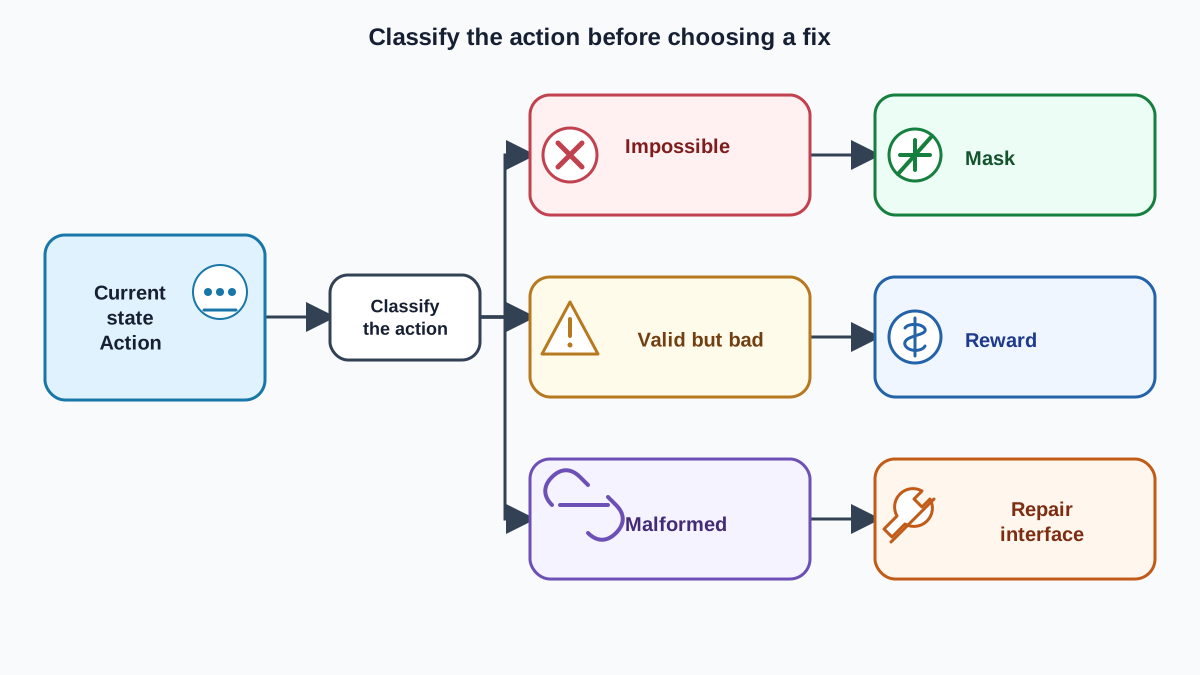
Before choosing a remedy, separate three cases that often get lumped together:
- Impossible actions are unavailable in the current state: moving into a wall, casting a spell still on cooldown, buying an item without enough gold. The state makes them structurally impossible.
- Valid-but-bad actions are physically possible but strategically poor: moving away from the goal, attacking a heavily armored target, wasting a resource. The agent should learn to avoid these through reward, not have them removed.
- Malformed actions reveal an interface problem: the action space itself is badly specified, or the observation does not carry enough information for the agent to know what is available.
Only the first category is an automatic masking candidate. The other two require reward, observation, or environment-design decisions. If you mask a valid-but-bad action, you are solving the agent's problem for it—and hiding the fact that your reward signal never taught the right behavior.
This distinction matters because reinforcement learning agents need a fixed action space. Neural policies output a fixed number of logits—one score per possible action. You cannot shrink or grow that output layer from state to state. So you build a full action space that is the union of all valid actions across all states, and in any given state, some of those actions are simply not available.
The core insight: your handling strategy does not just determine whether the agent picks legal moves. It changes what the policy and value function are actually learning.
Knowledge check
Check your understanding
Answer this question before you continue.
The Penalty Trap: Punishing the Symptom
The penalty approach is straightforward: when the agent picks an invalid action, the environment returns a negative reward. The hope is that the agent learns to avoid the action because it leads to punishment.
That hope runs into two mechanical problems.
First, the penalty becomes part of the reward signal you use to measure performance. If your evaluation metric is total episode reward, a penalty artificially lowers the score. An agent trained with masking and an agent trained with penalties are no longer being compared on the same scale—one is being judged on task performance, the other on task performance minus a running tally of mistakes.
Second, the agent spends gradient effort learning which actions are forbidden instead of learning the decision task. Every invalid action is a training signal that says "this action is bad here," but the agent has to rediscover that fact state by state. In a large action space, that is an enormous amount of wasted learning.
The scaling problem is brutal. As the invalid-action space grows, the agent may spend most of its training budget stumbling through invalid choices before it ever discovers a valid reward. In highly constrained environments, the agent can converge to a useless policy before learning any sequence of valid actions at all.
There is also a tuning trap. The penalty magnitude is a sensitive hyperparameter with no principled default. Set it too small and the agent ignores it. Set it too large and you distort the entire reward landscape. One grid-world builder reported an agent that learned to hug walls and repeatedly attempt invalid moves—because a consistent small negative reward was still more reliable than the sparse, uncertain rewards of actually pursuing the goal. The penalty had become the most predictable signal in the environment.
Knowledge check
Check your understanding
Answer this question before you continue.
Action Masking: Removing the Choice
Logit-level masking is the standard remedy for impossible actions, and for good reason. Before the softmax converts logits into probabilities, you set the logits of invalid actions to a very large negative number. Their softmax probabilities become effectively zero. The agent cannot sample them.
This is different from naive removal at sampling time. If you simply filter out invalid actions when you sample, the policy itself never changes. The invalid actions still carry probability mass, and their probabilities decay only through vanishing gradients—slowly, if at all. Naive removal also increases the divergence between successive policies, which can destabilize training.
Proper masking operates before the probability distribution is formed. The invalid actions are not just unselected; they are structurally absent from the distribution the agent samples from.
One useful way to think about masking: it is gradient-free in a specific sense. It does not directly shape the policy through a penalty gradient. It constrains the distribution the agent is allowed to sample from. The agent never receives a training signal about invalid actions because it never takes them.
That is also masking's honest limitation. Masking prevents the agent from choosing invalid actions, but it does not teach the underlying constraint. Remove the mask at evaluation time and behavior can degrade—the agent may start selecting invalid actions because it never learned they were invalid, only that they were unavailable.
Knowledge check
Check your understanding
Answer this question before you continue.
Constrained Action Design: Removing the Problem
The third option is to redesign the action space so invalid actions cannot exist. If every action in your space is valid in every reachable state, the problem disappears at the source.
This can mean parameterized actions, where the agent first selects an action type and then selects valid parameters for it. It can mean hierarchical action selection, where a higher-level policy chooses among a small set of valid options. Or it can mean encoding constraints directly into the action definition—instead of "move in any of eight directions," the action becomes "move to an adjacent valid cell."
The tradeoff is real. Constrained design can complicate the environment, shrink expressiveness, or require careful discretization. When action availability depends heavily on state—skills on cooldown, inventory constraints, position-dependent moves—a fixed constrained space may be impossible to construct without losing critical flexibility.
My rule of thumb: constrain when the action space is small and constraints are structural. Mask when the space is large and constraints vary by state. Penalties are rarely the right default.
Check the Environment Contract First
Before you pick any strategy, inspect what your environment actually does when the agent selects an invalid action. Four fields determine whether your fix will work:
- Next state: Does the state change, stay identical, or move to a fallback state?
- Reward: Does the agent receive a penalty, zero, or the normal step reward?
- Termination: Does the episode end, continue, or get truncated?
- Action recording: Is the attempted invalid action stored in the observation or trajectory?
The self-loop case shows why this matters. If an invalid action leaves the state unchanged, a deterministic policy can cycle forever: the same state produces the same action, the action changes nothing, and the agent repeats the mistake endlessly. Some environments add a random valid action as a fallback to guarantee progress—but that changes the task again, because the agent is no longer choosing the action that actually executes.
Choosing a Strategy
| Approach | Learning objective | Scaling | Tuning burden | Evaluation behavior |
|---|---|---|---|---|
| Penalty | Reward signal includes punishment for invalid picks | Poor in large invalid spaces | High—penalty magnitude is sensitive | Reward metric contaminated by penalty terms |
| Logit masking | Policy constrained to valid actions; no direct gradient signal | Good across large spaces | Low—no penalty hyperparameter | Remove mask at evaluation and behavior may degrade |
| Constrained design | Invalid actions cannot exist | Depends on environment structure | Medium—environment redesign effort | Clean, but may lose action expressiveness |
The decision rule has two stages. First, enforce known hard constraints at action selection: if an action is structurally impossible in the current state, mask it. Second, use learning signals only for constraints the agent is supposed to infer or generalize—for example, when deployment will not provide a mask and the policy must internalize feasibility rules on its own.
Mask removal is a separate robustness test, not the normal evaluation protocol. If your deployment environment includes the mask, evaluate with it. If deployment lacks the mask, train for that reality explicitly.
Knowledge check
Check your understanding
Answer this question before you continue.
Diagnosing Hidden Bugs
When your agent is behaving strangely around invalid actions, run these diagnostic checks:
- Does the agent still pick invalid actions at evaluation? If you masked during training but forgot to mask during evaluation, you are measuring a different policy than the one you trained.
- Does removing the mask degrade behavior? If yes, the policy never learned the constraints—it learned to rely on the mask.
- Is your reward metric contaminated by penalty terms? Compare episode rewards with and without penalties to see if your evaluation is measuring task performance or mistake avoidance.
- Is the agent stuck in a deterministic loop? If invalid actions leave the state unchanged, the agent can cycle forever, repeating the same invalid choice because the state—and therefore the policy's output—never changes.
- Does the environment's fallback behavior match your intent? If invalid actions trigger a random valid action, the agent is not learning the action sequence you think it is.
The hidden bug I see most often: masking applied during training and forgotten at evaluation. The training curves look beautiful. The evaluation results are nonsense. The agent was never actually learning to respect constraints—it was learning to exploit the mask, and the mask vanished exactly when you needed it most.
A Concrete Next Experiment
Pick one small environment with a clear invalid-action set. Train two agents: one with logit masking, one with a penalty. Keep everything else identical. Then measure four things:
- Invalid-action rate during training and at evaluation
- Task-success metric that excludes invalid-action bookkeeping
- Episode length and self-loop count
- Performance with and without the mask at evaluation
My hypothesis: the penalty agent will spend visible training time discovering avoidable mistakes, while the masked agent moves directly toward the task. But treat that as a hypothesis to test, not a guaranteed outcome. The point is to see how each approach changes the learning problem—and whether your evaluation is measuring what the agent actually learned to do, or what your environment accidentally taught it to avoid.
Knowledge check
Final check
Finish the article by checking the ideas you just learned.
References
- A Closer Look at Invalid Action Masking in Policy Gradient Algorithms | The International FLAIRS Conference Proceedings
- Exploring the Use of Invalid Action Masking in Reinforcement Learning: A Comparative Study of On-Policy and Off-Policy Algorithms in Real-Time Strategy Games
- Policy-Based Reinforcement Learning with Action Masking for Dynamic Job Shop Scheduling under Uncertainty: Handling Random Arrivals and Machine Failures
Research updated Sep 9, 2026


