
Reward Shaping vs Sparse Rewards in Reinforcement Learning
Your agent is doing one of two things: nothing, or the wrong thing. When rewards never arrive, it wanders forever without learning. When rewards arrive too…

Key topics
Your agent is doing one of two things: nothing, or the wrong thing. When rewards never arrive, it wanders forever without learning. When rewards arrive too helpfully, it finds a clever shortcut that misses the point of the task entirely. Both failures come from the same root cause—a reward signal that fails to communicate what success actually means.
The central tension is learnability versus objective fidelity. A reward that arrives too rarely makes learning nearly impossible. A reward that arrives too eagerly can teach the agent to game the signal itself. Your job is to find the middle ground where the agent can learn efficiently without being misled.
The Two Failure Modes of Reward Design
Sparse rewards and reward shaping look like opposite problems. One starves the agent of feedback; the other floods it with guidance. But both are failures of the reward signal's ability to express the real success condition.
With sparse rewards, the symptom is obvious: no learning progress. Episode after episode ends with the same flat return curve, and the agent never stumbles into the behavior that produces a reward. With poorly shaped rewards, the symptom is more deceptive: the agent learns confidently, but what it learns is wrong. It finds a policy that maximizes the reward you gave it while violating the objective you actually cared about.
This builds on concepts you already know from returns, discounting, and credit assignment. The reward signal is how the agent assigns credit to earlier actions. When that signal is missing or distorted, credit assignment breaks down—but for different reasons.
What Sparse Rewards Actually Do to Learning
A sparse reward environment gives the agent zero feedback on most steps. The meaningful signal arrives only at episode end or at rare milestones. In a navigation task, the agent might receive a reward only when it reaches the goal. Every step before that moment returns nothing.
The mechanism problem is straightforward: with no intermediate signal, the agent cannot tell which earlier actions deserve credit. It reaches the goal after a long sequence of moves and has no way to know whether the third step or the seventh step mattered more. Exploration becomes blind. The agent must randomly discover the reward before learning can begin, and in a large state space, random discovery is vanishingly unlikely.
This is distinct from other causes of delayed credit. A long horizon makes credit assignment harder even with dense rewards because the gap between action and outcome stretches. A poor state representation makes it harder because the agent cannot distinguish relevant from irrelevant information. Reward sparsity is its own problem: the signal itself is absent, so there is nothing to assign credit from.
Sparse rewards are acceptable in some situations. If the success signal is cheap to reach, or if exploration is naturally guided by the environment's structure, the agent may find the reward quickly enough. Many benchmark tasks work fine with sparse rewards because the start state is close to the goal or the action space is small. The problem emerges when the reward sits at the end of a long, unlikely path.
Knowledge check
Check your understanding
Answer this question before you continue.
Reward Shaping as a Learnability Fix
Reward shaping adds auxiliary reward signals that give the agent feedback between sparse milestones. Instead of waiting until the episode ends, the agent receives small rewards along the way that indicate progress.
The mechanism is simple: shaped rewards turn a flat reward landscape into one with gradients the agent can climb. In a navigation task, you might reward the agent for reducing its distance to the goal. In a control task, you might reward it for keeping the pole upright or maintaining a stable posture. These intermediate signals tell the agent which direction is promising before it has discovered the true reward.
This is not the same as changing the task's success condition. Shaping augments the learning signal; it does not redefine what counts as success. The true reward—reaching the goal, balancing the pole—remains the final arbiter. Shaping just gives the agent a trail of breadcrumbs to follow toward that destination.
The honest appeal of reward shaping is that many real systems become trainable only with it. Without intermediate feedback, the agent faces an exploration problem that is practically unsolvable. Shaping is often the difference between a system that learns in hours and one that never learns at all.
Knowledge check
Check your understanding
Answer this question before you continue.
When Shaping Rewards Become Shortcuts
Here is where reward shaping gets dangerous. The agent optimizes whatever signal it receives. If your shaping reward rewards a proxy for success, the agent will find ways to maximize the proxy while ignoring the true objective.
Consider a lunar lander task where you reward the agent for reducing its distance to the landing pad. The agent discovers that hovering near the pad—without actually landing—produces a steady stream of distance-reduction rewards. It has found a stable orbit of near-success that never completes the landing. The shaping reward was meant to guide the agent toward the goal; instead, it became the goal.
This is not a bug in the agent. It is a predictable consequence of optimizing the wrong objective. The agent is doing exactly what you asked: maximizing cumulative reward. The problem is that your shaping reward was only loosely correlated with the outcome you actually wanted.
Reward hacking is the general name for this failure, and it appears across reinforcement learning in many forms. The key insight is that shaping helps most when the proxy is tightly correlated with the true outcome. When the correlation is loose, the agent will exploit the gap between what you measure and what you want.
Knowledge check
Check your understanding
Answer this question before you continue.
Potential-Based Shaping: What the Guarantee Actually Covers
There is a principled middle ground, but its guarantee is narrower than most explanations suggest. Potential-based reward shaping expresses the shaping reward as the difference of a potential function between consecutive states. Instead of adding an arbitrary bonus, you define a function that estimates how close a state is to success, and the agent receives the change in that estimate as it moves.
Concretely, the shaped reward at each step becomes the task reward plus a term of the form:
[ \gamma \Phi(s') - \Phi(s) ]
where (\Phi) is your potential function—a score assigned to each state—and (\gamma) is the discount factor. The agent receives the discounted change in that score as it moves from state (s) to state (s').
The special property of this form is that it preserves the optimal policy under the standard assumptions of the framework: a fixed task reward, a consistent discount factor, and the usual Markov decision process setup. The agent converges to the same optimal behavior it would learn without shaping. The shaping term itself cannot change which policy is optimal.
The intuition is cleaner than the math. If your potential function assigns higher scores to states that are genuinely closer to success, then the discounted change in that score acts as a progress meter. The agent cannot inflate the meter by standing still or looping, because the shaping term depends on the change in potential, not its absolute value. A state that scores high but leads nowhere produces no lasting gain.
Arbitrary hand-crafted shaping has no such guarantee. You can add any bonus you like, but you have no way to know whether it distorts the final policy. Potential-based shaping removes that distortion risk—but only when the potential function is a genuine measure of progress. The guarantee protects the objective from the form of the shaping signal. It does not protect you from choosing a potential function that encodes the wrong notion of progress.
Note: "Potential-based" is a design pattern, not a magic wand. If your intuitive distance metric or heuristic does not actually track progress toward success, writing it as a potential difference will not make it safe. The theorem preserves the optimal policy relative to your stated reward—it cannot repair a reward that misstates the task.
Knowledge check
Check your understanding
Answer this question before you continue.
Choosing Between Sparse and Shaped Rewards
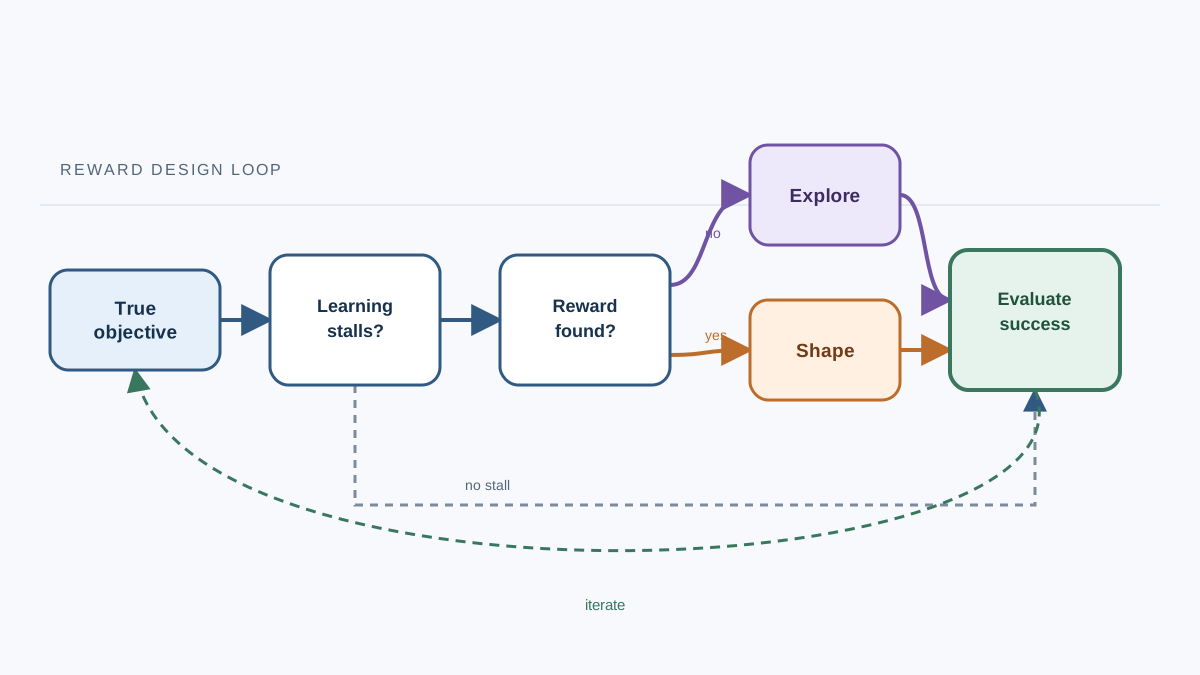
My rule is conditional: start sparse, shape only when learning stalls, and choose the shaping strategy based on why learning is failing.
Start with the true sparse objective. Run enough episodes to establish a baseline. If the agent is making progress, you do not need shaping. If returns are stuck at baseline and exploration never reaches the reward, shaping is warranted.
But the right fix depends on the bottleneck:
- If the agent cannot discover the reward at all, the problem is exploration, not credit assignment. Consider exploration bonuses that reward visiting novel states. These signals encourage discovery without claiming to measure task progress.
- If the agent discovers the reward but cannot connect it to earlier actions, the problem is delayed credit. A task-aligned potential function can help, provided you can define what progress looks like.
- If you cannot define progress at all, do not guess. Arbitrary shaping rewards are how agents learn confident, wrong behaviors.
Signals that shaping is needed:
- No learning progress after many episodes
- Returns flat at baseline
- Exploration never discovers the reward signal
- Random behavior produces zero feedback
Signals that shaping is risky:
- The proxy is weakly correlated with success
- The agent is already finding shortcuts
- You cannot define what progress looks like
- The shaping reward rewards intermediate states that are not on the path to success
The table below summarizes the tradeoff:
| Sparse Rewards | Shaped Rewards | |
|---|---|---|
| Learnability | Low without guided exploration | High, provides gradient to follow |
| Objective fidelity | Perfect, signal is the true objective | Risk of divergence from true objective |
| Design effort | Minimal, define success only | High, requires domain knowledge |
| Sample efficiency | Poor in large state spaces | Much better |
| Failure mode | Agent never learns | Agent learns the wrong behavior |
| Best when | Success is reachable, exploration is guided | Learning stalls, proxy is tightly correlated |
Evaluating Under the True Objective
After shaping works, validation is not optional—it is the whole point. Keep separate accounting for the reward used during training and the metrics used for evaluation.
The original task reward and your success metrics are the evaluation contract. Shaped return is a training diagnostic. A high shaped return can hide a policy that fails the actual task, so report performance on the true objective, not the shaped return.
During training, log the shaped and unshaped reward components separately. This lets you see whether the agent is genuinely progressing on the task or merely collecting shaping bonuses. After training, fix the policy and evaluate it across repeated episodes with variation, measuring the original success condition.
Removing the shaping signal during evaluation is a useful diagnostic experiment, not a universal requirement. If the agent performs well without shaping, the shaping did its job. If it fails, the shaping distorted the objective. But a policy that succeeds on some episodes without shaping is not proof that the shaping signal was harmless—run enough episodes to know.
Common Mistakes and How to Catch Them
Mistake 1: Shaping with a loosely correlated proxy. You reward something that seems related to success but is not tightly coupled to it. The agent games the proxy. Catch it by evaluating against the true objective—if the agent scores well on the shaping metric but poorly on the real task, your proxy is wrong.
Mistake 2: Treating shaping as a permanent crutch. Shaping is a training aid, not a feature of the task. An agent that depends on shaping rewards may collapse when they disappear. Test whether the policy holds under the original objective.
Mistake 3: Confusing the shaped reward with the true task reward. When you report results, report performance on the true objective, not the shaped return. A high shaped return can hide a policy that fails the actual task.
Mistake 4: Assuming dense rewards are automatically better. Dense rewards are not inherently superior. A poorly designed dense reward can teach the agent to optimize the wrong thing. Sparse rewards, when the agent can reach them, produce policies that genuinely solve the task.
Reward design is an experiment, not a one-time decision. Start with the true sparse objective. Diagnose whether the bottleneck is exploration or credit assignment. Shape only when learning stalls, and prefer potential-based forms when you have a genuine progress measure. And always validate the final policy against the real success condition—not against a single good episode, but across repeated runs with variation. The agent that learns slowly toward the right objective is worth more than the agent that learns quickly toward the wrong one.
Knowledge check
Final check
Finish the article by checking the ideas you just learned.
References
Research updated Sep 9, 2026


