
Credit Assignment in Reinforcement Learning: Connecting Late Rewards to Earlier Actions
The agent makes a move. Nothing happens. It makes another move, then another. Twenty steps later, a reward arrives—and the agent has no idea which action…

Key topics
The agent makes a move. Nothing happens. It makes another move, then another. Twenty steps later, a reward arrives—and the agent has no idea which action earned it. This is not a bug in your training loop. It is the credit assignment problem, and until you can name it, you will keep misreading why your agent learns slowly or not at all.
Here is the reframe that changes how you debug: delayed rewards are not one problem. They are three problems wearing the same coat—reward sparsity, long horizons, and poor state representation—and each needs a different fix.
The Reward Arrives Late. Which Action Earned It?
Imagine a game where you must position a piece early, then survive a sequence of exchanges before the setup pays off. The agent pushes the piece into place. Nothing happens. It dodges, blocks, retreats. Finally, many steps later, the payoff lands.
Now ask the agent: what did you do right?
The reward signal carries no timestamp and no pointer. It is a single number arriving at the end of a chain, and nothing in that number says which earlier action caused it. The agent must infer causality from correlation, separating the effect of its own choice from luck and from everything it did afterward.
That inference problem is credit assignment in reinforcement learning: measuring an action's influence on future rewards. It is the difference between knowing that you won and knowing why you won.
Knowledge check
Check your understanding
Answer this question before you continue.
Why a Reward Signal Does Not Tell You What to Change
Compare two situations. In the easy case, the agent acts and the reward arrives immediately. Cause and effect sit side by side. The update is obvious.
In the hard case, the reward arrives at the end of a long chain of decisions. Every action in that chain is a plausible suspect. The agent must separate skill from luck: a good action can be followed by a bad outcome, and a terrible action can be followed by a windfall. If you credit the windfall to the terrible action, you learn the wrong lesson.
Here is a useful analogy: you are a manager reading a quarterly result. Revenue is up. Which employee deserves the credit? The person who closed the deal this week? The person who built the pipeline last quarter? The person who fixed the bug that kept the product from shipping six months ago? The result is real, but the attribution is not written anywhere in the number.
The analogy stops being exact in one important way: employees can explain their reasoning, and you can interview them. An RL agent cannot. It only has the reward, the states it visited, and the actions it took. Everything else is inference.
Three Problems Hiding Behind One Symptom
When your agent fails to learn from delayed rewards, your first instinct is probably "the reward is too sparse." Sometimes that is true. But sparsity is only one of three distinct failure modes, and treating them all with the same remedy wastes weeks of training time.
Reward sparsity. The reward is genuinely rare or absent for long stretches. There is little signal to learn from at all, regardless of how clever your update rule is. The agent stumbles through the dark because the lights are almost never on.
Long horizons. Rewards may arrive frequently, but they land many steps after the decisive action. The signal is present; the causal link is stretched across time. The agent receives feedback, but the feedback is attached to the wrong moment.
Poor state representation. The state does not carry enough information to tell the agent which situation it is in. Even with dense, immediate feedback, credit cannot be assigned because the agent cannot distinguish the context that matters from the noise around it.
Here is a one-line diagnostic for each:
- If the agent almost never sees a nonzero reward, you have a sparsity problem.
- If rewards arrive regularly but long after the key decision, you have a horizon problem.
- If the agent sees rewards but cannot tell similar-looking situations apart, you have a representation problem.
Naming the problem is half the fix, because each one points in a different direction.
Knowledge check
Check your understanding
Answer this question before you continue.
How Algorithms Spread Credit Backward Through Time
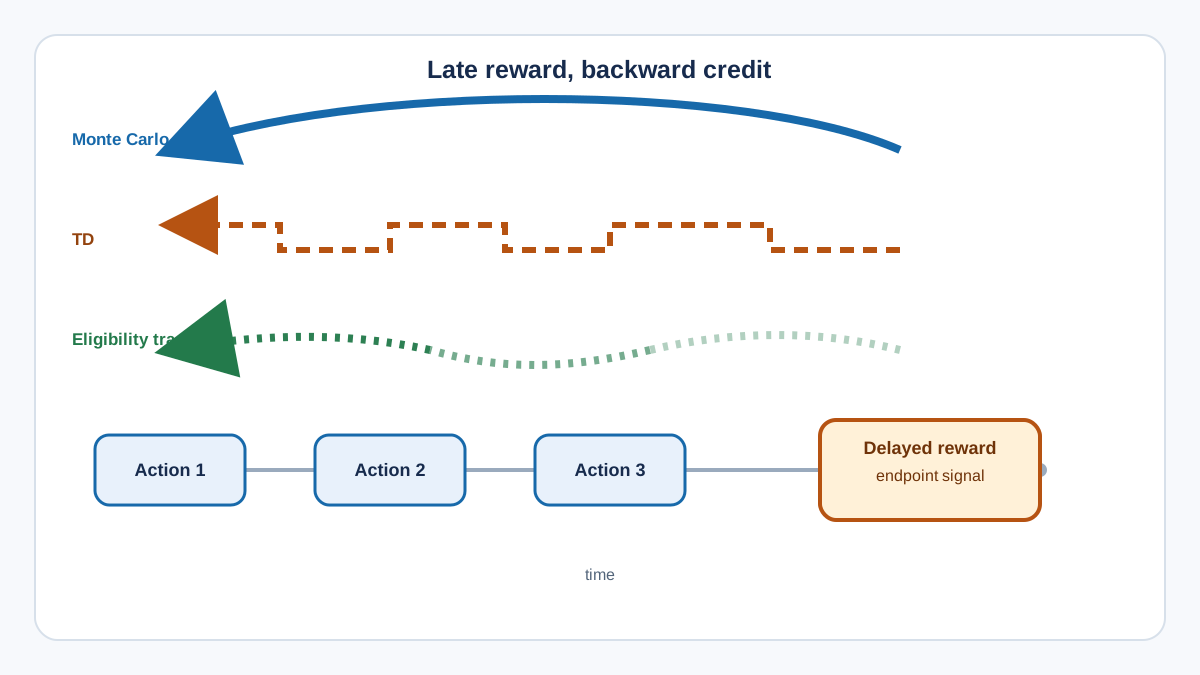
Once you know which problem you face, the next question is mechanical: how does an algorithm connect a late reward to an earlier action? The main strategies are three different answers to the same question—how far back should a reward reach, and how strongly should it pull each earlier action?
Monte Carlo methods wait for the episode to end, then credit every action in that episode with the final return. Simple and unbiased, but noisy: every action gets pulled by the same outcome, including the ones that had nothing to do with it. And the approach only works when episodes actually end.
Temporal-difference learning updates predictions step by step, using the next state's estimate instead of waiting for the final outcome. Credit spreads incrementally as the agent moves, so a reward can influence earlier decisions through a chain of bootstrapped predictions rather than one blunt retrospective.
Eligibility traces keep a decaying memory of recently visited state-action pairs. When a reward finally arrives, it flows back to several earlier steps with fading weight—the most recent actions get the strongest pull, and older ones get progressively less. This is the temporal credit assignment workhorse for problems where the decisive action sits a few steps behind the reward.
Each method is a different tradeoff between waiting and guessing. Monte Carlo waits for certainty and pays in noise. TD guesses earlier and pays in bias. Eligibility traces sit between them, letting you tune how far back the credit reaches.
Knowledge check
Check your understanding
Answer this question before you continue.
Why the Discount Factor Is Not a Fix for Credit Assignment
A common beginner move is to treat the discount factor as the cure for delayed rewards. It is not. Discounting changes how much the agent cares about the future; it does not tell the agent which past action caused a reward.
Think of it this way: discounting is about priority, credit assignment is about attribution. A low discount factor makes the agent myopic—it stops caring about distant rewards almost entirely. That can mask a long-horizon problem by making far-future rewards nearly invisible, but it never explains which action deserves the blame or praise.
If you already understand how returns and discounting work, you know the mechanism: distant rewards shrink in the return, so the agent optimizes for the near term. That is a statement about what the agent values. It is silent on the question of why a reward happened.
Knowledge check
Check your understanding
Answer this question before you continue.
Diagnosing Your Own Delayed-Reward Problem
When your agent learns slowly, run this diagnostic before you change anything else:
- Is the reward absent? If the agent rarely sees a nonzero reward, you have a sparsity problem. Look toward reward shaping or denser reward signals.
- Is the reward far away? If rewards arrive but long after the decisive action, you have a horizon problem. Look toward better value propagation—TD methods, eligibility traces, or architectures that carry information across time.
- Is the agent blind? If the state hides the relevant information, you have a representation problem. Look toward richer state features, better observation design, or a model that can infer what it cannot directly see.
The warning here matters: do not treat all three with the same hammer. Adding reward shaping will not fix a state that hides the relevant information. A longer trace will not help if the reward is genuinely absent. The remedy only works when it matches the disease.
Credit assignment in reinforcement learning is not a single algorithm you plug in. It is a lens for reading why an agent learns slowly or not at all. The next time your training curve flatlines, ask the diagnostic question first: is the reward missing, is it too far away, or is the agent blind to the situation it is in? Name the problem, and the fix direction becomes clear.
Knowledge check
Final check
Finish the article by checking the ideas you just learned.
References
Research updated Sep 9, 2026


