
Contextual Bandits vs Reinforcement Learning: When Actions Don’t Shape Future States
Picture a system that picks which article to show a returning reader. It looks at what it knows about them—their reading history, the time of day, the…

Key topics
An ad changes the reward. It doesn’t change the person who saw it.
Picture a system that picks which article to show a returning reader. It looks at what it knows about them—their reading history, the time of day, the device—and chooses one headline. The reader either clicks or scrolls past. The system logs the outcome and waits for the next visit.
That loop has a context, an action, and a reward. It looks like reinforcement learning. But one piece is missing, and that missing piece decides whether you should reach for the full RL toolkit or something much smaller.
The One-Step Assumption That Changes Everything
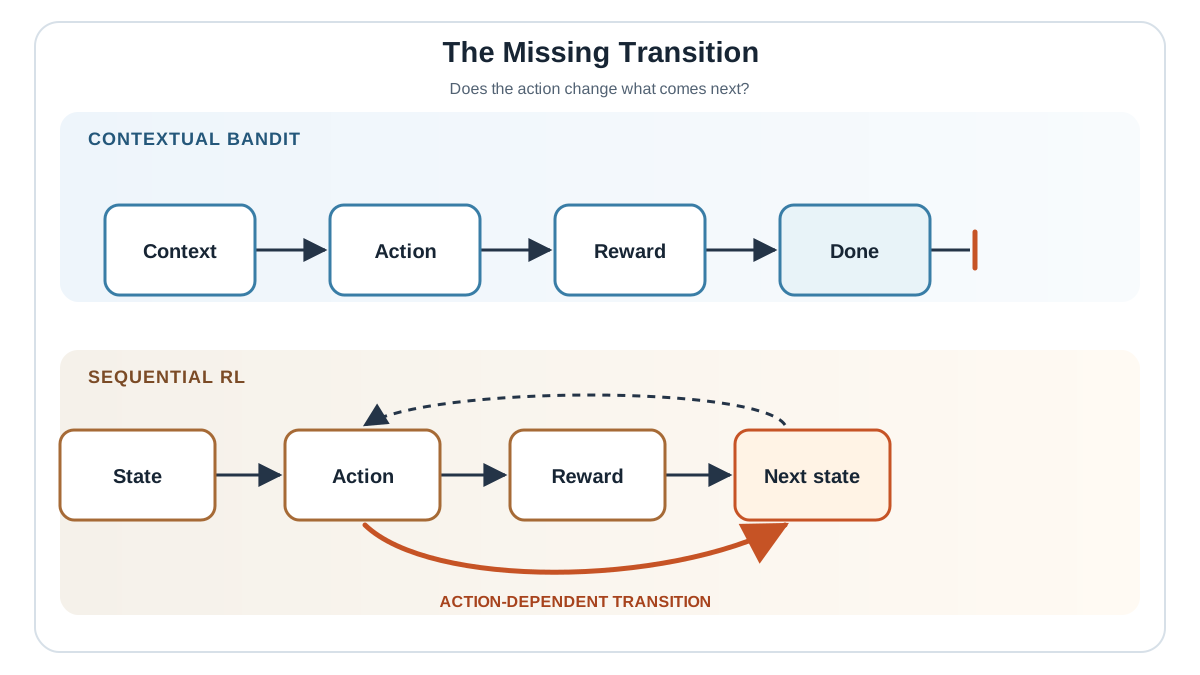
Here is the diagnostic question that carries this entire article: does the action change what comes next?
In a contextual bandit, the agent sees a context, picks an action, receives a reward, and the episode ends. The next episode arrives independently. The context influences the action, but the action does not influence the next context. That asymmetry is the whole distinction.
Compare two ad problems:
- Bandit: You choose an ad based on the user’s age group. The ad shown does not change the user’s age. Tomorrow’s context arrives fresh, unaffected by today’s choice.
- Sequential RL: You choose an ad, but serving expensive ads depletes your inventory, which limits what you can serve later. Or the ad you show today changes whether the user comes back at all. Now today’s action constrains tomorrow’s options.
The first problem has no arrow from action back to state. The second one does. That arrow—or its absence—is what separates a bandit from full reinforcement learning.
Visually, a bandit loop is flat: context → action → reward → done. A sequential RL loop is a chain: state → action → reward → next state → action → reward → next state. The bandit is missing the transition arrow. Everything else follows from that.
Knowledge check
Check your understanding
Answer this question before you continue.
A Quick Bridge: What You Already Know About the Loop
You already have the pieces: an agent observes a state, takes an action, receives a reward, and updates its behavior. You also know the exploration-exploitation tradeoff—the tension between trying new actions to learn and sticking with what works.
The bandit case keeps all of that. It just removes one thing: the agent’s past actions no longer produce the next observation. The context arrives from the world, not from the agent’s history. Think of it as an observation that shows up fresh each round.
Exploration still matters here. You still have to decide when to try a new ad and when to serve the one you know performs well. The problem just loses its temporal dimension. That simplification is not a downgrade—it is a controlled setting where you can study exploration without the complications of a changing world.
Knowledge check
Check your understanding
Answer this question before you continue.
Multi-Armed Bandit vs Contextual Bandit vs Full RL
These three settings are not unrelated topics. They are nested special cases on a single axis.
| Multi-armed bandit | Contextual bandit | Sequential RL | |
|---|---|---|---|
| Context/state | None | Context arrives each round | State persists and evolves |
| Does action affect next state? | No | No | Yes |
| Learning target | Immediate reward per arm | Immediate reward given context | Long-term return across time |
| Credit assignment | Trivial—reward belongs to the arm | Trivial—reward belongs to the action just taken | Hard—reward may arrive many steps later |
| Typical exploration | Epsilon-greedy, UCB, Thompson sampling | Same family, conditioned on context | Exploration must account for future consequences |
| Implementation cost | Low | Moderate | High |
A multi-armed bandit has no context at all. The reward depends only on which arm you pull. A contextual bandit adds a context that conditions the reward, but still no state transition. Full RL turns that context into a state, and the action changes which state comes next.
If the action cannot change the next context, the temporal machinery of RL is buying you nothing. You are paying for bootstrapping, value functions, and multi-step credit assignment to solve a problem that has none of those needs.
Knowledge check
Check your understanding
Answer this question before you continue.
Why the Difference Is Not Just Terminology
When there are no state transitions, several hard parts of RL simply disappear.
There is no bootstrapping—no using an estimate of the future to update an estimate of the present. There is no value function over future states, because there is no future state to value. There is no temporal-difference target, because the learning target is the immediate reward and nothing more.
Credit assignment collapses. In full RL, a reward that arrives ten steps after the action that caused it creates a genuine puzzle: which of those ten actions deserves the credit? In a bandit, the reward is attributable to the action just taken. The hard part of RL vanishes.
This is why bandit methods are often the pragmatic choice. Implementation complexity drops. You can test an idea in a bandit setting in an afternoon that would take weeks to debug in a full RL pipeline.
One caveat on the research framing: episodic RL generalizes contextual bandits, and the long horizon and unknown transitions are often assumed to be the source of extra difficulty. That assumption is itself studied and partly challenged—some results suggest the horizon and unknown transitions pose less additional sample-complexity difficulty than commonly believed. So do not treat “RL is harder because of the horizon” as settled. Treat it as an open question with active research.
The reverse mistake is more common and more costly: assuming a problem is one-step when a delayed consequence quietly violates the assumption. That is the failure mode to watch for.
Knowledge check
Check your understanding
Answer this question before you continue.
Exploration in a World Without Consequences
Exploration still costs you immediate reward in a bandit. Trying a new ad means potentially losing a click you would have gotten from the known-good one. But exploration cannot damage future states, because there are no future states to damage. The risk profile is simpler.
Because each round is independent, you can reason about regret per round rather than over a trajectory. Regret—the gap between what you earned and what the best action would have earned—becomes a per-round quantity you can measure and bound. In full RL, regret accumulates over a trajectory, and a single bad early decision can poison many later steps.
This makes bandits a clean laboratory for exploration strategies. If you want to test whether Thompson sampling beats epsilon-greedy, a bandit is the controlled setting where you can isolate that question. Add temporal complexity later, once the exploration idea works.
Warning: When human feedback or expert guidance narrows the action space too early, exploration can collapse. Research on contextual bandits with human feedback shows that at low expert levels, action-level guidance can disrupt learning by prematurely restricting what the agent tries. The bandit stops exploring and locks onto a suboptimal arm. If you add human input to a bandit system, watch whether exploration is still happening.
When to Treat a Problem as a Bandit
Use a bandit when the action’s effect is contained in the immediate reward and the next context arrives independently of what you did.
Use full RL when the action changes the state, consumes a shared resource, changes user behavior over time, or creates delayed consequences.
The practical test is one question: what does the next context depend on? If the answer is “nothing I did,” the one-step assumption holds. If the answer includes anything your action touched—inventory, user attention, system load, trust—you are in sequential territory.
Common mistake: A problem can look one-step at first glance and violate the assumption one step later. Serving an ad does not change the user’s age, but it might change whether they return. Depleting inventory does not change today’s context, but it changes tomorrow’s available actions. Check the second-order effects before committing to the bandit framing.
One more consideration: supervised classification and regression can be recast as contextual bandits. The context is the input, the action is the predicted label or value, and the reward indicates correctness. But the scalar reward carries less information than a full label. Training is typically slower. If supervised learning fits your problem, use it—do not reach for bandits just because the framing is possible.
Common Mistakes and How to Catch Them
Mistake 1: Calling every one-step decision a bandit while ignoring a delayed consequence.
Symptom: Your bandit performs well in simulation but degrades in production over weeks. Correction: Ask whether the action affects anything that shows up in a later context. If yes, you have a sequential problem wearing a bandit costume.
Mistake 2: Assuming bandits are “RL without the hard parts.”
Symptom: You describe bandits as a simplified RL and then wonder why your value-function code does not help. Correction: A bandit is a different problem with a different learning target. The target is immediate reward, not long-term return. The algorithms are different because the problem is different.
Mistake 3: Importing value functions and bootstrapping into a problem with no future state.
Symptom: You build a Q-table or a value network for a problem where the episode always ends after one step. Correction: If there is no next state, there is nothing to bootstrap from. Use a bandit algorithm. The extra machinery adds complexity without adding capability.
Mistake 4: Treating the context as a state the agent can influence.
Symptom: You design actions intended to shape future contexts, but your learning target only looks at immediate reward. Correction: If you want to influence future contexts, you are solving sequential RL. If you only want to maximize immediate reward given the current context, you are solving a bandit. Pick one and match your algorithm to it.
Where This Leads Next
Once the action starts shaping the next state, the immediate-reward target is no longer enough. You need a way to value the future—to estimate not just what this action earns now, but what it enables or prevents later. That is the doorway to temporal-difference learning and credit assignment across time.
Before you go there, try this: take a decision problem you know—something from work, a side project, or a system you use—and write down what the next context depends on. If the answer is “nothing I did,” you have a bandit. If the answer includes something your action touched, you have a sequential problem, and the next set of ideas will matter.
The test is one question. Apply it before you build.
Knowledge check
Final check
Finish the article by checking the ideas you just learned.
References
Research updated Sep 9, 2026


