Behavior Cloning and Covariate Shift: Why Demonstrations Fail Off the Training Path
A behavior-cloned agent can look flawless on training data and fall apart the moment it makes one small mistake. That is not bad luck. It is the signature…

Key topics
A behavior-cloned agent can look flawless on training data and fall apart the moment it makes one small mistake. That is not bad luck. It is the signature of a policy that learned to copy an expert without learning what to do when it stops being the expert.
The Policy That Looks Perfect Until It Isn't
Behavior cloning treats imitation as a supervised learning problem. You collect expert demonstrations, record the state-action pairs, and train a policy to reproduce the expert's action given the observed state. For discrete actions, that usually means minimizing cross-entropy. For continuous actions, mean-squared error. The setup is simple enough that it feels like ordinary classification or regression.
That feeling is the trap.
A classifier is evaluated on fixed inputs. You train on a dataset, then test on new examples drawn from a similar distribution. If the model performs well on the training set, you have reasonable confidence it will perform well on the test set, because both come from the same underlying population.
An agent is not a classifier. An agent's actions produce its next inputs. Every time the policy picks an action, it changes the state it will observe one step later. The policy is not predicting on a static distribution. It is steering itself through state space, and each decision determines which states it will ever get to see.
So the question this article answers is simple to state and surprisingly easy to underestimate: what happens after the first small mistake?
What Vanilla Behavior Cloning Actually Optimizes
Behavior cloning minimizes a per-state loss. For each training example, the loss asks one question: given this state, how closely does the policy's action match the expert's action?
That is the entire objective. The loss never asks whether the chosen action leads to a state the expert would have visited. It never asks whether the action is safe, recoverable, or even sensible beyond the immediate step. Each training example is treated independently, as if the sequence of states and actions had no causal connection.
The result is a mapping from states the expert visited to actions the expert took. The policy learns a set of input-output associations, not a model of what happens after the action lands.
Here is the part that breaks the supervised-learning intuition: an expert's demonstrations are a single path through state space, not a map of the whole region. A human driver, a PID controller, or a trained RL agent produces trajectories that reflect good behavior. Those trajectories pass through states reachable by good actions. They rarely pass through states reachable by slightly wrong actions, because the expert does not take slightly wrong actions.
The policy only knows how to behave where the expert happened to go. Everywhere else is a blank space in its training data.
Knowledge check
Check your understanding
Answer this question before you continue.
Covariate Shift: The Distribution Moves Under the Policy
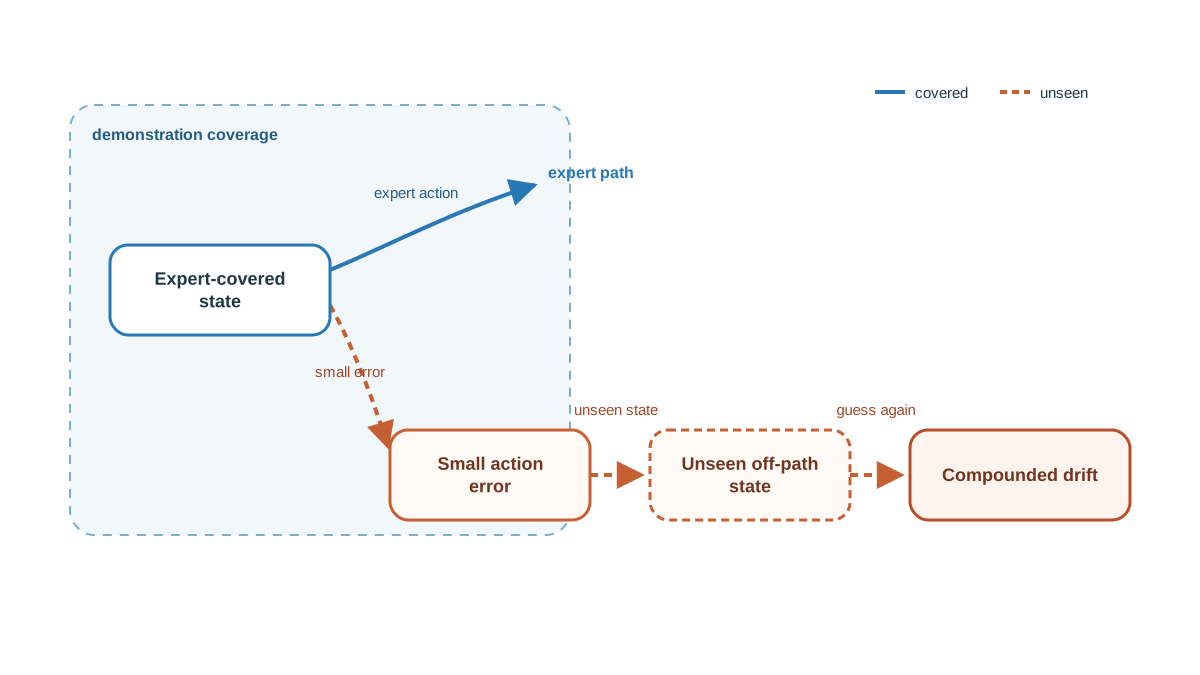
Covariate shift is the technical name for a plain-sounding problem: the states the policy faces at deployment differ from the states it was trained on.
In ordinary supervised learning, covariate shift is a data problem. Your training set and test set come from different distributions, and you can sometimes detect the mismatch and fix it by collecting better data. The model does not cause the shift. It just suffers from it.
In imitation, the policy itself creates the shift.
Walk through the mechanism step by step. The expert only visits states reachable by expert actions. The cloned policy is trained on those states. At deployment, the policy takes an action that is almost right but not exactly right. That small error lands it in a state the expert never visited. In that off-distribution state, the policy has no reliable training signal. It guesses. The guess may be wrong again, pushing it further from the expert's path. The next state is even further from the training distribution, so the next guess is even less reliable.
The loop feeds itself: wrong action leads to unseen state, unseen state produces another guess, and each guess risks compounding the error.
Think of the expert's trajectory as a narrow road through a wide field. Behavior cloning teaches the policy to drive on the road by showing it thousands of frames of road. But the policy has never seen the shoulder, the ditch, or the field beyond. The moment a small steering error takes it off the pavement, it has no idea what to do, because nothing in its training data resembles where it now finds itself.
Knowledge check
Check your understanding
Answer this question before you continue.
Why Small Errors Compound Instead of Cancel
A policy with 95 percent per-action accuracy sounds good. Over a single step, it makes a mistake one time in twenty. Over a trajectory of a hundred steps, that error rate should average out, right?
It does not, because the errors are not independent coin flips. They are conditional: once the policy leaves the expert's state distribution, it has no corrective signal pulling it back. The expert's demonstrations may contain recovery behavior, but only for states the expert actually reached. The dataset rarely covers the states the learner reaches after its own mistakes, because those states were produced by a different policy. The cloned policy therefore never learns what recovery looks like from where it actually ends up.
Here is a concrete three-step version of the mechanism:
| Step | State the policy sees | What the policy does | Resulting state |
|---|---|---|---|
| 1 | On the expert's path | Slightly wrong action (95% accurate) | Off the path, but close |
| 2 | Near the path, but not in the demonstrations | Guesses, with no reliable training signal | Further off the path |
| 3 | Clearly outside demonstration coverage | Guesses again, now on truly unfamiliar input | Even further off the path |
The per-step accuracy at step 1 was 95 percent. The problem is that step 2 is not a fresh draw from the same distribution. It is a state caused by the step-1 error, and it is exactly the kind of state the expert never visited. The policy is now being evaluated on input it was never trained to handle, and its next action is likely to make things worse.
This is the sharpest contrast with reinforcement learning. An RL agent that drifts off path still receives reward feedback from the environment. It experiences its own mistakes, feels the penalty of being in a bad state, and can learn to recover. A behavior-cloned policy never experiences its own mistakes during training. It only sees the expert's successes, so it never learns what to do with its own failures.
Consider a lane-keeping task. A small steering error moves the vehicle slightly off course. The next state, a car angled toward the shoulder, is not in the demonstrations, because the expert never drove angled toward the shoulder. The policy guesses at a steering correction. The guess is based on states that look vaguely similar but are not the same, so it is likely wrong again. The vehicle drifts further. Each step takes it deeper into territory the demonstrations never covered.
The practical takeaway is uncomfortable but important: average imitation accuracy is the wrong metric. What matters is whether the policy's errors stay inside the region the demonstrations cover. A policy that is 99 percent accurate per step can still fail catastrophically over a long horizon if that one percent error pushes it off the distribution and there is no way back.
Knowledge check
Check your understanding
Answer this question before you continue.
When Behavior Cloning Works and When It Breaks
Behavior cloning is not useless. It fails in predictable ways, and understanding those ways tells you when you can trust it.
Behavior cloning works when the task has strong state stability. If small action errors do not push the agent into meaningfully different states, or if the environment naturally corrects course, then the policy rarely leaves its training distribution. A short-horizon task with forgiving dynamics can tolerate cloning quite well. The policy makes a small mistake, the environment absorbs it, and the next state still looks like something from the training data.
Behavior cloning breaks when the task is sensitive to small errors, has long horizons, or involves states where recovery is hard once you leave the demonstrated path. The longer the trajectory, the more opportunities for a single error to accumulate. The more sensitive the dynamics, the more a tiny action error changes the next state. The harder recovery is, the more costly it is to leave the distribution even briefly.
Data coverage matters too. Diverse demonstrations that visit more of the state space give the policy more room before it falls off the distribution. If your expert demonstrations cover a wide range of situations, the policy has seen more of the field around the road. But no finite dataset covers everything, and the policy will eventually reach the edge of what it has seen.
My rule of thumb: if the cost of one wrong action is high and the environment does not self-correct, treat pure behavior cloning as a starting point, not a finished policy. Use it to bootstrap. Do not deploy it as the final answer.
Knowledge check
Check your understanding
Answer this question before you continue.
Remedies Depend on What Feedback You Can Access
The standard remedies all address the same root cause, but they differ in what they assume you can get: corrective labels, environment rewards, or neither.
Interactive corrective demonstrations (DAgger-style). These approaches collect new demonstrations from the states the current policy actually visits. Instead of only showing the policy where the expert went, you let the policy act, observe where it drifts, and ask the expert to demonstrate the correct action from those off-distribution states. This closes the loop between the policy and its own distribution. It requires an expert who can label states on demand.
RL fine-tuning after cloning. The agent starts with the expert's behavior, then experiences its own mistakes and learns recovery through reward feedback. This requires a reward signal and the ability to interact with the environment. Pure cloning never gives the policy that experience.
Offline RL and policy-constraint methods. These address a related but distinct problem: when you cannot interact with the environment at all, and you must learn from a fixed dataset. They do not feed the policy newly visited states. Instead, they constrain the learned policy to stay close to the behavior policy that generated the data, preventing the worst out-of-distribution actions. This manages extrapolation risk rather than collecting new on-policy experience.
The pattern across the first two approaches is the same: the fix is not about tweaking the loss function. It is about making sure the policy learns from the states it actually reaches, not just the states the expert reached. The third approach is what you reach for when neither option is available.
The Decision Rule
Before you trust a behavior-cloned policy, ask one question: would a single small action error push the agent into a state the demonstrations never covered?
If the answer is no, because the task is short, the dynamics are forgiving, or the demonstrations are broad enough to absorb small deviations, behavior cloning may be all you need.
If the answer is yes, expect compounding drift. Plan for a remedy that feeds the policy its own states, whether that means collecting corrective demonstrations, adding RL fine-tuning, or constraining the policy to stay near the data.
The best way to see this gap firsthand is to run a small experiment. Train a cloned policy on expert demonstrations, then evaluate it two ways: on the training distribution, where it will look competent, and on its own rollouts, where you will watch it drift. But do not just compare success scores. Watch for the specific signals that confirm the mechanism: the first step where the rollout state falls outside the demonstration envelope, how quickly the deviation grows, whether the policy can recover when you deliberately perturb one action, and the final task completion rate. The difference between those two evaluations is the entire lesson of this article.
Knowledge check
Final check
Finish the article by checking the ideas you just learned.
References
Research updated Sep 9, 2026


