
Imitation Learning vs Reinforcement Learning: Copying Behavior or Optimizing Outcomes?
You have a stack of expert demonstrations. Maybe you recorded a human driving a car, or you logged the decisions of a system that already works well. The…

Key topics
You have a stack of expert demonstrations. Maybe you recorded a human driving a car, or you logged the decisions of a system that already works well. The question feels simple: why not just copy what the expert did?
That instinct is reasonable, and it is also the exact point where beginners pick the wrong learning setup. Copying behavior and optimizing outcomes look similar from the outside, but they answer different questions. Imitation learning asks, "What would the expert do here?" Reinforcement learning asks, "What action produces the best outcome over time?"
The difference is not academic. It determines whether your agent can handle situations the expert never faced, whether it can exceed the expert's skill, and whether it will fail in ways you can predict. The real question behind the comparison is this: what tells your agent it is doing well—an expert's example, the environment's feedback, or both?
The Question Behind the Comparison
Imagine you want to teach an agent to drive. You have hours of footage from a skilled driver. You could train the agent to mimic that driver's steering and pedal inputs. Or you could set up a simulation where the agent drives on its own, receives a reward for staying on the road and avoiding collisions, and gradually discovers good driving through trial and error.
Both approaches produce a policy—a rule that maps what the agent observes to what it should do. But they learn from different teachers.
Imitation learning treats the expert's demonstration as the source of truth. Reinforcement learning treats the environment's reward signal as the source of truth. That single distinction drives everything else: what data you need, how much exploration is required, what failure modes you should worry about, and whether your agent can ever become better than the person who provided the demonstrations.
The decision rule you will carry away from this article is simple: choose the setup whose decisive learning signal you actually have. If you have high-quality demonstrations and matching expert behavior is the goal, imitation learning is the faster path. If you need the agent to optimize a measurable outcome, handle rare situations, or exceed the demonstrator, reinforcement learning—or a combination of both—is the stronger choice.
Knowledge check
Check your understanding
Answer this question before you continue.
What Imitation Learning Actually Learns
Imitation learning is a broad family of methods where an agent learns from expert demonstrations. It is also called learning from demonstrations. The name matters less than the mechanism: you collect recordings of an expert performing the task, usually as state-action pairs, and train the agent to reproduce the expert's action given the observed state.
The simplest and most common form is behavioral cloning. Think of it as treating the demonstrations like labeled data. Each demonstration is a pair: "when the agent saw this state, the expert took this action." You train a policy to predict the expert's action from the state, using the same supervised learning machinery you would use for image classification or language modeling.
Here is what a demonstration dataset looks like for a robot arm learning to pick up an object. Each timestep produces one training example: the state might be the position of the arm and the object, plus the camera image; the action might be the joint angles the expert commanded. Collect thousands of these pairs across many pick-up attempts, and you have a dataset. Train the policy to imitate, and you have a behavioral cloning agent.
The appeal is obvious. No reward function to design. No simulation to build. The expert already figured out what good behavior looks like, and you are borrowing their judgment.
But notice what the agent never learns: why the expert acted that way. It learns to match the expert's choices, not to understand the consequences of those choices. That distinction becomes critical when the agent encounters a situation the demonstrations never covered.
One clarification before we go further: imitation learning is an umbrella term. Behavioral cloning is the passive baseline—it trains on a fixed set of demonstrations and never interacts with the environment. Other imitation methods are more active. Some query an expert interactively when the agent reaches unfamiliar states. Others try to infer the reward the expert was optimizing, then use reinforcement learning to find a policy that maximizes it. What unites the family is the goal: learn from an expert rather than from scratch. When people contrast imitation learning with reinforcement learning in practice, they usually mean passive behavioral cloning, so that is the version we will compare head-to-head.
Knowledge check
Check your understanding
Answer this question before you continue.
What Reinforcement Learning Actually Optimizes
Reinforcement learning starts from a different premise. There is no expert to copy. There is only an agent, an environment, and a reward signal.
If you have read about the agent-environment loop, you know the shape of it: the agent observes a state, takes an action, the environment responds with a new state and a reward, and the cycle repeats. What matters for this comparison is what the agent learns from. It learns from the consequences of its actions—the rewards it receives and the states those actions lead to—rather than from a fixed example of correct behavior.
That means the agent must explore. It has to try actions that might fail, because no one showed it what happens when you brake too late or steer too wide. It also has to assign credit across time. A reward that arrives ten steps after the action that caused it still needs to influence that earlier decision.
This is harder than imitation in one obvious way: the agent starts with no idea what good behavior looks like. But it is more powerful in another way. Because the agent optimizes outcomes rather than matching examples, it can discover behavior that is better than the demonstrator's. It can find a faster route, a more efficient control strategy, or a safer response to a rare event—precisely because it is not limited to what the expert happened to do.
Note: Reinforcement learning can train on its own mistakes, but experiencing a consequence is not the same as learning from it. If the reward is too sparse, too delayed, or poorly designed, the agent may collect plenty of experience and still never figure out which action deserved credit. RL's advantage over imitation is access to its own mistakes, not a guarantee that it will learn from them.
Knowledge check
Check your understanding
Answer this question before you continue.
Imitation Learning vs Reinforcement Learning: Side by Side
The comparison becomes clearer when you line up the two setups across the axes that actually matter. To keep the contrast honest, this table compares passive behavioral cloning with reward-driven RL—the two setups beginners actually choose between.
| Axis | Behavioral Cloning | Reinforcement Learning |
|---|---|---|
| Data source | Fixed expert demonstrations, usually state-action pairs | Experience collected by the agent itself through interaction |
| Objective | Match the expert's behavior | Maximize cumulative reward |
| Feedback | The demonstration is the only teacher | The environment's reward is the teacher |
| Exploration | None during training—the expert already explored | Must explore to discover which actions produce good outcomes |
| Typical failure mode | Drifts when the agent reaches states the demonstrations never covered | Struggles when rewards are sparse, delayed, or poorly designed |
Walk through each row and you get a reusable mental boundary. Behavioral cloning is supervised learning in disguise: the data comes pre-labeled by the expert. Reinforcement learning is optimization through interaction: the data is generated by the agent's own decisions and evaluated by the reward signal.
The exploration row is worth pausing on. Behavioral cloning gets to skip exploration because the expert already did the work of finding good behavior. That is a massive efficiency gain. But it is also a hidden dependency: the agent inherits the expert's coverage of the state space and nothing more. Reinforcement learning pays the exploration cost directly, and in exchange it builds a policy that knows what to do in states the agent reaches on its own.
Why Copying Fails: Covariate Shift and the Drift Problem
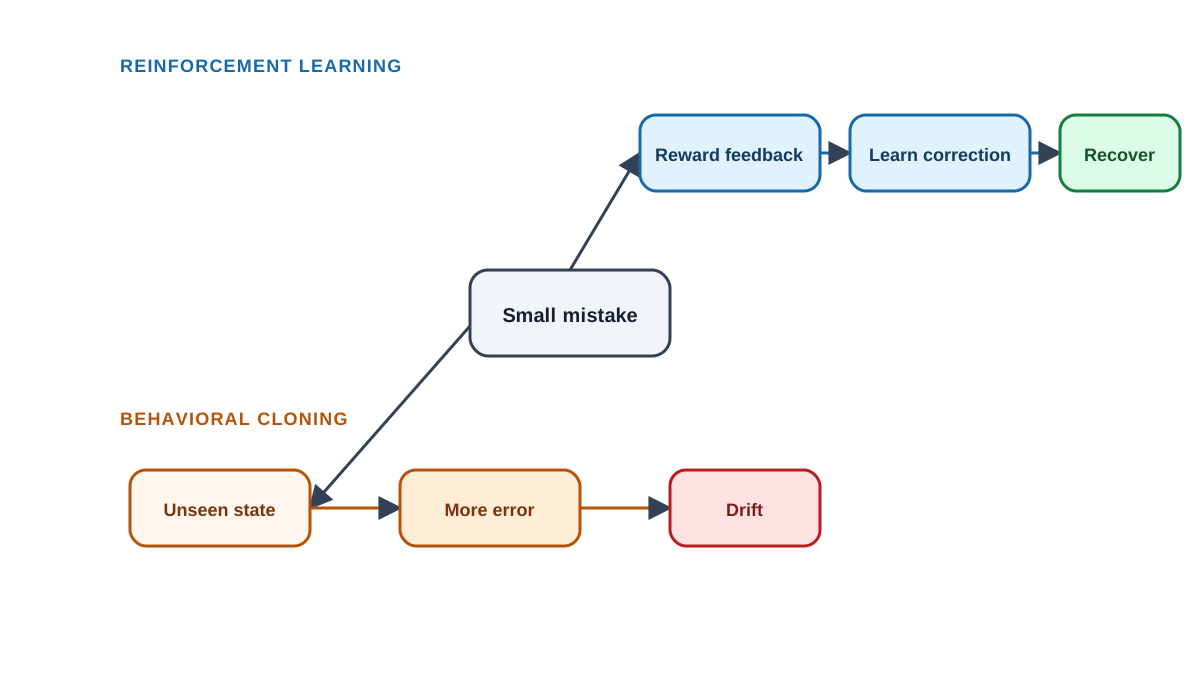
The most important failure mode in behavioral cloning has a formal name: covariate shift. The plain-English version is easier to remember.
The agent makes a small mistake. That mistake puts it in a state the demonstrations never covered. Now the agent has no example to follow, so it makes another guess, which leads to another uncovered state, and the errors compound. The agent drifts further from the demonstrated behavior until it is completely lost.
Watch this happen in driving. The expert's demonstrations mostly show the car in the center of the lane. The behavioral cloning agent learns to steer from the center. Then one day it drifts slightly toward the lane edge. That position was never in the training data. The agent has no example of how to recover from the edge, so it guesses. The guess is wrong, the car drifts further, and soon the agent is in a state so far from anything the expert demonstrated that its policy is just making things up.
Reinforcement learning handles this failure differently, because the agent learns from its own experience. When it drifts toward the lane edge during training, it feels the consequence—a reward penalty or a collision—and can learn to correct. Its training distribution includes the mistakes it actually makes, so it has a chance to learn what to do when it finds itself in them.
Common mistake: Do not assume RL automatically recovers from every mistake. The agent only learns a correction if the reward makes the failure detectable, the environment lets it reach recoverable states, and the algorithm gets enough informative experience to connect the late penalty to the earlier action. RL's advantage is that its training distribution includes its own errors—not that errors magically teach it the right response.
Researchers have developed more advanced imitation methods to address drift, such as interactively querying the expert when the agent encounters unfamiliar states. These approaches help, but they add complexity. The core lesson remains: a policy trained only on expert examples is only as good as the coverage of those examples.
Knowledge check
Check your understanding
Answer this question before you continue.
When Demonstrations and Rewards Work Together
Here is the practical secret that most beginners discover only after failing with one approach: imitation learning and reinforcement learning are not always either/or choices. Many real systems combine them, and the combination is often stronger than either approach alone.
The common hybrid pattern is straightforward. Use demonstrations to give the agent a strong starting point, then let reinforcement learning refine its behavior against the reward signal. In practice, this might mean pre-training a policy with behavioral cloning before switching to RL training, or seeding the agent's replay buffer with demonstration data so its first experiences are good ones.
The two approaches have complementary strengths. Imitation learning provides fast, human-like starting behavior without requiring a carefully designed reward. Reinforcement learning provides robustness in states the demonstrations never covered, because the agent learns to optimize outcomes rather than match examples.
This pattern shows up in serious applications. In autonomous driving research, for example, systems trained on large amounts of human driving data perform well in common scenarios but struggle with rare, high-risk situations. Combining imitation with reinforcement learning—using a simple reward that penalizes collisions and off-road driving—has been shown to substantially improve safety in those challenging cases. The demonstrations teach the agent normal driving; the reward signal teaches it what to do when normal driving is not enough.
The lesson for your own projects: if you have demonstrations and a reward function, you do not have to choose. You can use both.
How to Choose: A Decision Rule
When you sit down with your own problem, ask one decisive question: what is your learning signal—an expert's example, environment feedback, or both?
Start with what you have. Do you have high-quality demonstrations of the task being done well? If yes, imitation learning is the faster path. You can train a behavioral cloning agent with supervised learning and get reasonable behavior quickly, especially if your task mostly stays within the situations the expert demonstrated.
Do you have a reward function that captures what good behavior means? Can the agent collect enough experience to learn from it? If yes, reinforcement learning is the stronger choice, particularly when the goal is to exceed the demonstrator, handle rare states, or optimize a measurable outcome.
Here is the when-to-use framing in compact form:
Use imitation learning when:
- You have high-quality demonstrations that cover the situations your agent will actually face.
- Matching expert behavior is the actual goal.
- You want a fast start without designing a reward function.
Use reinforcement learning when:
- You can define a reward that gives informative feedback, not just a nominal one.
- The agent can explore and reach the states where mistakes and recoveries happen.
- You want the agent to potentially exceed the demonstrator's skill.
Use both when:
- You have demonstrations and a reward function.
- You want fast initial progress plus robustness in rare situations.
The quality checks matter as much as the signal check. Demonstrations that never show recovery from the lane edge will not teach recovery, no matter how many hours you record. A reward that only fires after a full episode of correct behavior may be too sparse for the agent to learn from. Before choosing a setup, ask not just which signal you have, but whether that signal is strong enough to teach the behavior you need.
The practical next step is small. Pick a task you can simulate or record quickly. Identify which signal you actually have—demonstrations, rewards, or both. Then run the simplest version of the matching approach. Watch where it succeeds and where it fails. That failure will teach you more about the difference between copying behavior and optimizing outcomes than any comparison table can.
The right setup is not the more sophisticated one. It is the one whose learning signal matches the information you can actually provide.
Knowledge check
Final check
Finish the article by checking the ideas you just learned.
References
Research updated Sep 9, 2026


