
Reinforcement Learning vs Supervised Learning: How the Feedback Loop Changes
A reward is not a delayed label. That single confusion sits behind most of the trouble beginners have telling supervised learning and reinforcement…

Key topics
A reward is not a delayed label. That single confusion sits behind most of the trouble beginners have telling supervised learning and reinforcement learning apart. Once you see why, the two paradigms stop looking like variations of the same idea and start looking like what they are: answers to different questions.
The Misconception: "RL Is Just Supervised Learning With Delayed Labels"
Here is a mental model many beginners carry: supervised learning teaches a model from examples that have correct answers, and reinforcement learning does the same thing—except the answer arrives late, after a whole sequence of actions.
The analogy seems to work at first. Imagine a game where you only learn your score at the end. You made a series of moves, and then the environment tells you how you did. That feels like training data arriving after a delay.
But the analogy breaks at the exact point where it matters. A label specifies the correct output for an example. A reward assigns a numeric evaluation to what happened after an action. Those are different kinds of information, and confusing them leads you to expect things from reinforcement learning that it will never deliver.
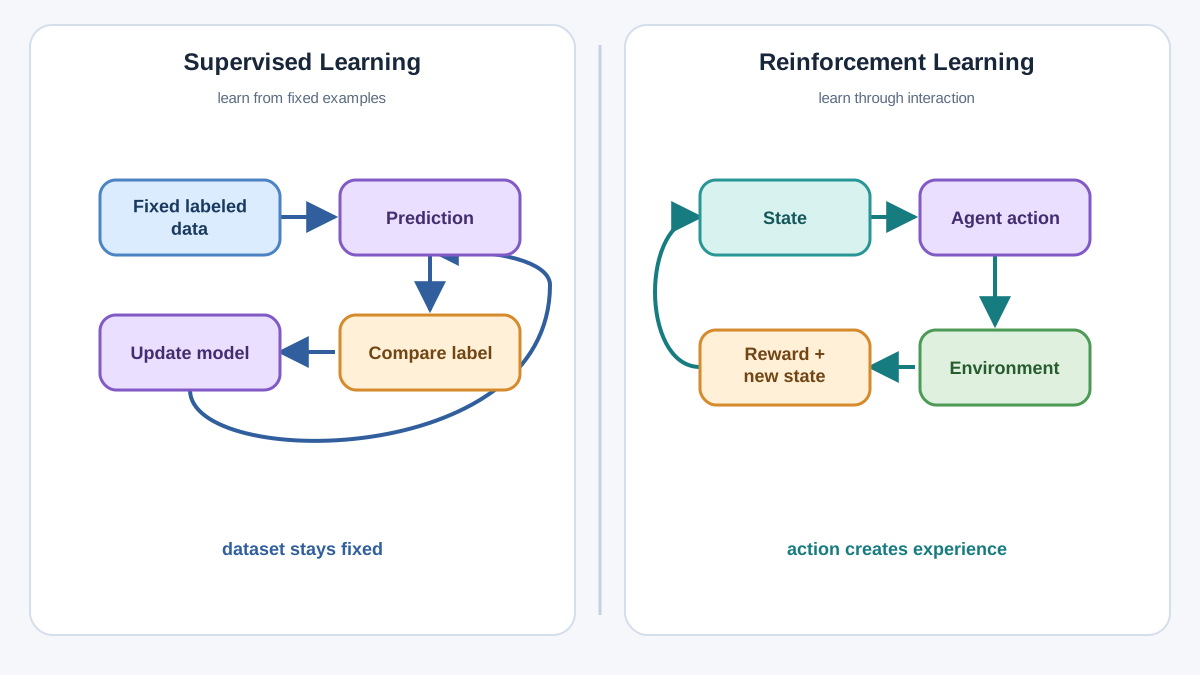
Here is the central handle for everything in this article: in the standard supervised learning setup, the data exists before the model does anything. In reinforcement learning, the agent's own actions decide which data it will ever see. That difference in the feedback loop changes the entire learning problem.
If you need a refresher on the agent-environment loop itself—the cycle where an agent picks an action, receives a reward, and lands in a new state—you can find it in the foundation article on reinforcement learning basics. This comparison assumes you have that loop in view and focuses on why it matters.
What Supervised Learning Actually Needs: Labels and a Fixed Dataset
Supervised learning runs on a simple contract: every training example already carries the correct answer. That answer is the label.
Think about classifying images. You have a dataset of photos, and each one is tagged with what it contains: dog, cat, car, tree. The model learns by comparing its predictions against those known answers and adjusting until its error shrinks. Or think about predicting a house price from square footage, location, and age. Every row in your training data already has the price that was actually paid.
Notice what the model never does in either case: it never changes the world it learns from. The dataset is fixed before training starts. The model's predictions do not alter the next image it sees or the next price it tries to predict. In the standard setup, each example is independent. Get one wrong, and the next input arrives exactly as it would have anyway.
The objective is clean: minimize error against known answers. You can measure progress at every step because the ground truth is sitting right there in the training set.
That property—training data independent of the model's own behavior—is what makes supervised learning feel safe and predictable. It is also exactly what reinforcement learning removes.
Knowledge check
Check your understanding
Answer this question before you continue.
What Reinforcement Learning Changes: The Agent Shapes Its Own Data
Now watch what happens when you remove the fixed dataset.
In reinforcement learning, there is no pre-collected answer key waiting to be loaded. The agent starts inside an environment, picks an action, and the environment responds with two things: a reward and a new state. That new state becomes the next decision point. The agent acts again, receives another reward, lands in another state, and the cycle continues.
Here is the part that changes everything: the agent generates its own training data by acting. The experiences it collects depend on the actions it chooses. Choose differently, and you collect different experiences.
This creates what I think of as the exploration burden. To learn what works, the agent must try actions it is not sure about. But those trials are not neutral experiments—they change what the agent sees next. A robot that turns left instead of right ends up in a different part of the room, facing different obstacles, collecting different evidence. A game agent that makes a weak early move faces a different board position than one that played aggressively.
Put the two data flows side by side and the contrast becomes obvious:
- Supervised learning: fixed data → model learns → model never affects the data
- Reinforcement learning: agent acts → data is generated → next data depends on the action
That is the feedback loop difference in its purest form. Supervised learning is learning from a record of the past. Reinforcement learning is learning by changing the future you get to observe.
Knowledge check
Check your understanding
Answer this question before you continue.
Rewards Are Not Labels: What Each Signal Actually Tells You
Let me make the deepest source of confusion explicit, because it causes more trouble than anything else in this comparison.
A label is an answer. It tells the model what the correct output is for a given input. Show the model a picture of a cat, and the label says "cat." The model can compare its prediction to the label and know exactly how wrong it was.
A reward is a numeric signal defined by the environment or task. It evaluates what happened after an action or transition—but it does not say which action caused it or what the agent should have done instead. If you win a chess match, the reward says "good outcome." It does not say whether your opening move, your mid-game sacrifice, or your endgame technique deserves the credit.
That ambiguity has a name in reinforcement learning: the credit-assignment problem. When a reward arrives after many actions, which choice earned it? The final win or loss does not reveal which early move mattered most. The signal may be sparse, delayed, and silent about cause.
This is why reinforcement learning is harder than supervised learning in one specific way. Supervised learning hands you the answer and asks you to match it. Reinforcement learning hands you a score and asks you to figure out what produced it—while your own choices keep changing the situation you are trying to understand.
One more nuance worth noting: an agent rarely acts on a single reward. It accumulates rewards across many steps into a return—a running total that represents the long-term outcome. That is why credit assignment is difficult. The algorithm must decide how much of the final return each earlier action deserves.
Knowledge check
Check your understanding
Answer this question before you continue.
Sequential Decisions and Consequences That Compound
There is one more structural difference worth making visible: supervised learning problems are usually independent, while reinforcement learning problems are sequential.
In supervised learning, each prediction stands alone. Misclassify one email as spam, and the next email arrives unchanged. Your error does not reshape the input stream. The model lives in a world where its mistakes have no ripple effects.
Reinforcement learning does not work that way. Every action changes the state, and decisions link together in a chain. Early choices constrain later ones. A wrong turn in a maze puts you in a corridor where the remaining options are different from the ones you would have faced on the correct path. A resource-management agent that spends too much early ends up with nothing left to allocate later.
This is where the word "delayed" finally earns its keep—but not in the way the original misconception imagined. The delay is not about feedback arriving late. The delay is about consequences compounding across time. The best immediate move may be terrible for the long-term goal. The move that looks slightly worse right now may set up a much better position three steps ahead.
A chess player who grabs an exposed pawn but leaves their king vulnerable understands this instinctively. The immediate reward feels good. The long-term consequence is defeat. Reinforcement learning forces the agent to care about the whole chain, not just the current step.
Knowledge check
Check your understanding
Answer this question before you continue.
A Decision Rule: Is Your Problem Supervised or Reinforcement?
You now have the pieces. Here is how to put them together when you face a new problem.
Ask two questions in order:
- Is the system choosing actions whose quality is judged by consequences over time? If the goal is to pick a sequence of decisions that leads to a good long-term outcome, you have a policy problem. If the goal is simply to predict a correct answer for each input, you have a supervised problem.
- Where does the data come from? If you have labeled examples, supervised learning is on the table. If the agent must interact to discover what works, you have an exploration problem that points toward reinforcement learning.
| Supervised Learning | Reinforcement Learning | |
|---|---|---|
| Feedback | Label: the correct answer | Reward: a numeric evaluation of what happened |
| Data source | Fixed, pre-collected dataset | Generated by the agent's own actions |
| Objective | Minimize error against known answers | Maximize long-term return through a sequence of decisions |
| Decision consequences | Independent; errors do not change future inputs | Sequential; actions change future states |
Try the decision rule on a few examples.
Spam detection. Each email has a correct label. The data is fixed. Your classifier does not change which emails arrive next. Supervised learning is the right tool.
Teaching a robot to navigate a room. There is no correct action for every moment. The robot's movements change where it is and what it can observe next. Feedback about reaching the goal arrives after a long sequence of movements. This is reinforcement learning territory.
Learning to imitate moves from recorded expert games. You have examples of what skilled players did in specific positions. Each position has a demonstrated action taken by an expert. The data is fixed. This is supervised learning—often called behavior cloning—even though the underlying game is sequential. One caveat: a recorded action is a demonstration, not a proof of optimality. Experts make mistakes, and imitation only reproduces what was observed. It does not optimize the outcome beyond the demonstrations.
The honest answer is that real systems sometimes blur the line. Many modern systems pretrain on demonstrations using supervised learning, then fine-tune with reinforcement learning to optimize the actual objective. That combination works because each paradigm contributes what it does best: supervised learning provides a strong starting point from human examples, and reinforcement learning pushes toward the real goal.
There is also a subtlety worth knowing: reinforcement learning can be studied with fixed, logged experience. In that case, the agent does not control data collection during training, and the hard problem shifts to learning a policy from data gathered by someone else. The beginner version of the decision rule—live interaction means RL, fixed answers mean supervised learning—is a good starting point, but the deeper distinction is about what you are optimizing and whether your actions shape the consequences you observe.
Common Beginner Mistakes and How to Recover
Every beginner hits the same walls. Here is what they look like and how to get past them.
Mistake 1: Treating a reward as a delayed label. You expect the agent to learn the way a supervised model does, just with feedback arriving later. Then you wonder why training is unstable and the agent does not converge to clean answers.
What to try instead: Remind yourself what each signal contains. A label says "this was the correct output." A reward says "this is how the outcome scored." When you catch yourself expecting the reward to tell the agent what to do, stop and ask what the agent is supposed to learn from a score that does not assign blame.
Mistake 2: Expecting RL to learn from a fixed offline dataset without the exploration problem. You collected a batch of experiences and expect the agent to learn from them the way a supervised model learns from its training set. But if the agent cannot try new actions, it never discovers what happens outside that batch.
What to try instead: If you only have a fixed dataset, ask whether you can frame the problem as supervised learning—predicting the demonstrated action from examples. If you truly need reinforcement learning, accept that the agent must interact with the environment to collect its own data, or that you are solving the harder offline problem where the agent must generalize from someone else's experience.
Mistake 3: Treating every sequential problem as RL. Just because a problem unfolds over time does not mean you need reinforcement learning. If you have recorded examples of good decisions, supervised learning can learn to imitate them far more simply.
What to try instead: Run the decision rule. If a correct answer exists for each decision point and the data is fixed, start with supervised learning. Reach for reinforcement learning when the data does not exist yet and the agent must generate it through trial and error.
The Rule You Can Carry Forward
Before you choose a learning paradigm, ask one question: is this a prediction problem with known answers, or a decision problem where actions have consequences that unfold over time?
That question separates the two paradigms more cleanly than any other. Supervised learning works when the answers already exist and the model cannot change the world it learns from. Reinforcement learning exists for the harder case: when there is no answer key, when decisions have consequences that ripple forward, and when the agent must act to discover what works.
The natural next step is to look at how reinforcement learning actually learns from that feedback loop—how value methods turn sparse rewards into a usable signal for choosing better actions. That is where the theory starts paying off.
Knowledge check
Final check
Finish the article by checking the ideas you just learned.


