
Combining Demonstrations With Reinforcement Learning
Pure reinforcement learning wastes samples rediscovering what a demonstrator already solved. Pure imitation freezes at the demonstrator's ceiling. The real…

Key topics
Pure reinforcement learning wastes samples rediscovering what a demonstrator already solved. Pure imitation freezes at the demonstrator's ceiling. The real question is not whether to combine demonstrations with reinforcement learning—it's where demonstrations enter the pipeline. Each entry point makes a different promise about what later environment feedback can fix.
Why Demonstrations and RL Want Each Other
Start with the two failure modes you already know. RL from scratch explores state-action space inefficiently, especially when rewards are sparse or horizons are long. The agent spends thousands of episodes bumping into states a competent demonstrator would never visit. Behavior cloning, on the other hand, inherits the demonstrator's ceiling—and covariate shift means the policy drifts off the training path the moment it makes its first mistake.
The combined setting assumes three things: you have environment access, reward feedback is available, and at least one demonstration source exists. Given those, demonstrations can compress the exploration problem while RL keeps the door open to exceeding the demonstrator.
But "combine demonstrations with RL" is not a single algorithm. It is a family of design choices. Demonstrations can affect the policy directly, the value learner through stored transitions, the visitation distribution during exploration, or the initial-state distribution at episode start. Each choice changes what the agent can later improve and what biases it inherits.
The Entry-Point Map: Where Demonstrations Can Enter
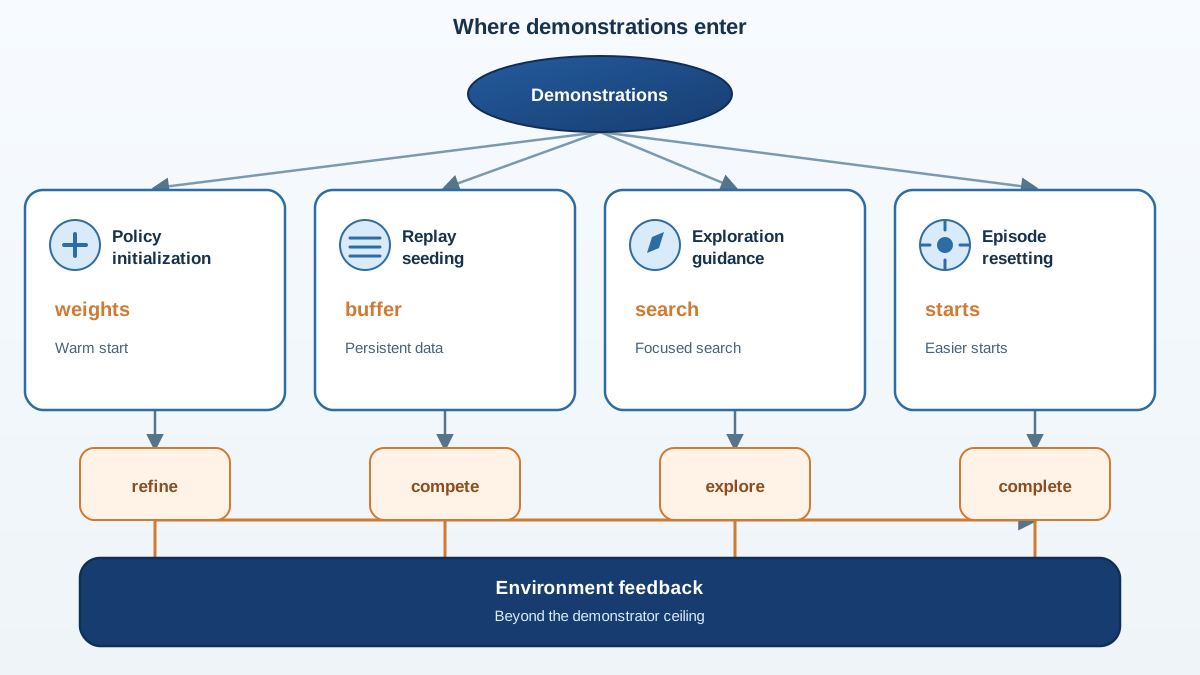
Think of the RL pipeline as a sequence of stages: policy initialization, experience collection, learning updates, and episode starts. Demonstrations can be injected at any of them.
| Entry point | Mechanism | What later RL can fix |
|---|---|---|
| Policy initialization | Pretrain policy or value function on demonstrations | Poor starting distribution, wasted early exploration |
| Replay seeding | Store demonstration transitions in the replay buffer | Suboptimal demonstrated actions, via better agent experience |
| Exploration guidance | Bias where the agent looks or shape the reward | Inefficient search, sparse reward discovery |
| Episode resetting | Start episodes from demonstrated states | Hard exploration problems, rare reward discovery |
The entry point you choose determines the contract between demonstration signal and environment feedback. Initialization says: start here, then learn. Replay seeding says: keep the demonstrations in the loop. Guidance says: use the demonstrator as a compass, not a cage. Resetting says: guarantee the agent reaches task-relevant states.
To see the difference, imagine a sparse-reward navigation task where a demonstrator walks from a fixed start to a goal across a few rooms. The same demonstration can enter your pipeline four ways. Pretraining bakes the demonstrated path into the policy weights. Replay seeding stores each demonstrated transition as a learning example. Guidance nudges the agent toward rooms the demonstrator visited. Resetting drops the agent near the goal and lets it learn backward. Same data, four different mechanisms, four different failure modes.
Knowledge check
Check your understanding
Answer this question before you continue.
Initializing the Policy: A Head Start With a Ceiling
The most common entry point is behavior-cloning pretraining. You train the policy supervised on demonstration state-action pairs, then fine-tune with RL. This gives the policy a useful starting distribution, so early exploration stays task-relevant instead of scattering across irrelevant state-action space.
For policy-gradient methods, this matters enormously. These methods explore through the stochasticity of the policy itself. If the policy starts random, early rollouts visit states that have nothing to do with the task. A good initialization means the agent spends its sample budget refining near-task behavior rather than discovering what the task is.
But initialization only sets the starting point. The pretrained policy is valid near the demonstration support—the region of states the demonstrations actually cover. Outside that region, the policy is arbitrary. And the ceiling depends on whether fine-tuning can move the policy off the demonstrated path.
Here is the failure mode: if fine-tuning is too weak, or the reward too sparse, the agent stays pinned near the demonstrations. It polishes the demonstrated behavior but never escapes it. The policy inherits the demonstrator's ceiling because the RL signal never dominates the initialization.
My rule: treat BC pretraining as a warm start, not a solution. Watch whether the learning curve during fine-tuning actually exceeds the demonstration baseline. If it plateaus at the demonstrator's level, the RL signal is not strong enough to move the policy.
Knowledge check
Check your understanding
Answer this question before you continue.
Seeding the Replay Buffer: Demonstrations as Persistent Data
Off-policy methods offer a different entry point. Instead of using demonstrations once at initialization, you store demonstration transitions directly in the replay buffer alongside agent experience. The agent samples both during learning.
This keeps demonstrations in the loop rather than only at the start. Prioritized replay can weight demonstration transitions heavily early on, then let agent experience dominate as learning progresses. The agent can improve beyond the demonstrator because it keeps learning from its own higher-return experience.
The contrast with BC pretraining is sharp. Pretraining bakes the demonstration policy into the weights; replay seeding keeps demonstration transitions as data that competes with better data. But do not assume the competition resolves itself. A transition's sampling priority is not the same as its trajectory's quality. Demonstration transitions can keep influencing the value function long after better behavior appears, especially if the buffer weights them by TD error or recency rather than by source quality.
The failure mode is over-weighting. If demonstration transitions dominate the buffer for too long, the agent may never escape the demonstrated behavior even when better actions exist. The demonstrations act as a prior that refuses to yield. Replay seeding is persistent influence, not an automatic curriculum from bad to good data.
This approach works cleanly with off-policy algorithms like DDPG or Q-learning variants. It does not fit on-policy methods, which discard old experience by design.
Knowledge check
Check your understanding
Answer this question before you continue.
Guiding Exploration: Demonstrations as a Compass, Not a Cage
A third family of approaches uses demonstrations to shape where the agent looks without forcing what it does. The demonstrator becomes a reference signal during learning, not a target to copy.
The key distinction: guidance constrains the search distribution, not the action distribution. The agent can still take actions the demonstrator never took, but it spends more time in task-relevant regions.
Two common mechanisms:
- Reward shaping from demonstrations. Densify a sparse reward signal by giving partial credit for approaching demonstrated behavior. This can make reward discovery tractable. But a poorly shaped signal can distort the true objective—if the shaping reward rewards imitation itself, the agent may optimize for matching the demonstrator instead of solving the task.
- Support-based switching. Some methods learn when to trust the demonstration signal. The behavior derived from demonstrations is only valid within demonstration support—the states or state-action regions the demonstrations represent. Outside that region, the agent falls back on a broader prior or free exploration. This prevents the agent from following the demonstrator into states where the demonstration signal is meaningless.
The failure mode here is subtle. Shaping rewards that reward imitation can trap the agent at the demonstrator's level. The shaping signal competes with the task reward, and if it is too strong, the agent finds a locally optimal policy that matches the demonstrator but misses the task optimum.
Resetting Episodes From Demonstrated States
The most aggressive entry point changes where episodes begin. Instead of sampling start states from the environment's natural distribution, you initialize episodes from states along the demonstration trajectory.
Backward initialization is the cleanest version: start near the goal, then move earlier along the trajectory as learning progresses. The agent starts each episode close to success, learns to complete that step, then gets pushed further back.
This converts a hard exploration problem into an easier one. The agent never has to discover the goal by chance—it is placed near it.
But the tradeoff is real. The agent may learn a policy that only works from demonstrated start states and fails from states it never visits. Resetting helps sample efficiency by hiding the generalization gap that random starts would expose. You are optimizing the learning curve at the cost of masking coverage problems.
This approach works cleanly in discrete or episodic settings. It is harder to apply in continuous control or non-episodic tasks where "episode start" is not a well-defined concept.
Knowledge check
Check your understanding
Answer this question before you continue.
When Demonstrations Bias the Policy: Quality and Coverage Limits
Every entry point inherits a risk: demonstration quality and coverage can bias the final policy. Three distinct failure modes deserve separate attention.
Suboptimal demonstrations set a low ceiling if the agent cannot escape them. The agent can only improve if later RL finds better returns. If the environment feedback is weak or the demonstrations are over-weighted, the policy converges to the demonstrator's level.
Narrow coverage means the demonstrations only cover part of the state space. The agent must generalize elsewhere—or fail. This is the same coverage problem you know from offline RL, but here the agent can escape it through environment interaction. The question is whether the entry point lets it.
Conflicting or noisy demonstrations inject contradictory signal. Multiple demonstrators may solve the same task differently, or a single demonstrator may be inconsistent. The learning process averages over the conflict, producing a policy that matches no one.
The agent's ability to exceed the demonstrator depends on whether environment feedback can dominate the demonstration signal. Demonstrations help most when they are good enough to guide exploration but not so dominant that they cap the policy.
Choosing an Entry Point: A Practical Decision Rule
Here is the compact framework I use when deciding where demonstrations should enter a pipeline. The deciding criteria are reward availability, demonstrator quality, state coverage, deployment start distribution, and tolerance for off-support exploration.
- Do your demonstration transitions include reward labels, and are you using an off-policy method with a replay buffer? Replay seeding is the natural fit. Demonstrations persist in the learning loop, and agent experience can gradually dominate them—provided you monitor source weighting.
- Are you using on-policy or policy-gradient methods? BC pretraining is the common starting point. Fine-tuning then has to escape the demonstration path—watch whether it does.
- Are rewards sparse but demonstrations good, and does your deployment start distribution match the demonstrated states? Episode resetting or shaping can make reward discovery tractable. If deployment starts differ from demonstrated states, resetting will hide the gap.
- Is your goal to exceed the demonstrator? Prefer entry points that keep environment feedback in the loop. One-shot initialization makes it too easy for the policy to stay pinned near the demonstrations.
- Are demonstrations weak or narrow? Treat them as exploration hints, not targets to imitate. Guidance or resetting will serve you better than pretraining or replay seeding.
Evaluating Whether You Escaped the Demonstrator
A single learning curve will not tell you whether your method worked. Return can rise because the policy genuinely improved, because resets made the task easier, or because shaping rewards changed the objective. Separate those explanations with a small evaluation protocol.
First, measure final task return from the deployment start distribution—not the training distribution. If you used resetting, report both separately. Second, compare against the demonstrator under the original task reward, without shaping bonuses. Third, test on unseen states or perturbations outside demonstration support. A policy that only succeeds from demonstrated starts has not escaped the demonstrator; it has memorized it.
Demonstrations Are a Prior, Not a Target
The entry point you choose determines whether later environment feedback can lift the policy past the demonstrator or only polish the demonstrated behavior. Demonstrations compress the exploration problem; RL provides the escape route from the demonstrator's ceiling. The mistake is treating demonstrations as the destination rather than the starting point.
Pick one entry point for your own setting. Run it. Watch whether the learning curve escapes the demonstration baseline—or stalls at it. Then check whether the improvement survives evaluation from deployment starts and unseen states. That combination will tell you whether your entry point gave environment feedback room to work.
Knowledge check
Final check
Finish the article by checking the ideas you just learned.
References
Research updated Sep 9, 2026


