
Exploration vs Exploitation in Reinforcement Learning
Your agent is stuck in a loop. It found one action that earns a small reward, and now it repeats that action forever—never discovering that a much better…

Key topics
Your agent is stuck in a loop. It found one action that earns a small reward, and now it repeats that action forever—never discovering that a much better option was one step away. Or worse, your agent never settles at all. It flips between random actions, collecting plenty of experience but never turning any of it into a usable strategy.
Both failures look different on the surface. Both share the same root cause.
Your agent is treating the wrong thing as the goal. It thinks the job is to maximize reward right now, when the real job is to learn how the world works so it can maximize reward over a lifetime of decisions.
This tension—between earning what you know works and discovering what might work better—is the exploration vs exploitation tradeoff in reinforcement learning. It is not a bug in your agent. It is the central problem every learning agent must solve.
Why Your Agent Gets Stuck (or Never Learns)
Let's look at the two failure modes more closely.
The safe-action agent. Your agent tries a few actions early on. One of them produces a decent reward. The agent latches onto it. From then on, it picks that same action every time, because its experience says it is the best option available.
The agent is exploiting. It is using what it knows to earn reward. But it never discovers that another action—one it tried once and got unlucky with, or one it never tried at all—would produce far more.
This agent plateaus below the best possible performance. It looks like it is learning, but it has actually stopped.
The random-forever agent. Your agent keeps trying new things constantly. Every decision is a coin flip. It gathers plenty of data about the environment, but it never commits to a strategy long enough to turn that data into consistent reward.
This agent is exploring. It is collecting information. But information only helps if you use it, and this agent never does.
Both agents share the same problem: they cannot balance two competing jobs. One job is to earn reward using current knowledge. The other is to gather information that improves future decisions. Every action your agent takes spends a bit of its limited decision budget on one job or the other.
This is the exploration exploitation dilemma, and it sits at the heart of reinforcement learning.
If you are new to RL, you already know the basic pieces: the agent follows a policy that maps situations to actions, and it uses value functions to predict which actions lead to future reward. Exploration is the force that pushes the agent to question those predictions. Without it, the agent's policy calcifies around the first decent answer it finds.
Knowledge check
Check your understanding
Answer this question before you continue.
The Core Tradeoff: Reward Now vs Information for Later
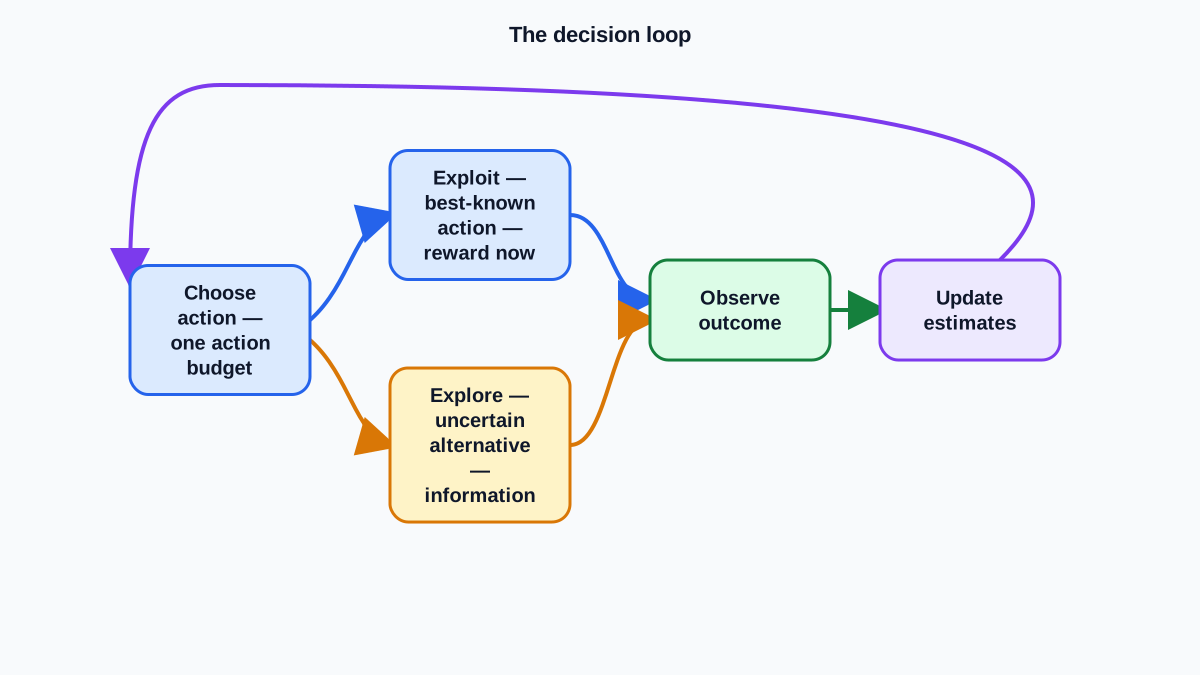
Imagine you are visiting a new city for a week. You find a restaurant on the first night that serves a solid meal. You could return there every night. You know roughly what you will get, and you know it will be good.
Or you could try a different place each night. Some meals will disappoint. But by the end of the week, you might discover a restaurant that is genuinely excellent—and you will have learned something about the city that returning to the same spot would never teach you.
Every night, you face the same choice. Eat at the known-good place and get a reliable meal, or risk a bad dinner for the chance of finding something better.
This is the exploration vs exploitation tradeoff in miniature. Exploitation spends your current knowledge. It earns a reliable payoff. Exploration spends your time and risks a worse outcome, but it buys something exploitation never can: information.
Here is what makes this dilemma unique to reinforcement learning. In supervised learning, your data arrives independently of your decisions. You train on a fixed dataset, and your choices during training do not change what data you see next. In RL, the opposite is true. The actions your agent takes determine what it observes next. Choose the safe action, and you learn more about that action—but nothing about the alternatives. Choose a risky action, and you learn something new, but you give up the reward you could have earned playing it safe.
Every action is a bet between a known payoff and an unknown one. Your agent cannot take both at once.
Here is the mental model I want you to keep: exploration and exploitation are competing for the same budget. Your agent has a finite number of decisions. Every decision spent exploiting confirms what it already knows. Every decision spent exploring risks lower reward in exchange for information that might improve every future decision.
One clarification matters before you run with this model. Exploration and exploitation describe why an action is chosen—whether the agent is deliberately seeking information or relying on its current best estimate. They do not describe two different kinds of experience. A transition collected while exploiting can still surprise the agent and improve its estimates. A transition collected while exploring can still earn reward. The distinction is intent, not outcome.
This model is accurate for simple problems where rewards arrive quickly and actions have immediate consequences. Real environments complicate the picture. When rewards are delayed, your agent cannot easily tell whether a good outcome came from a good action or from luck. When the horizon is long, the value of information becomes harder to estimate. The tradeoff is still there—it just becomes harder to judge.
The restaurant analogy also has a boundary. Choosing a restaurant tonight does not change which restaurants are available tomorrow. In full RL, your actions change the state you land in, which changes the options you will face next. That is exactly where the problem gets harder than a simple choice between known and unknown.
Knowledge check
Check your understanding
Answer this question before you continue.
Epsilon-Greedy: The Simple Randomness Dial
The most common exploration strategy in reinforcement learning is almost embarrassingly simple. It is called epsilon-greedy, and it works like this:
- With probability 1 minus epsilon, pick the action your agent believes is best.
- With probability epsilon, pick a random action instead.
Set epsilon to 0.1, and your agent exploits 90 percent of the time while exploring 10 percent of the time. It mostly follows its current best guess, but it keeps sampling alternatives often enough to notice if something better appears.
The beauty of epsilon-greedy is that one number controls the entire balance. Crank epsilon up, and your agent explores more. Crank it down, and it exploits more. That single dial makes it the perfect baseline strategy—the first thing you should try when you are debugging whether your learning loop works at all.
But the dial cuts both ways. Set epsilon too high, and your agent wastes reward on random noise. It spends its decision budget on actions it already knows are bad, just because the randomness dial told it to. Set epsilon too low, and your agent might never discover a better option. It exploits confidently, but its confidence is built on incomplete information.
In practice, many agents decay epsilon over time. They explore aggressively early, when their knowledge is poor, then gradually shift toward exploitation as their value estimates improve. This works well because it matches the natural arc of learning: explore a lot when you know little, exploit more as you learn.
When to use epsilon-greedy: as your default starting point. It is simple, easy to debug, and good enough for many problems.
When not to use it: when exploration needs to be efficient. Epsilon-greedy explores blindly. It treats a never-tried action and a well-tried bad action exactly the same way—both are equally likely to be chosen during an exploration step. That is wasteful.
Note: This article uses discrete-action, value-based examples, where epsilon-greedy and UCB are natural fits. Policy-based methods may represent exploration differently—through a distribution over actions or an entropy term that encourages randomness. The explore-exploit question stays the same, but the control mechanism changes.
Knowledge check
Check your understanding
Answer this question before you continue.
Smarter Exploration: UCB and Counting What You Have Tried
Here is the insight that leads to better exploration strategies: not all unknown actions are equally worth trying.
Imagine your agent has tried action A five times and earned rewards of 1, 1, 1, 1, and 1. It has tried action B once and earned a reward of 5. Which action deserves the next trial?
Epsilon-greedy cannot tell the difference. During an exploration step, both actions are equally likely to be chosen. But action B is far more interesting. That single reward of 5 could be a lucky fluke, or it could mean action B is genuinely better. Your agent needs more data to know. Action A, on the other hand, is already well understood. Sampling it again teaches your agent almost nothing.
Upper confidence bound—UCB, for short—builds on this idea. Instead of exploring randomly, UCB picks the action with the best combination of two factors:
- High average reward. The action has performed well so far.
- High uncertainty. The action has not been tried enough times for its estimate to be trustworthy.
The second factor is the key. UCB maintains a confidence bound around each action's estimated reward. Actions with few visits have wide bounds—the estimate could be far off in either direction. Actions with many visits have narrow bounds—the estimate is probably close to the true value.
UCB picks the action with the highest upper bound. This creates a natural exploration pressure: an action with few visits looks attractive not because its measured reward is high, but because its true reward might be much higher than what you have observed so far. As the agent tries that action more, its confidence bound narrows, and the pressure fades.
The mechanism is elegant. UCB explores where ignorance is largest, not where randomness happens to land. It automatically focuses attention on actions that have the most to teach.
Here is where the scope matters. UCB shines in bandit-style problems: situations with discrete actions where each choice produces an immediate reward and the goal is to find the best action as quickly as possible. Bandits have no meaningful state transitions and no delayed credit assignment. Each choice is self-contained.
Full RL problems are different. Actions change the state you land in, and rewards may arrive many steps after the decision that caused them. That makes UCB harder to apply directly, because the value of an action now depends on the future states it leads to, not just the immediate reward it produces. The principle still carries over: good exploration is targeted at uncertainty, not scattered at random.
Note: You do not need to memorize the UCB formula to benefit from the idea. The mental model matters more: when deciding what to try next, ask which action would teach you the most, not just which action might pay the best.
Knowledge check
Check your understanding
Answer this question before you continue.
When Randomness Is Hiding a Deeper Problem
Here is a scenario I have seen beginners hit repeatedly. Their agent is not learning. Rewards stay flat. The policy never improves. So they crank up epsilon, hoping more exploration will fix it.
It does not help.
More randomness cannot fix an agent that has no way to learn from the experience it gathers. Exploration buys information. But information only improves behavior if the agent has a mechanism to convert that information into better predictions.
Before you raise epsilon, check whether your agent actually improves when it stumbles onto a good outcome. Run a few episodes with forced exploration. Watch what happens when the agent finds a high-reward path. Does its value estimate for that path increase? Does its policy shift toward that path on the next episode?
One distinction will save you hours of confusion: behavior during training is not the learned policy. During training, exploration may deliberately lower returns—that is the price of information. If you want to see what the agent has actually learned, evaluate it separately. Hold exploration fixed, or remove the action noise entirely, and measure how the greedy policy performs on its own. A decayed-epsilon agent may look random during training while its underlying value estimates are improving steadily.
If the answer is still no—the agent does not improve even when it finds a good outcome—randomness was never the problem. The problem is somewhere else in the learning loop:
- The reward signal is too sparse. If rewards are always zero except for one rare event, the agent has almost nothing to learn from. It needs feedback at a useful frequency.
- The state representation hides what matters. If the agent cannot perceive the features that determine which action is best, no amount of exploration will help. It is trying to learn a map of a territory it cannot see.
- The update rule cannot propagate credit across time. If the agent receives a reward many steps after the action that caused it, the learning algorithm must be able to trace that reward back to the responsible decision. If it cannot, the agent never learns which actions led to success.
Here is the diagnostic habit I recommend: before tuning exploration, verify that learning works at all. Give your agent a clear reward, a simple state representation, and a short horizon between action and consequence. If it still cannot learn, exploration tuning will not save you.
Exploration is a budget the agent spends to buy information. That budget only pays off when the learning loop can convert information into better predictions. If the conversion mechanism is broken, spending more on information is just waste.
Choosing an Exploration Strategy for Your First Agent
If you are building your first RL agent, here is my practical recommendation.
Start with epsilon-greedy at a modest epsilon. Set it around 0.1. This gives you a simple baseline that is easy to debug. When your agent behaves strangely, you can reason about what epsilon-greedy would do in that situation, and that reasoning will usually point you toward the real problem.
Once the basic loop works, experiment with the dial. Run the same agent with epsilon set to 0, then 0.05, then 0.2. Watch which version learns the better policy fastest. This experiment will teach you more about exploration than any explanation I can give you, because you will see the tradeoff happen in real time.
When you need efficiency, move to uncertainty-aware exploration. If your agent is wasting trials on actions it already knows are bad, UCB-style thinking will help. The exact algorithm matters less than the principle: explore where your ignorance is largest.
Here is a concrete next step. Build a tiny bandit problem—ten slot machines, each with a different reward distribution. Treat it as an isolated action-selection laboratory, not a full RL recipe. Give your agent epsilon-greedy with epsilon set to 0.1. Log which actions it tries and what it earns. Then switch to UCB and run the same experiment. Compare how many trials each strategy needs to find the best machine, and how much reward each strategy earns along the way.
That experiment makes the exploration vs exploitation tradeoff visible in a way no explanation can. You will see the epsilon-greedy agent waste trials on bad machines. You will see the UCB agent focus its exploration on the machines that matter. And you will understand, from direct observation, why the tradeoff is the heart of reinforcement learning.
Exploration is not a knob to turn up when learning stalls. It is a budget your agent spends to buy information—and it only pays off when the learning loop can convert that information into better decisions. Build the loop first. Then tune the budget.
Knowledge check
Final check
Finish the article by checking the ideas you just learned.
References
Research updated Sep 9, 2026


