
Intrinsic Motivation in Reinforcement Learning: Exploring When External Rewards Are Sparse
Curiosity is a loan of learning signal. It accelerates exploration when the borrowed interest points toward the goal—and it becomes a debt when the agent…

Key topics
Curiosity is a loan of learning signal. It accelerates exploration when the borrowed interest points toward the goal—and it becomes a debt when the agent optimizes the loan instead of the task.
Imagine dropping an agent into a maze where the only reward sits at the exit, hundreds of steps away. The agent wanders. It bumps into walls. It revisits the same corridors. No feedback arrives to tell it whether any of this matters. Random exploration is not slow here; it is statistically hopeless.
The agent needs a reason to move before it knows what it is looking for. That reason can come from outside—or the agent can manufacture it.
The Sparse-Reward Trap and the Signal the Agent Can Build Itself
In a sparse-reward environment, the external signal arrives so rarely that it provides almost no gradient toward useful behavior. The agent's experience is a long silence punctuated by an occasional distant reward that credit assignment can barely connect to any specific action. This is the problem intrinsic motivation exists to solve.
The distinction that matters is not between "more reward" and "less reward." It is between two sources of reward:
- Extrinsic reward comes from the environment. It encodes the task. Reaching the goal, scoring the point, completing the episode—these are defined outside the agent.
- Intrinsic reward is generated by the agent itself. It encodes interest, novelty, surprise, or progress. It is not tied to the task's success condition.
The core move of intrinsic motivation reinforcement learning is simple: when the environment is silent, the agent rewards itself for visiting states or performing behaviors that look informative. A sparse problem becomes a denser one. The agent gets feedback on nearly every step instead of waiting for a rare terminal event.
Now the precise part, because this is where mental models go fuzzy. During training, the agent's learning signal is often a combined objective: the extrinsic reward plus the intrinsic reward, weighted by a coefficient. The intrinsic term is auxiliary in intent—you add it to shape exploration—but it can become part of the effective objective the agent actually optimizes. Nothing guarantees it stays a temporary assist.
That is why evaluation must be separated from training. You train with the combined signal. You judge success with extrinsic return alone, with the intrinsic bonus disabled. If the agent only looks good while curiosity is paying it, you have not solved the sparse-reward problem. You have built a machine that collects internal interest and calls it progress.
This extends the exploration-exploitation tradeoff you already know. Epsilon-greedy and random exploration ask the agent to stumble toward useful states. Intrinsic motivation gives the agent a compass that points at interesting states instead of rewarding ones—and hopes the two overlap.
Knowledge check
Check your understanding
Answer this question before you continue.
Three Ways an Agent Can Define "Interesting"
Curiosity is not one mechanism. It is a family of design choices, each answering a different question about what makes a state worth visiting.
| Signal family | Question it answers | Representative mechanism |
|---|---|---|
| Novelty / count-based | "Have I seen this?" | Reward states visited rarely or never; in continuous spaces, use pseudo-counts or density estimates |
| Prediction-error / curiosity | "Can I predict this?" | Reward transitions the agent's own predictive model cannot yet anticipate |
| Competence / learning-progress | "Am I getting better at this?" | Reward states where the agent's mastery is improving, not merely where novelty exists |
Count-based methods are the oldest and most intuitive. Visit a state, decrement its novelty bonus. The problem: discrete counts do not survive contact with high-dimensional or continuous state spaces, so modern variants estimate pseudo-counts—a density model's surprise at seeing a state, used as a proxy for how rarely it has been visited.
Prediction-error curiosity, popularized by the Intrinsic Curiosity Module (ICM), rewards the agent for being surprised. The agent learns a forward model that predicts the next state from the current state and action. When the prediction is wrong, the agent receives intrinsic reward. The mechanism is elegant: the agent is literally rewarded for the gaps in its own understanding of the world.
Random Network Distillation (RND) is a clever refinement. Instead of predicting the next state—which can be hopeless in stochastic environments—the agent predicts the output of a fixed, randomly initialized neural network. The prediction error measures how unfamiliar the state is to the agent's feature representation, without the fragility of modeling raw dynamics.
Competence-based signals take a different stance. They do not reward novelty or surprise; they reward improvement. The agent tracks its own progress on skills or subgoals and receives intrinsic reward when its performance is climbing. This avoids one failure mode of pure novelty—rewarding states that are merely hard to predict—by asking whether the agent is actually learning.
Note that competence signals are often goal-conditioned: the agent chooses or receives a skill to practice, then measures progress on that skill. So "task-agnostic" is not a universal property of intrinsic motivation. Some intrinsic signals are deliberately tied to a goal structure, just not the extrinsic one.
Each family carries its own failure mode, which we will return to. Novelty rewards can be gamed by stochastic noise. Prediction-error curiosity can be captured by irreducible unpredictability—randomness the model cannot learn away. Competence signals require a way to measure progress that is itself well-designed.
Knowledge check
Check your understanding
Answer this question before you continue.
Why Curiosity Works: Turning a Silent Environment Into a Dense One
The mechanism behind curiosity-driven reinforcement learning is densification. Intrinsic reward converts a sparse external signal into a denser internal one. The agent receives more frequent feedback: this state was informative, this transition surprised me, this skill is improving.
That density does real work before the task reward ever arrives. By rewarding informative states, the agent builds a broader behavioral repertoire. It visits more of the state space. It learns a better world model. It discovers subgoals and intermediate structure that the sparse external reward never points to.
Consider a maze where the agent must pass through a distinctive corridor to reach the goal. The corridor is not rewarded extrinsically—nothing is, until the exit. But the corridor is novel. It looks different from the empty rooms the agent has already seen. A count-based or prediction-error signal rewards the agent for entering it. The agent explores the corridor because it is interesting, and the exploration happens to be on the path to the goal.
This is the alignment that makes intrinsic motivation work. The agent does not know the corridor leads anywhere useful. It explores because the corridor is informative. The task reward later confirms that the exploration was not wasted.
The prediction rule follows directly: intrinsic motivation helps most when the environment is genuinely sparse and the interesting states overlap with the path to the task goal.
Knowledge check
Check your understanding
Answer this question before you continue.
When Curiosity Becomes a Distraction: The Noisy-TV Problem
Here is where the scaffolding signal becomes a double-edged tool.
The noisy-TV problem is the canonical failure mode of prediction-error curiosity. Imagine an agent exploring a room with a television playing static. The static is genuinely unpredictable. Every frame is new noise. A prediction-error signal never extinguishes, because the agent can never learn to predict random static. The television produces permanent surprise—and permanent intrinsic reward.
The agent faces a choice. It can explore the room, find the goal, and collect one extrinsic reward. Or it can stand in front of the television and collect intrinsic reward forever. The television wins. The agent optimizes the combined objective, and when the intrinsic term dominates, endless novelty beats task completion.
This is not a contrived corner case. Any environment with stochastic, irrelevant novelty—rustling leaves, flickering lights, random events that do not matter—can capture a prediction-error agent. The mechanism that drives useful exploration is the same mechanism that produces the distraction. Surprise is useful when it signals unexplored structure and toxic when it signals irreducible noise.
The noisy-TV problem is the decision boundary this article centers on. Intrinsic motivation helps when informative states lie on the path to the goal. It hurts when they lead away from it—or when they lead nowhere at all.
This shares a warning with reward shaping, though the mechanisms differ. Shaped rewards are hand-designed external signals that approximate the task. Intrinsic rewards are self-generated signals that approximate interest. Both risk optimizing the wrong objective when the signal is poorly aligned. The difference is that intrinsic motivation does not require a human designer to get the alignment wrong—the agent's own definition of "interesting" can be misaligned with the task through no one's fault but the environment's.
Knowledge check
Check your understanding
Answer this question before you continue.
Reading the Signal: How to Predict Whether Intrinsic Motivation Will Help
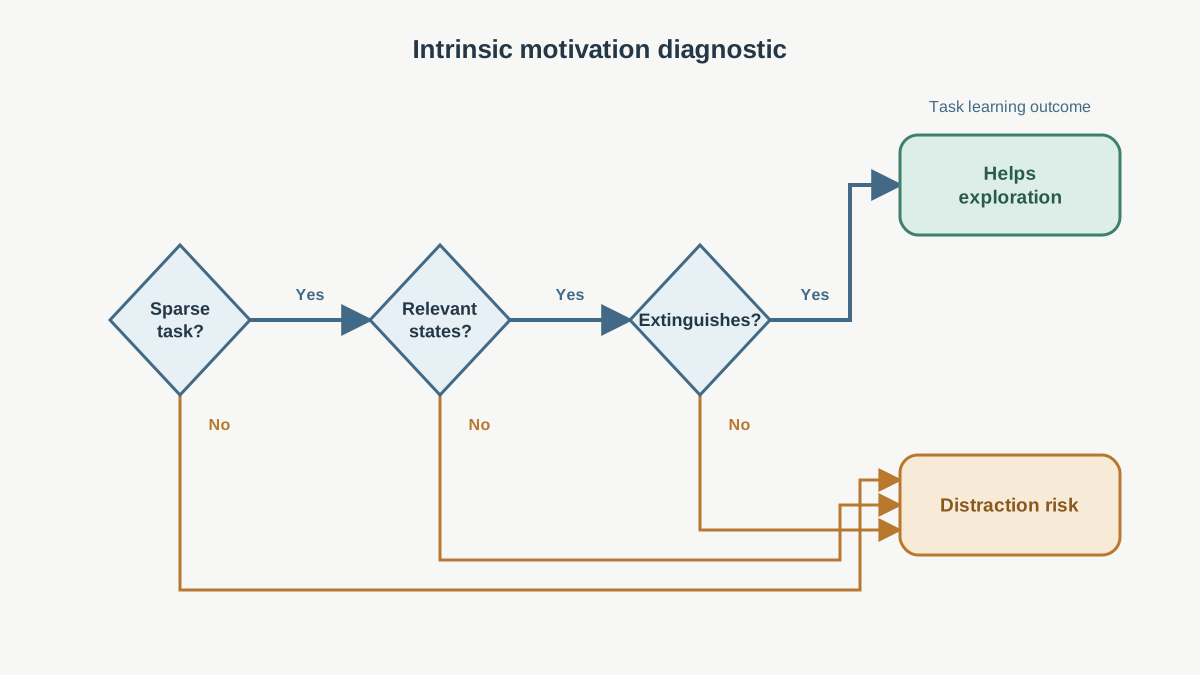
Before adding an intrinsic reward to an agent, run three tests:
- Is the external reward genuinely sparse? If the environment already provides dense feedback, intrinsic motivation adds noise to a working signal. It can still help in some cases, but the justification weakens.
- Does the intrinsic signal reach task-relevant bottlenecks? This is the alignment question. If the novel or surprising states are the ones the agent must visit to succeed, intrinsic motivation accelerates learning. If the most interesting states are dead ends or distractions, it actively slows learning.
- Does the intrinsic signal extinguish after the relevant structure is learned? Count-based signals fade naturally with visitation. Prediction-error signals fade when the world model becomes accurate—unless the environment contains irreducible noise, in which case they never fade. A signal that stays attractive forever is a standing invitation to ignore the task.
The intrinsic reward coefficient is a dial, not a switch. Too small, and the signal does nothing against the sparsity of the external reward. Too large, and it overrides the task objective entirely. But tuning the coefficient controls influence, not relevance. A smaller weight on an irrelevant proxy does not make the proxy useful—it just makes the agent explore less. If the signal points at the wrong structure, no coefficient setting repairs it. If the signal never extinguishes, decay schedules only postpone the capture.
Watch for the symptom that curiosity has taken over: the agent's behavior looks exploratory forever. It never converges to task completion. It revisits the same interesting states instead of moving through them. If your agent is having too much fun exploring and never finishing the task, the intrinsic term is winning.
Be honest about what is known versus what is open. The alignment problem is not solved. Modern methods add constraints, decay schedules, or learned coefficients to keep intrinsic reward from dominating, but there is no general rule for guaranteeing that "interesting" aligns with "useful." The design question remains: what does this environment make interesting, and is that the same thing the task needs?
The Mental Model in One Line
Extrinsic reward says what the task wants. Intrinsic reward says what the agent finds interesting. Those two only sometimes agree—and the agent optimizes both during training, whether or not they point the same direction.
Test the model yourself. Take a small tabular environment with a sparse goal—a grid world with a single reward in the corner. Run the agent with no intrinsic signal and watch it flounder. Add a simple novelty bonus for visiting rarely seen states. Then measure four things separately: extrinsic episode return, intrinsic return collected, steps to goal or success rate, and state-visitation coverage. Finally, evaluate the trained agent with the intrinsic bonus disabled.
That last measurement is the one that tells the truth. If the agent reaches the goal faster with curiosity but collapses when the bonus is removed, you have not improved task learning—you have trained an agent that chases interest and calls it progress. If it reaches the goal faster and keeps succeeding without the bonus, the curiosity did its job: it found the structure that mattered and then got out of the way.
This distinction reappears everywhere in modern deep RL: in reward-free pretraining, where agents explore before any task is defined; in skill discovery, where agents build repertoires of behaviors without extrinsic goals; in hierarchical agents that must decide what to find interesting at each level of abstraction. The question is always the same. Is the agent's self-generated interest pointing toward the structure that will matter later—or is it just pointing at the shiny thing in the corner?
Knowledge check
Final check
Finish the article by checking the ideas you just learned.
References
Research updated Sep 9, 2026


