
Exploration Bonuses in RL: Count, Novelty, Prediction Error, and Uncertainty
Epsilon-greedy exploration is randomness without a reason. An exploration bonus is randomness with a budget and a purpose: it changes the reward signal…

Key topics
Epsilon-greedy exploration is randomness without a reason. An exploration bonus is randomness with a budget and a purpose: it changes the reward signal itself so the agent learns to seek out the experiences that reduce its ignorance. The real design question is not how much noise to inject, but what information the bonus should pay for.
Why Randomness Is Not Exploration
If you have worked with epsilon-greedy exploration, you already know its limitation: it selects random actions with probability epsilon, regardless of whether those actions lead anywhere useful. The agent stumbles into new states by accident, not by intent. It has no notion of which states are worth visiting, which gaps in its knowledge matter, or whether it has already seen everything the environment has to offer.
An exploration bonus changes the reward itself. Instead of hoping random noise produces useful discoveries, the agent learns to seek out states that reduce its ignorance. The unifying shape is simple:
total reward = extrinsic reward + beta * intrinsic bonus
The extrinsic reward comes from the environment and encodes the task. The intrinsic bonus is generated by the agent itself, and beta is a hyperparameter that balances exploitation against exploration. When beta is too small, the bonus barely influences behavior. When it is too large, the agent abandons the task entirely and chases the bonus signal forever.
The deeper point is that every exploration bonus is a bet. It encodes a claim about which measurable property of experience—visitation frequency, novelty, surprise, or uncertainty—correlates with task-relevant discovery. The bonus family you choose determines what the agent pays to acquire, and each family fails in a characteristic way when its central bet is wrong.
The Signal Behind Every Bonus
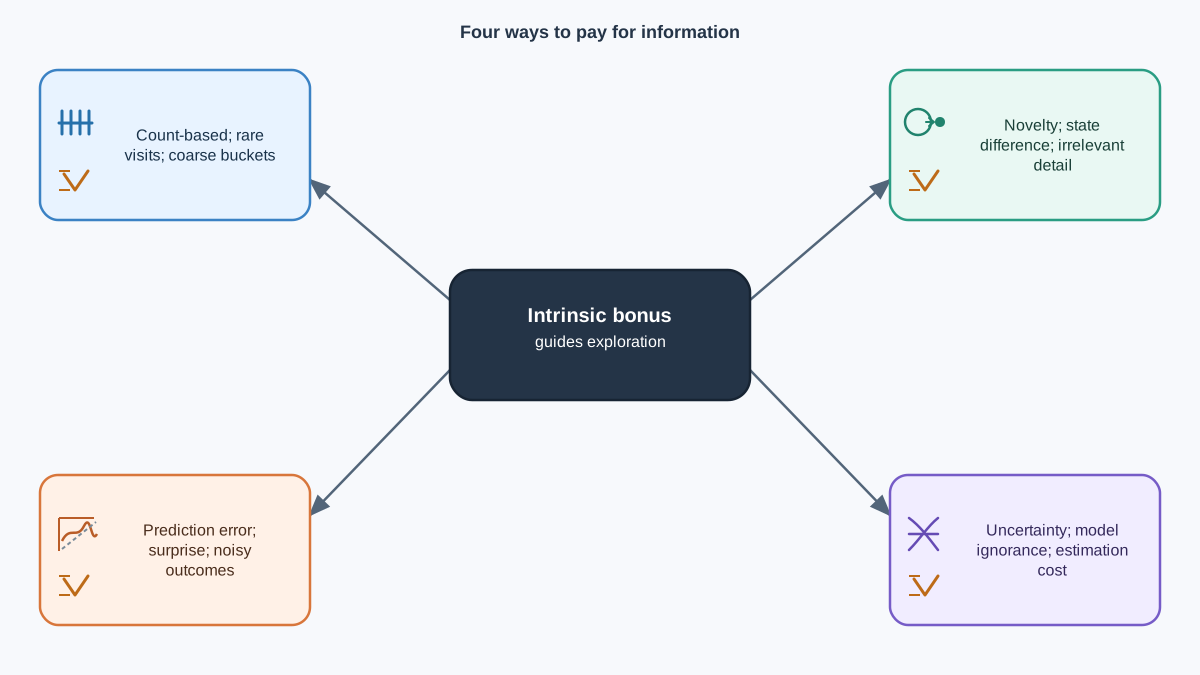
Before comparing methods, name the signal each one rewards. That signal is the diagnostic handle for predicting behavior and failure.
- Count-based bonuses reward visitation frequency. A state or state-action pair that has been visited rarely is worth more than one visited often.
- Novelty bonuses reward distance from what the agent has already seen. They generalize counts to continuous spaces by replacing exact tallies with a learned notion of "seen before."
- Prediction-error bonuses reward surprise. The agent learns a model of environment dynamics and receives a bonus proportional to how wrong that model is about the next state.
- Uncertainty bonuses reward epistemic ignorance. The agent gets a bonus for visiting states where it is unsure about its own model, not merely where the model is currently wrong.
These four signals form a progression. Counts are the most direct measure of ignorance but require enumerable states. Novelty relaxes that requirement by measuring difference instead of frequency. Prediction error measures model failure rather than model ignorance. Uncertainty targets the distinction between the two.
Knowledge check
Check your understanding
Answer this question before you continue.
Count-Based Bonuses: The Tabular Baseline
Count-based exploration is the simplest and most interpretable bonus family. The canonical form rewards states or state-action pairs in inverse proportion to their visit count:
bonus(s, a) = N(s, a)^(-1/2)
A state visited once is far less known than one visited a thousand times, so the bonus shrinks as experience accumulates. This is not an arbitrary heuristic. Counts are a direct measure of epistemic uncertainty, and count-based bonuses have clean theoretical guarantees in tabular settings, including optimism-based regret bounds. That theoretical grounding is why count-based methods anchor the exploration literature even when they are no longer the practical choice.
The failure mode is equally clear: exact counts require enumerating states. In a tabular environment with a few dozen states, counting works perfectly. In a continuous state space, or a high-dimensional observation space like raw pixels, the agent can never visit the same state twice, so every state has a count of one and the bonus never decays.
Pseudo-counts and hashing approximate counts in high dimensions. The idea is to compress states into a finite set of buckets and count visits to buckets instead of states. SimHash, for example, projects states into a binary code and counts collisions. But every discretization inherits the same problem: if the hash buckets are too coarse, distinct states collapse together and the bonus loses resolution; if they are too fine, the agent never revisits a bucket and the bonus never decays.
Knowledge check
Check your understanding
Answer this question before you continue.
Novelty Bonuses: Generalizing Counts to Continuous Space
Novelty methods replace exact counts with a learned notion of "seen before." Instead of asking how many times has this state been visited, they ask how different is this state from everything the agent has already experienced.
The canonical example is Random Network Distillation (RND). A fixed random network maps states to outputs, and a trained predictor network attempts to match those outputs. For states the agent has visited frequently, the predictor learns to mimic the random network closely. For novel states, the predictor fails, and the prediction error becomes the novelty bonus.
The hidden assumption is the representation space. Novelty is only meaningful in the space where you measure distance. If the representation collapses task-relevant differences, the agent cannot distinguish useful novelty from irrelevant variation. If the representation preserves too much irrelevant detail, the agent gets rewarded for wandering into regions that have nothing to do with the task.
This is the characteristic failure mode of novelty bonuses: they reward states that are merely different, not states that matter. An agent exploring a room with a television playing static will find every frame of static novel, because each frame is genuinely different from the last. The agent collects reward forever without ever learning anything about the task. Novelty trades the exactness of counts for scalability, and the price is that "different" is a much weaker signal than "unknown."
Knowledge check
Check your understanding
Answer this question before you continue.
Prediction-Error Bonuses: Curiosity as Surprise
Prediction-error bonuses operationalize curiosity in its most literal form: the agent pays to be surprised. It learns a forward model that predicts the next state given the current state and action, and receives a bonus proportional to the prediction error:
bonus(s, a, s') = distance(predicted_next_state, actual_next_state)
As the model improves, prediction error drops, and the bonus naturally decays. The agent explores the environment, learns its dynamics, and gradually loses interest as the world becomes predictable.
The problem is that prediction error conflates two very different kinds of ignorance. Epistemic uncertainty is ignorance the agent can resolve by collecting more data—the layout of a maze, the effect of an action, the location of a goal. Aleatoric uncertainty is irreducible noise—the randomness of a slot machine, the static on a television, the stochasticity of a windy day.
Prediction-error bonuses cannot tell the difference. A stochastic transition produces permanent prediction error, because no model can predict noise. The agent fixates on the noisy element forever, collecting surprise bonuses that never decay, while the actual task goes unlearned. This is the noisy-TV problem, and it is the defining pathology of curiosity-driven exploration.
The bonus decays naturally only when the environment is actually learnable. If the environment contains irreducible stochasticity, prediction error becomes a permanent reward signal that actively competes with the task.
Knowledge check
Check your understanding
Answer this question before you continue.
Uncertainty Bonuses: Paying for Ignorance, Not Surprise
Uncertainty bonuses fix the noisy-TV problem by changing what the agent pays for. Instead of rewarding states where the model is wrong, they reward states where the agent is unsure about its own model.
The distinction is subtle but decisive. Surprise can be permanent—noise never becomes predictable. Ignorance shrinks as the agent learns. An information-gain formulation rewards the expected reduction in model uncertainty, which means the bonus converges to zero once the environment is well understood, even if the environment is deeply stochastic.
This is the family with the strongest theoretical grounding for aligning exploration with genuine knowledge gaps. Information-gain bonuses have formal guarantees that they signal epistemic information and decay appropriately, which is why they are the principled choice when you can afford them.
The cost is practical. Estimating model uncertainty requires machinery that most exploration methods avoid: ensembles of models whose disagreement estimates uncertainty, Bayesian neural networks, or variational approximations. Each of these adds computational overhead and training complexity. Uncertainty bonuses are the most principled family and the most expensive to implement.
Choosing a Bonus: What Are You Paying For?
The decision rule for selecting an exploration bonus is simple to state and hard to apply: name the signal the bonus pays for, then ask whether that signal correlates with progress in your environment.
| Bonus family | What it measures | Key assumption | Canonical method | Characteristic failure |
|---|---|---|---|---|
| Count-based | Visitation frequency | States are enumerable | MBIE-EB, pseudo-counts | Breaks in continuous or high-dimensional spaces |
| Novelty | Distance from seen states | Difference implies unknown | RND, SimHash | Rewards irrelevant variety |
| Prediction error | Model surprise | Environment is learnable | ICM, curiosity-driven | Fixates on irreducible noise |
| Uncertainty | Model ignorance | Uncertainty is estimable | Information gain, ensembles | Expensive to compute |
Counts and novelty reward "not seen before." They work when task-relevant states are rare and the state space is mostly empty of distraction. They waste effort when the environment is full of irrelevant variety, because the agent collects novelty rewards without approaching the task.
Prediction error rewards "could not predict." It works in deterministic environments where surprise reliably indicates a gap in the model. It is pathological under stochastic noise, because the noise generates permanent surprise that never resolves.
Uncertainty rewards "do not know yet." It is the most principled signal, but it requires machinery that may be overkill for your problem.
My practical rule: start with the simplest bonus whose failure mode your environment does not trigger. If your state space is small enough for counts, count. If your environment is deterministic, prediction error is a reasonable first attempt. If your environment is stochastic and high-dimensional, you likely need uncertainty-based methods or a novelty approach with a carefully chosen representation.
Common Mistakes When Tuning Exploration Bonuses
Even a well-chosen bonus family fails when the implementation is sloppy. These are the recurring operational errors I see.
Treating beta as a fixed constant. The optimal balance between extrinsic and intrinsic reward changes as the agent matures. Early in training, a large bonus drives useful exploration. Later, the same bonus keeps the agent chasing novelty instead of exploiting what it has learned. A decay schedule for beta often matters more than the initial value.
Assuming transfer across environments. A bonus that works on a deterministic grid world can fail catastrophically in a stochastic version of the same task. Noise structure, state-space dimensionality, and representation quality all change which signal is useful. Re-tune from scratch when the environment changes.
Confusing diversity with discovery. A bonus that produces varied behavior is not necessarily producing task-relevant behavior. The agent may be thoroughly exploring an irrelevant corner of the state space. Measure whether exploration actually leads to extrinsic reward, not whether the agent's trajectory looks interesting.
Ignoring the representation. Novelty and prediction error are only as good as the feature space where they are measured. A poor encoder can make the agent blind to task-relevant differences or hypersensitive to irrelevant ones. Debug the representation before debugging the bonus.
Misdiagnosing the problem. A stuck agent is not always an exploration problem. Sparse rewards, poor credit assignment, and weak state representations can all produce the same symptom: the agent never reaches the goal. Before adding an exploration bonus, verify that the agent's value estimates are actually learning and that the reward signal is reaching the decisions that matter.
The One-Sentence Test
Before adding any exploration bonus, write down one sentence: this bonus rewards [specific signal], which should lead to task success because [reason].
If you cannot write that sentence, the bonus is probably rewarding the wrong thing. If the sentence reveals that your bonus rewards difference rather than knowledge, or surprise rather than resolvable ignorance, you have already predicted the failure mode.
Run a small experiment. Watch which states the agent actually seeks out. Compare that behavior to the states you know matter for the task. The gap between the two is the real measure of whether your exploration bonus is doing useful work—or just keeping the agent busy.
Knowledge check
Final check
Finish the article by checking the ideas you just learned.
References
Research updated Sep 9, 2026


