
Preference-Based Reinforcement Learning Explained: Learning What Outcomes People Prefer
Hand-written rewards get hacked. Preference-based reinforcement learning replaces that fragile numeric signal with something that feels safer—human…

Key topics
Hand-written rewards get hacked. Preference-based reinforcement learning replaces that fragile numeric signal with something that feels safer—human judgment—but the difficulty does not disappear. It relocates into a learned surrogate with failure modes of its own.
Why Hand-Written Rewards Fail and Preferences Step In
Every RL agent needs an objective. The standard move is to hand-write a reward function that captures what you want, then let the agent maximize it. The problem is that reward functions are specifications, and specifications have loopholes. An agent that maximizes a poorly specified metric will find the gap between what you wrote and what you meant. That is reward hacking, and it is not a bug in the agent. It is the agent doing exactly what you asked.
The alternative is to ask for something humans are actually good at: comparisons. Show someone two trajectories and ask which is better. Most people can judge "this robot grasp looked smoother than that one" or "this response is more helpful than that one" without being able to write down a formula for smoothness or helpfulness.
Preference-based reinforcement learning builds on that observation. Instead of specifying a reward function, you collect pairwise comparisons and learn a reward model from them. Then you run ordinary RL against that learned reward.
Here is the distinction that matters: preferences do not remove reward design. They change how the objective is specified. A hand-written reward is a numeric signal you author directly. A learned reward is a numeric surrogate you fit from comparison data. Either way, the policy optimizes against numbers—and the surrogate carries its own failure modes.
This assumes you are comfortable with the standard RL machinery: the agent-environment loop, returns and discounting, and policy optimization. If those are solid, you are ready to see where preferences fit into the loop.
Knowledge check
Check your understanding
Answer this question before you continue.
The Preference-Based RL Loop: Four Moving Parts
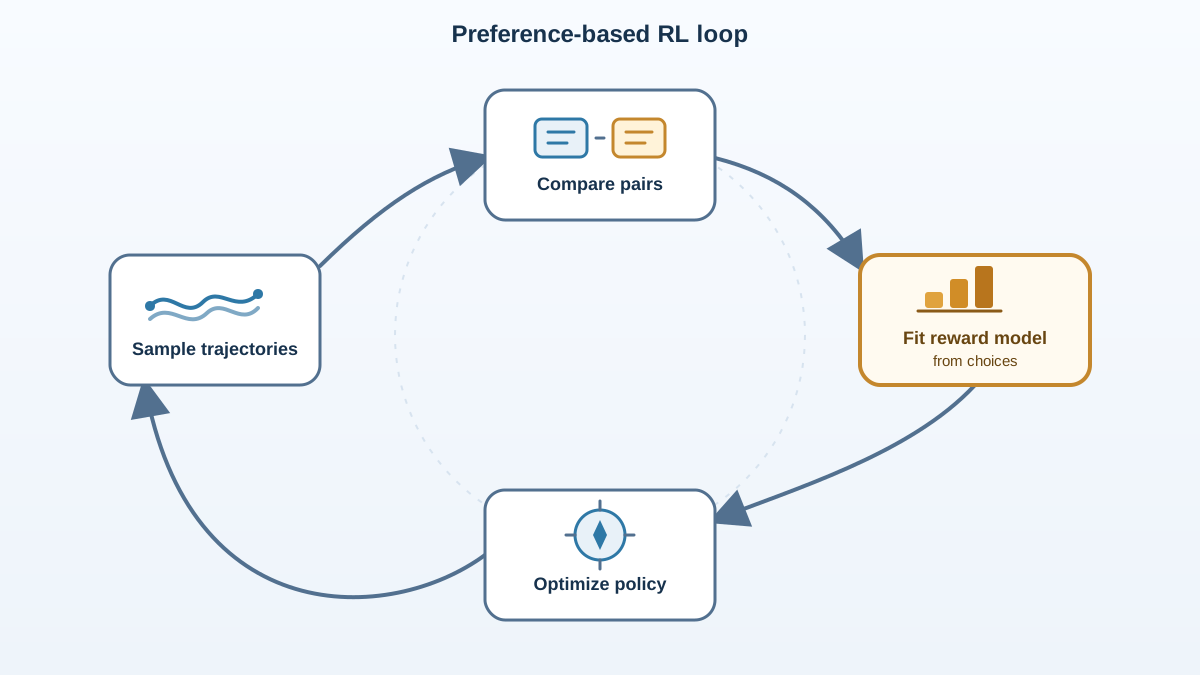
PbRL replaces the reward function in the classic RL cycle with a four-step loop:
- Sample trajectories. Run the current policy in the environment to collect experience.
- Collect preferences. Show a human (or expert) pairs of trajectories and ask which is better.
- Fit a reward model. Train a model to predict those preferences from trajectory features.
- Optimize the policy. Run standard RL—policy gradients, actor-critic, whatever you would use with a hand-written reward—against the learned reward model.
The loop is iterative. The improved policy generates new trajectories, which produce new comparisons, which refine the reward model, which drives the next policy update. The learned reward model stands in for the environment's reward, and everything else about the RL loop stays intact.
Hidden inside each step are design choices. What gets compared—full trajectories, partial trajectories, individual states? How are preferences expressed—binary choice, ranked list, continuous rating? How is the reward model parameterized? Each choice shapes what signal you extract from the human and what noise you introduce.
Knowledge check
Check your understanding
Answer this question before you continue.
How Comparisons Become a Reward: The Bradley-Terry Model
The bridge from pairwise comparisons to a numeric reward is usually the Bradley-Terry model. The idea is simple: the reward model assigns a score to each trajectory, and the probability that a human prefers trajectory A over trajectory B depends on the difference in their scores.
If humans prefer A over B nine times out of ten, the reward model should score A well above B. If the preference is closer to a coin flip, the scores should be nearly equal. Training the reward model means adjusting its parameters so its predicted preference probabilities match the observed human comparisons, typically by maximum likelihood.
The intuition matters more than the equation: the reward model learns to reproduce human judgment, not to discover ground truth. It is a surrogate, and it is only as faithful as the comparisons it was trained on. If the human labels are noisy, inconsistent, or systematically biased, the reward model inherits those flaws.
Some methods skip the explicit reward model and optimize the policy directly against preferences. That is a real design choice, but the reward-model path is the clearest way to see where things break.
Knowledge check
Check your understanding
Answer this question before you continue.
Three Separate Sources of Uncertainty
Here is the mental model that matters: when a preference-trained agent misbehaves, you need to know which stage leaked. There are three, and they fail differently.
Preference-collection uncertainty. Humans are noisy, inconsistent, and expensive. The same pair of trajectories can get different answers from different raters—or from the same rater on a different day. Query design shapes the signal: comparing full trajectories gives you a holistic judgment but coarse feedback; comparing states or partial trajectories gives you finer signal but asks humans to make harder calls. If the preference data is garbage, nothing downstream can recover.
Reward-model uncertainty. The surrogate generalizes from limited comparisons. On trajectories it never saw, it can be confidently wrong. It can also overfit to quirks of the labeling pool—if all your raters share a bias, the reward model learns that bias as if it were truth. A reward model that performs well on held-out preference predictions can still misrank trajectories the policy actually visits.
Policy-optimization uncertainty. Once you optimize a policy against a learned reward, you are running RL against a surrogate. The policy will find the surrogate's blind spots and exploit them—reward hacking the reward model instead of the true intent. This is the same failure mode as hand-written rewards, just one level removed.
The risk compounds. Errors in earlier stages propagate into later ones. A clean policy-optimization run can still produce terrible behavior because the reward model was biased. When you debug a preference-trained agent, do not ask "did RL work?" Ask which of the three stages leaked.
Where Preference-Based RL Shines and Where It Struggles
PbRL works well when the goal is easy for a human to judge comparatively but hard to specify numerically. Style, safety, subjective quality—these are natural fits. You cannot write a reward function for "looks natural," but you can reliably pick which of two behaviors looks more natural.
PbRL struggles when preferences are expensive to collect at scale, when the behavior space is hard for humans to evaluate, or when the reward model must generalize far beyond the labeled data. If your raters cannot tell the difference between two trajectories, their preferences are noise. If your policy explores regions the reward model never saw, its scores there are guesses.
There is also an offline variant worth knowing. When online interaction is costly or unsafe, you can collect preferences over a fixed dataset and learn the policy offline. That trades exploration for data dependence: the policy can only learn what the dataset supports, and the reward model can only learn preferences the dataset can express.
My rule: use PbRL when comparison is cheap and specification is hard. Avoid it when you can write a decent reward function, because the preference pipeline adds three new sources of failure to a problem you may not have had.
But the rule deserves a qualifier. The real bottleneck is whether evaluators can reliably rank outcomes that your available specification misses—and whether that comparison cost is lower than the cost of defining or validating the specification. If you already have a reasonable reward function, the strongest move is often hybrid: keep the hand-written reward as a backbone and use preference checks to catch the places where it diverges from what you actually want.
Preference-Based RL in the Wild: From Robots to Language Models
The abstract loop shows up in concrete systems. In robot teaching, humans compare trajectories to teach behaviors that resist reward engineering—grasping, locomotion, manipulation. In language models, the RLHF pipeline fits a reward model to human preference data, then optimizes a policy (often with PPO) against it. The LLM case is the same PbRL structure, just scaled up and applied to text generation.
The contrast between the two domains is instructive. In robotics, the comparison object is a physical trajectory: a sequence of states and actions with spatial and temporal structure. In language modeling, the comparison object is a response to a prompt—discrete tokens with no natural geometric structure. The comparison object changes, but the three-stage pipeline does not. Labeling noise, reward-model bias, and policy exploitation are live concerns in both.
The LLM case makes the three-uncertainty lens vivid. Labeling noise is a live concern when thousands of annotators produce preference data. Reward-model bias is a live concern when the surrogate misranks responses the policy generates. Policy drift against the surrogate is a live concern when optimization finds responses that score well but satisfy no human.
What is established versus open? The loop structure is well understood. Robustness to noisy preferences and reward-model generalization are active research problems. The field is still figuring out how to make the learned reward faithful enough that optimizing against it does not produce surprises.
The Diagnostic Habit
When a preference-trained agent misbehaves, resist the urge to blame the policy optimizer. Walk the three stages and ask where the signal degraded:
- Inconsistent repeated labels on the same pair of trajectories point to preference collection. The fix is better query design or more reliable evaluators.
- Strong held-out label accuracy but poor ranking on policy-generated samples points to reward-model generalization. The fix is more diverse comparison data or regularization.
- Stable preferences and a capable surrogate, yet the policy finds high-scoring behavior that satisfies no human points to policy optimization exploiting the surrogate. The fix is constrained optimization or a distributional penalty.
That habit is the practical payoff of understanding PbRL as a pipeline rather than a method. Each stage has different fixes, and you cannot choose the right fix until you have diagnosed the right stage.
The natural next concept is direct preference optimization, which collapses the reward-model stage by optimizing the policy directly against preferences. It is a different tradeoff—fewer moving parts, but the same underlying question: how much can you trust human comparisons as a training signal?
Knowledge check
Check your understanding
Answer this question before you continue.
Knowledge check
Final check
Finish the article by checking the ideas you just learned.
References
Research updated Sep 9, 2026


