
Model-Based vs Model-Free Reinforcement Learning: What Does the Agent Know?
The real difference between model-based and model-free reinforcement learning is not how much the agent learns. It is whether the agent can predict what…

Key topics
The real difference between model-based and model-free reinforcement learning is not how much the agent learns. It is whether the agent can predict what happens next before it acts.
The Misconception: Model-Free Does Not Mean Structure-Free
When beginners first hear "model-free," many assume the agent is learning blindly—trying random actions until something works. That picture is wrong in a useful way.
Both model-based and model-free agents learn from experience. Both improve over time. Both can master complex tasks. The distinction is narrower and more practical: can the agent predict the next state and reward before choosing an action?
A model-free agent treats the environment as a black box. It observes a state, takes an action, receives a reward, and updates its estimates based on what actually happened. It never tries to answer "what would happen if I did this?" before doing it.
A model-based agent answers that question constantly. It carries an internal representation of the environment's rules—an environment dynamics model—and uses that representation to simulate outcomes, compare options, and plan.
So the core question that separates the two approaches is simple: what does the agent know about the environment's rules before it acts?
If you have already worked through states, actions, and value functions, you have the vocabulary for this comparison. The value function tells the agent how good a state or action is. The model tells the agent where it will end up and what it will earn. These are different jobs, and knowing which one your agent needs is the first design decision in any reinforcement learning project.
Knowledge check
Check your understanding
Answer this question before you continue.
What an Environment Model Actually Predicts
An environment model is a function. Give it a state and an action, and it returns two things:
- Transition dynamics — the next state the agent will land in.
- Reward function — the reward the agent will collect.
Think of a board game. If you know the rules, you can look at the current board position, consider a move, and predict exactly where the pieces will be afterward. You can also predict whether that move earns points. That is a perfect model.
Now imagine the same game with the rulebook hidden. You can still play—you make moves, observe where the pieces land, and notice which moves earn points—but you cannot look ahead. Every move is a guess until you have tried it.
That contrast captures the entire model-based versus model-free distinction.
When the model is perfect, reinforcement learning becomes a search problem. The agent can evaluate any action by simulating its consequences, compare long sequences of moves, and choose the path with the highest expected return. Trial and error is replaced by planning.
When the model is unknown, the agent has only one source of information: real experience. It must try actions, observe outcomes, and gradually refine its estimates.
One important caveat: in real applications, a learned model is never ground truth. It is an approximation built from data, and approximations carry errors. That single fact drives most of the practical tradeoffs in this comparison.
Knowledge check
Check your understanding
Answer this question before you continue.
Model-Free RL: Learning Value and Policy Directly from Experience
Model-free methods skip the model entirely. The agent learns value functions or policies straight from observed transitions and rewards.
Q-learning is the clearest example. The agent maintains an estimate of Q(s, a)—the expected return from taking action a in state s. After each real interaction, it updates that estimate using the reward it actually received and the value of the state it actually reached. The agent never predicts the next state in advance. It waits, acts, observes, and corrects.
Policy-gradient methods follow the same philosophy. The agent adjusts its policy based on the rewards it collects from real trajectories, without ever asking what a different action would have produced.
This approach has a distinct character. The agent treats the environment as an oracle that only answers questions you actually ask. Every answer costs one real interaction.
The cost is sample efficiency. Model-free methods typically need many more interactions to learn a good policy because every piece of knowledge must be earned through direct experience. In simulated environments with cheap interaction, that is acceptable. In robotics, healthcare, or any setting where real interactions are expensive or risky, it can be prohibitive.
But there is a compensating strength: the agent learns only from what really happened. No imagined trajectory, no simulated outcome, no model error can corrupt its estimates.
Knowledge check
Check your understanding
Answer this question before you continue.
Model-Based RL: Planning by Thinking Ahead
A model buys the agent the ability to think before it acts.
Instead of requiring real experience for every question, the agent can generate imaginary experience—simulated trajectories produced by its model—and learn from those. This is why model-based methods achieve dramatically better sample efficiency. The model stands in for the environment, answering thousands of "what if" questions for the cost of one real interaction.
Model-based agents use their models in two main ways.
The first is generating simulated experience for learning. The agent learns a dynamics model from real interactions, then uses that model to produce additional training data. A model-free learner can then train on this imagined experience as if it were real. This hybrid pattern appears in algorithms like Dyna-Q, where the agent interleaves real and simulated updates.
The second is explicit planning. The agent uses the model to search over action sequences, evaluate their outcomes, and select the best one. At the extreme, model-predictive control performs this search at every step: observe the current state, plan an optimal sequence over a fixed horizon, execute the first action, discard the rest, and replan. No explicit policy is stored at all.
AlphaZero offers the most famous demonstration of planning with a model. The agent plays games against itself, using its knowledge of the rules to simulate millions of positions, and learns to evaluate board states through that simulated experience. The model—the game rules—is perfect, which makes the planning reliable.
The appeal is obvious. A good model converts an expensive trial-and-error problem into a cheap simulation problem. The agent can explore hypothetical futures, avoid costly mistakes, and arrive at good behavior with far fewer real interactions.
Knowledge check
Check your understanding
Answer this question before you continue.
The Real Tradeoff: Model Error Compounds
Here is where the comparison gets honest.
A learned model is never perfect. It is built from limited data, and it will mispredict some transitions and rewards. The danger is not that the model makes occasional mistakes. The danger is that the agent exploits those mistakes.
When an agent plans against a flawed model, it optimizes for the imagined world, not the real one. If the model believes a particular action leads to high reward, the agent will favor that action—even if the belief is wrong. The more the agent plans, the more thoroughly it exploits the model's blind spots.
This is the central failure mode of model-based reinforcement learning: model bias compounds. Small errors in the model grow into large errors in the policy, because the agent systematically seeks out the places where the model is most wrong.
The research literature documents this pattern clearly. Model-based methods can achieve near-optimal control quickly in settings with simple, learnable dynamics. But in complex environments with nonlinear dynamics, learned models struggle to predict accurately over long horizons, and the agent's plans degrade accordingly.
Model-free methods never face this problem. They learn only from real experience, so their estimates cannot be corrupted by model bias. They pay for that robustness in sample efficiency—often requiring orders of magnitude more interactions.
So the tradeoff is not model-based versus model-free as "smart versus simple." It is a genuine exchange:
- Model-based buys sample efficiency with the risk of compounding model error.
- Model-free buys robustness to model error with the cost of many more real interactions.
Choosing Between Them: A Decision Rule
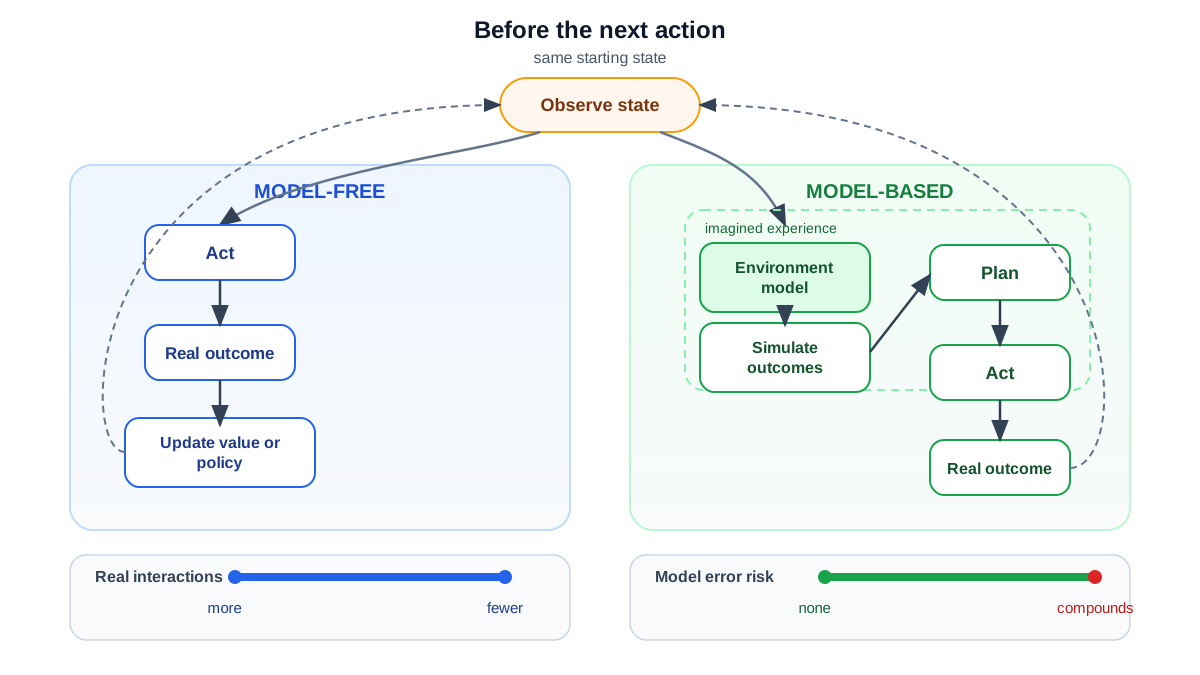
When you face a new reinforcement learning problem, ask one question first: can I predict the next state and reward accurately enough to plan?
If the answer is yes—because the rules are known, or because the environment is simple enough to model well—a model-based approach will save you enormous amounts of real interaction. Plan with the model. Simulate. Search.
If the answer is no—because the environment is too complex, too high-dimensional, or too poorly understood to model accurately—learn value or policy directly from real experience. Accept the sample cost in exchange for immunity to model bias.
| Model-Based RL | Model-Free RL | |
|---|---|---|
| Uses an environment model? | Yes, learns or is given one | No, treats environment as black box |
| Sample efficiency | High, model simulates experience | Low, needs many real interactions |
| Computation cost | Higher, planning and simulation | Lower per interaction |
| Main failure mode | Model error compounds into bad policy | Slow learning in complex tasks |
| Typical algorithms | Dyna-Q, AlphaZero, MPC | Q-learning, DQN, policy gradients |
| Best for | Known or learnable dynamics, expensive real interaction | Complex environments, cheap simulation |
A few practical guidelines sharpen this further.
Choose model-based methods when real interaction is expensive, when the environment dynamics are structured enough to learn, or when you already have an accurate simulator. Robotics, recommendation systems, and control problems often fit this pattern.
Choose model-free methods when the environment is too complex to model faithfully, when you have access to cheap and abundant interaction, or when model error would be dangerous. High-dimensional visual environments and tasks with chaotic dynamics often push practitioners toward model-free approaches.
Also notice that this is not a permanent either-or choice. Modern systems frequently blend both approaches. A common pattern is to learn a model, use it to generate additional experience, and feed that imagined experience into a model-free learner. The model accelerates learning; the model-free learner provides a robust foundation. The boundary between the two camps is more like a spectrum than a wall.
Common Mistakes Beginners Make
Mistake: Assuming model-free agents are "dumber." Model-free methods are not random trial and error. They are sophisticated learning systems that extract value estimates and policies from real experience. They simply do not predict the future before acting.
Mistake: Trusting a learned model as ground truth. A model learned from data is an approximation with errors. Treating it as the real environment invites the agent to exploit its blind spots. Always ask how accurate the model is, and over what horizon its predictions remain reliable.
Mistake: Judging sophistication by the algorithm family. The same algorithm can appear in both camps depending on how it uses a model. Dyna-Q is a model-free learning rule combined with a learned model. The label describes what the agent knows about the environment, not how advanced the algorithm is.
Mistake: Forgetting that model error grows with prediction horizon. Even a good model degrades as you ask it to predict further into the future. Planning over long horizons with an imperfect model multiplies the opportunity for error to compound.
The Decision You Carry Forward
Before choosing an RL approach, ask whether you can predict the next state and reward accurately enough to plan.
If yes, a model buys you sample efficiency—the ability to learn from imagination instead of expensive reality. If no, learn value or policy directly from real experience, and pay the interaction cost for the safety of learning only from what truly happens.
The model-based versus model-free distinction is not about which agent is smarter. It is about what the agent knows about the rules of its world, and whether that knowledge is trustworthy enough to plan with.
Your next step is to connect this distinction to concrete algorithms. When you meet a new RL method, ask where it sits on this spectrum: Does it learn a model? Does it plan? Does it learn only from real experience? That single question will tell you more about the algorithm's strengths and weaknesses than its name ever will.
Knowledge check
Final check
Finish the article by checking the ideas you just learned.
References
Research updated Sep 9, 2026


