
Compounding Model Error in Reinforcement Learning: Why Planning Drifts
A model that predicts the next state almost perfectly can still produce plans that drift into nonsense after a few imagined steps. The mistake is treating…

Key topics
A model that predicts the next state almost perfectly can still produce plans that drift into nonsense after a few imagined steps. The mistake is treating "small per-step error" as if it guaranteed "small total error." It does not—because the model feeds on its own output.
The Model Looks Fine One Step Ahead
You train a transition model that predicts the next state given the current state and action. You evaluate it on held-out transitions, and the numbers look good. Single-step predictions are close to what the real environment produces. So you let the agent plan by rolling the model forward several steps, and the imagined trajectory wanders into states the real environment would never visit. The agent acts on plans built from those drifted states, and performance collapses.
The surprise is understandable. If each imagined step is only slightly wrong, a few steps should stay roughly right. That intuition holds for some kinds of error—but not for the kind a planning model produces.
The core question is where the drift comes from, and why a small one-step error becomes a large multi-step error.
Why Small Errors Grow: The Feedback Loop
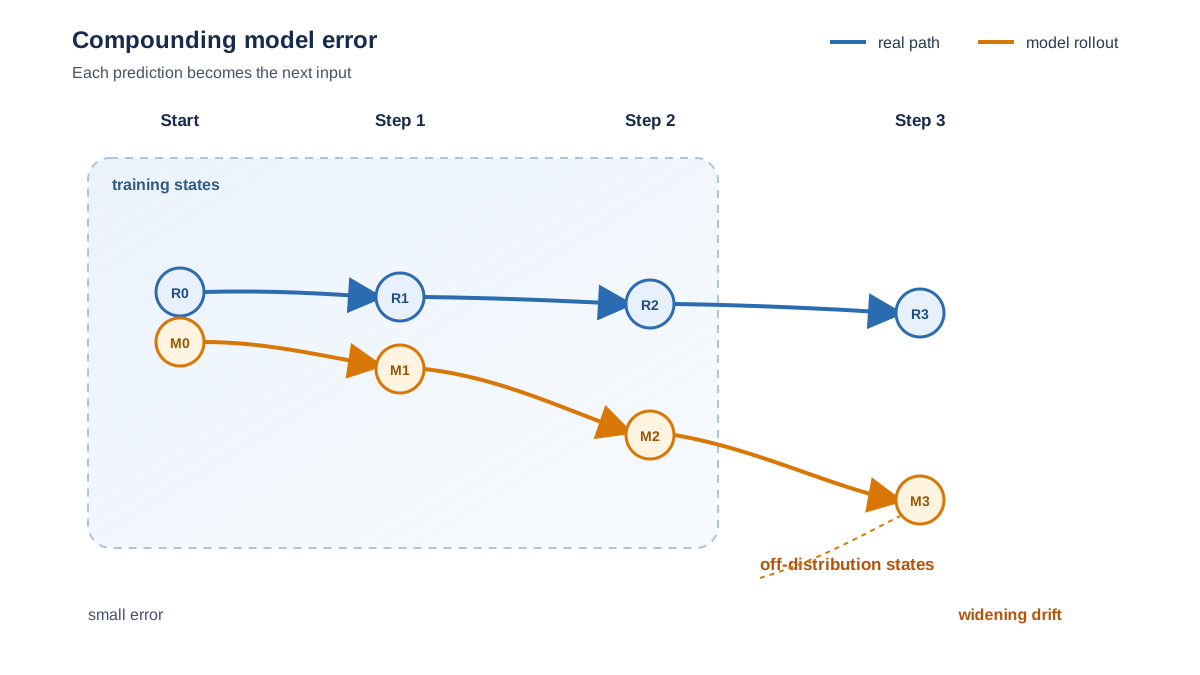
There are two ways to imagine error accumulating across steps. The first treats each step as an independent, small mistake: five steps with 1 percent error each give you roughly 5 percent total error. That is linear accumulation, and it is not the real problem.
The second is recursive. The model rolls out from its own output. A small mistake at step one changes the input to step two. The model was trained on states from the real environment, not on slightly-off imagined states, so its prediction at step two is less reliable than its prediction at step one. That error feeds into step three, where the model is even further from the states it saw during training. Each step builds on the previous step's mistake.
Think of a photocopier copying its own copy. The first generation is nearly identical to the original. The second generation copies the first copy's imperfections. By the fifth generation, the image has drifted noticeably—not because any single copy was terrible, but because each copy inherited the previous copy's flaws.
The same mechanism operates in model rollouts. The imagined trajectory can wander into regions of state space the model never trained on, and in those regions its predictions get worse still. The model is being asked to predict in territory it has never seen, based on states it invented.
This is what researchers mean when they talk about model error compounding in reinforcement learning. The error does not simply add up. It compounds, because the model's predictions become the inputs to its next predictions.
Note: "Compounding" describes recursive dependence, not a guaranteed explosion. Some errors cancel, some plateau, and some dynamics are forgiving. The danger is that multi-step error can grow much faster than the one-step metric suggests—not that it always must.
To see the mechanism concretely, imagine a simple two-state environment where the model makes a small mistake: from state A, the real environment always transitions to state B, but the model predicts a 90 percent chance of B and a 10 percent chance of a drifted state A'. After one imagined step, the rollout is usually still plausible. After three steps, the rollout has branched through states the real environment would never produce, and every further prediction is made from those invented states. The one-step error was 10 percent. The three-step trajectory can be entirely wrong.
Knowledge check
Check your understanding
Answer this question before you continue.
The Horizon Tradeoff: Trusting the Model Longer vs Shorter
Longer rollouts are attractive for a real reason. More imagined steps can reveal longer-term consequences of an action, which is part of why model-based methods can be more sample-efficient than model-free ones. If the model is accurate, planning further ahead lets the agent evaluate actions by their downstream effects rather than only their immediate results.
The counterweight is compounding. Each extra imagined step gives the rollout more chances to drift into unreliable territory. The question is not "how long can I plan?" but "how long can I trust this model from this particular state?"
The decision rule is straightforward: when the model is accurate in the local region around the current state, a longer horizon helps. When the model is unreliable there, a shorter horizon—or a model-free backup—is safer.
One useful way to think about this is as a trust boundary rather than a fixed hyperparameter. Some model-based methods try to adapt the planning horizon per state, using a longer rollout where the model is known to be accurate and a shorter one where it is not. That is an active research direction, and the conceptual point matters more than any specific algorithm: the right horizon depends on where the model is trustworthy, not on a global setting you pick once.
Knowledge check
Check your understanding
Answer this question before you continue.
Why the Model's Loss Doesn't Match What Planning Needs
Here is a subtle point that explains why the failure is structural rather than a matter of training harder.
A model trained to minimize one-step prediction error is rewarded for being right about the immediate next state. That is a reasonable objective for many purposes, but it is not the objective planning needs. Planning needs the model to stay on track over many steps, visiting states that may differ from anything in the training data.
The states a planner visits during a rollout are not the states in the training distribution. They are the model's own inventions, slightly off from reality at every step. So the model is being asked to predict in regions it may never have seen, and its one-step loss says nothing about how it behaves there.
Some model-based methods address this by training or evaluating models on multi-step objectives, or by learning models that predict quantities useful for planning rather than raw next-state accuracy. The research is still settling the best framing, but the lesson is clear: a low one-step loss on training-distribution states does not guarantee reliable rollouts.
Knowledge check
Check your understanding
Answer this question before you continue.
What This Means for Choosing a Model-Based Method
Given that compounding is real, how do model-based methods cope? The practical answers fall into a few patterns.
Some methods limit rollout length, keeping imagined trajectories short enough that the model stays within its competence. Some blend model rollouts with model-free value estimates, using the model where it helps and falling back on learned values where it does not. Some use ensembles of models to hedge against uncertainty, treating disagreement among models as a signal that the rollout is unreliable.
Warning: Ensemble disagreement is a useful signal, not a guarantee. A model can be confidently wrong when it is systematically biased—for example, when the real environment has dynamics the model architecture cannot represent. If all ensemble members share the same blind spot, they will agree on a wrong answer.
The when-to-use framing matters more than the algorithm names. Prefer longer model-based planning when the model is trustworthy in the relevant region. Fall back to shorter rollouts or model-free updates when it is not. A model that is accurate in local subsets of the state space can still be useful—as long as planning stays within those subsets.
The failure is not a reason to abandon model-based RL. It is a reason to treat the model's trust region as a first-class design constraint. The question is not "model-based or model-free?" but "how far can this model be trusted, and where does its error land?"
Knowledge check
Check your understanding
Answer this question before you continue.
Common Mistakes When Reasoning About Model Error
Mistake 1: Assuming a low one-step loss guarantees reliable rollouts. The loss is measured on training-distribution states, not on the drifted states a rollout visits. A model can look excellent on held-out transitions and still produce nonsense after a few imagined steps.
Mistake 2: Blaming the whole failure on "the model is bad." The real issue is often that a good local model is being asked to predict far outside its competence. The model is not uniformly bad. It is being misused.
Mistake 3: Assuming longer planning is always better because it is more "model-based." Horizon must be matched to model trust. Longer is only better when the model stays accurate over that distance.
Mistake 4: Treating compounding as a model-free vs model-based binary. The real axis is how far the model is trusted and where its errors land. Both families can suffer from error propagation; the difference is in how the error enters and what you can do about it.
Diagnosing Drift in Your Own Rollouts
When you plan with a learned model, treat the planning horizon as a trust boundary tied to where the model is accurate—not as a fixed hyperparameter. If you want to see the failure with your own eyes, run a small diagnostic:
- Pick a starting state from real experience.
- Generate model rollouts of horizons 1, 3, and 5 from that state.
- Compare each predicted state or return against what the real environment produces, or against a held-out real continuation.
- Record the error by horizon and inspect whether the visited states leave the region your model saw during training.
If error rises with horizon, shorten the rollout or bootstrap from a value estimate. If error is localized to particular regions, restrict planning to trusted states and collect more data where the model drifts. If the model is confidently biased—consistently wrong even where it has data—do not rely on ensemble disagreement alone; the model needs a different objective or more expressive architecture.
Note: With stochastic dynamics, a single long rollout may differ from reality legitimately, not because the model compounded error. Compare several rollouts or use average error rather than judging from one trajectory.
That drift is not a bug in your implementation. It is the compounding mechanism doing exactly what compounding does. The remedy is not to abandon the model. It is to know its limits, plan within them, and treat the trust boundary as part of the design.
Knowledge check
Final check
Finish the article by checking the ideas you just learned.
References
Research updated Sep 9, 2026


