
Safe Exploration in Reinforcement Learning: Action Shields, Rules, and Fallbacks
Your agent proposes an action that crosses a hard safety boundary. You can block it, replace it, or fall back to a known-safe controller. The naive…

Key topics
Your agent proposes an action that crosses a hard safety boundary. You can block it, replace it, or fall back to a known-safe controller. The naive answer—just clamp the action—silently corrupts the learning signal. The real design question is what the safety layer does to the agent's model of the world, not just what it does to the action.
Why Exploration and Safety Pull Against Each Other
Exploration methods exist to try things. Epsilon-greedy throws random actions into the stream. Noise injection perturbs continuous controls. Entropy bonuses push the policy toward more stochastic behavior. None of these mechanisms know which actions are dangerous. They are designed to be ignorant in a useful way: if the agent already knew the best action, it would not need to explore.
But some unsafe actions are known before learning begins. Domain rules, physics, regulatory constraints, and operator experience all tell you things the agent has not learned yet. You know the robot arm must not exceed its joint limits. You know the trading agent must not place an order that exceeds its position cap. You know the vehicle must not enter the pedestrian zone. This knowledge is not discovered through reward—it is structural.
The constrained-MDP framing separates reward from cost constraints, and the invalid-actions discussion established why masking differs from penalizing. This article moves to the runtime layer: what happens when the agent proposes an action your known rules reject, and how you make that intervention visible to the learning process.
Penalizing unsafe actions in the reward discourages them. It does not guarantee they never happen. A shield is a hard filter, not a soft incentive. The central tension is that blocking too little risks damage, while blocking too much prevents the agent from ever learning where the safe boundary actually sits.
The Layered Interaction Loop: Where the Shield Sits
The architecture is simple to state and easy to get wrong in practice:
agent policy → proposed action → safety layer (check)
    → accepted action OR fallback → environment → observation/reward
    → wrapper records intervention → replay/update → back to agent
The safety layer sits between the policy and the environment. It does not live inside the reward function, and it does not live inside the policy itself. That placement is the whole point. The shield sees the same state the agent sees, but it applies rules the agent does not own.
Why does placement matter so much? Because the agent's value estimates and policy updates are computed from what the environment actually returns. When the shield changes an action, the environment returns a different transition than the agent's proposed action would have produced. The shield therefore shapes the data the agent learns from—and what the agent learns depends entirely on what you do with the intervention.
This is the difference between a safety layer and a reward hack. A reward penalty teaches the agent that an action is costly. A shield teaches the agent nothing directly—it just prevents the action from reaching the environment. The learning consequence is determined by how you record and replay the intervention.
Knowledge check
Check your understanding
Answer this question before you continue.
Three Ways to Intervene: Block, Replace, Fall Back
Once the safety layer detects an unsafe proposal, you have three intervention strategies. Each changes what the agent observes, and each is appropriate for a different kind of danger.
Block rejects the unsafe action and forces a resample or masks it out of the action set. This is cleanest when a safe alternative exists and the agent can simply choose again. The agent proposed something forbidden; you refuse it. The agent never receives a transition from the forbidden action.
Replace projects the proposed action onto the nearest safe action. This is common in continuous control, where the safety layer clamps a joint velocity or projects a control signal onto a safe set defined by control barrier functions or similar constraints. The agent proposed a continuous action; you substitute the closest safe one. The agent experiences the consequence of the substituted action, not its own proposal.
Fall back hands control to a known-safe backup policy that returns the system to a safe region, then resumes learning. This matches the safety-function and backup-policy framing from the safe-exploration literature: a safety function determines a state's degree of safety, and a backup policy can lead the system from a critical state back to a safe one. Fallback is the right choice when the danger is a state you must escape, not just an action you must avoid.
The decision rule is not about action-space type. It is about what the system can safely do with a rejected proposal:
- Block when a safe alternative exists and the agent can choose again without harm.
- Replace when a valid transformation of the proposed action keeps the system inside the safe set.
- Fall back when the danger is a state requiring recovery, and a tested backup policy can perform that recovery.
Discrete action spaces often use blocking; continuous spaces often use projection. But the same environment may need different interventions at different states. A discrete action that leads into a critical region may require fallback, not a resample. Choose per danger type, not per action-space type.
Knowledge check
Check your understanding
Answer this question before you continue.
Two Actions, One Transition: What the Learner Actually Sees
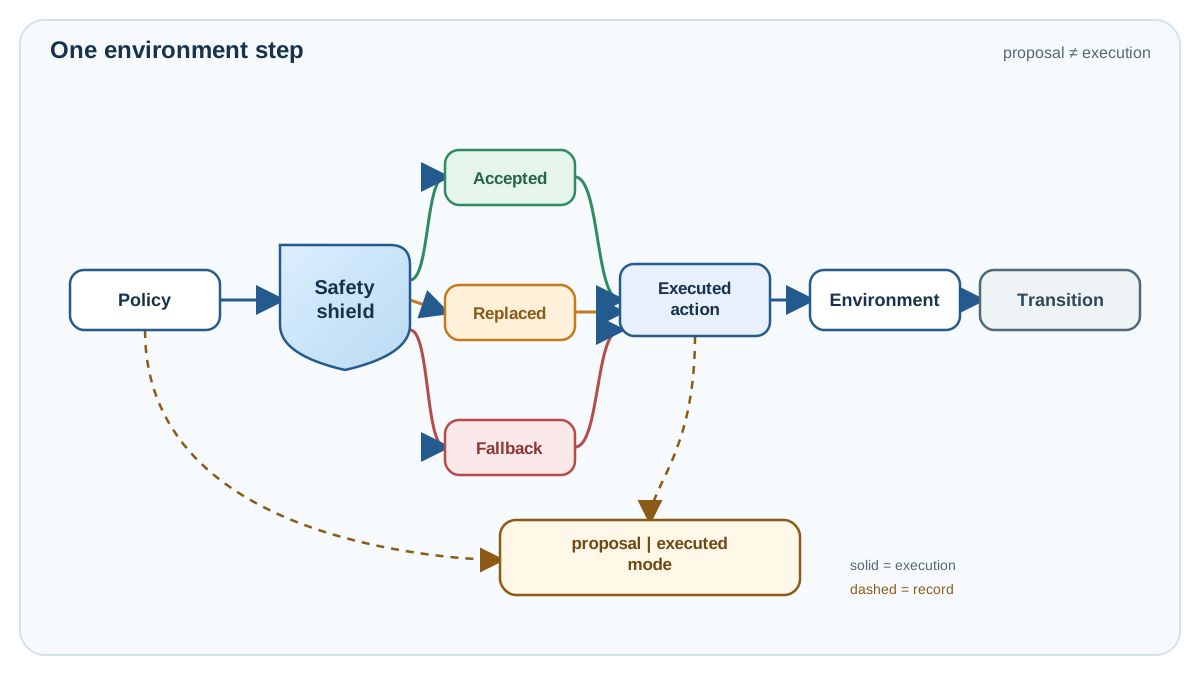
Here is where most shielding implementations go wrong. The shield works perfectly—every unsafe action is caught, every intervention is clean—and the agent still fails to learn the safety boundary.
The problem is transition semantics. When the shield intervenes, there are two actions in play: the action the policy proposed and the action the environment executed. These are not the same, and what you store for learning determines whether the agent internalizes the boundary or learns to lean on the shield.
| Intervention | Proposed action | Executed action | What the agent experiences |
|---|---|---|---|
| Block | Unsafe, rejected | Safe alternative chosen by resample | A transition from an action the policy did not propose |
| Replace | Unsafe, projected | Nearest safe action | A transition from a modified action |
| Fall back | Unsafe, overridden | Backup policy's action | A recovery trajectory the policy did not generate |
If you store only the executed action, the policy learns from transitions it never proposed. If you store only the proposed action, you train on transitions that never happened in the environment. Both choices distort the learning problem.
The safe design records both actions plus the intervention metadata, then decides deliberately what the update consumes. Some algorithms train only on executed actions and use the intervention signal as auxiliary data. Others add a safety loss that penalizes proposals the shield rejected. The choice depends on your algorithm, but the decision must be explicit. Treating replacement and fallback as identical to ordinary accepted actions hides the intervention from the learner—and the learner never corrects the value estimate that produced the unsafe proposal.
The shield also changes the state distribution the agent trains on. States that would have been reached through unsafe actions never occur. States that the shield permits become over-represented. Value estimates can become biased toward the states the shield allows, which means the agent's model of the world is a model of the shielded world, not the real one.
This is why recording interventions is not optional bookkeeping. It is the only way to see whether the agent is learning the boundary or just being rescued across it.
Knowledge check
Check your understanding
Answer this question before you continue.
Recording Interventions: The Telemetry You Cannot Skip
Every intervention should be logged with enough context to diagnose why it happened and what the agent was trying to do. At minimum, record the proposed action, the executed action, the state, the reason for rejection, and the intervention type.
Track the intervention rate over training time, but interpret it as a diagnostic, not a verdict. A falling rate alongside preserved state coverage and task performance suggests the agent is internalizing the boundary. A falling rate alongside shrinking coverage near the boundary suggests the agent learned to avoid the region entirely—which may be safe but is not the same as learning where the boundary sits. A high rate near a newly explored boundary can represent productive exploration rather than failure.
Separate interventions by type. A block tells a different story than a fallback. A block means the agent proposed a forbidden action in a state where a safe alternative existed. A fallback means the agent entered a state from which it needed rescue. Each failure mode points to a different learning problem.
Correlate intervention spikes with state regions. A persistent spike in one region means the agent keeps proposing the same unsafe action there. That is a targeted signal: the value estimate for that action in that state region is wrong, and the shield is preventing the correction that would fix it.
Use the intervention log to decide when to relax the shield, tighten it, or change the learning signal so the agent internalizes the boundary instead of depending on rescue. The log is not a compliance record. It is a learning diagnostic.
Common mistake: Treating a shield that never fires as proof that safety is handled. A shield that never fires may mean the agent learned the boundary—or it may mean the agent never explored near it. Check the state coverage before celebrating.
Knowledge check
Check your understanding
Answer this question before you continue.
When the Shield Is the Wrong Tool
Action shielding is not the answer to every safety problem. It has sharp limits, and knowing them saves you from building a filter that provides only the illusion of safety.
Shields only work for dangers you can specify in advance as rules or safe sets. If the unsafe region is not well-characterized, a hand-written shield cannot protect against it. Unknown or emergent hazards require a learned safety model or formal reachability analysis over learned dynamics, where the shield itself is constructed from verification rather than from prior knowledge.
If the danger is a state you cannot escape once entered, a fallback policy must exist that can actually recover the system. A shield that blocks the action leading into the state is cosmetic if the system can drift into it through other paths. The backup policy must be real, tested, and capable of recovery from the critical region.
Shielding is also overkill when the unsafe action is merely suboptimal rather than dangerous. If the action costs reward but does not risk damage, a penalty or mask is the simpler, sufficient tool. Adding a hard filter to a soft problem introduces the learning distortions described above without buying anything you need.
The boundary between this article and the constrained-RL prerequisite is worth stating plainly: constraints shape the objective; shields shape the action stream. If your problem is about trading off reward against cost, you need constrained optimization. If your problem is about preventing known dangerous actions from reaching the environment, you need a shield. Know which problem you are solving before you build the mechanism.
A Design Checklist for Your Own Agent
When you build a safe exploration loop, work through these steps:
- Specify the known-unsafe set. Write down the rules, safe sets, and state constraints you know before learning begins. If you cannot specify the danger, you cannot shield it.
- Choose the intervention per danger type. Block when a safe alternative exists. Replace when a valid projection is defined. Fall back when the danger is a state requiring tested recovery.
- Define the transition record. Store the proposed action, executed action, state, rejection reason, and intervention type. Decide explicitly whether your update consumes the executed action, an auxiliary intervention signal, or both.
- Log every intervention. This log is your primary window into whether the shield is helping or masking.
- Evaluate the shield as a diagnostic, not a verdict. Watch the intervention rate alongside boundary coverage, task return, and recovery success. Falling interventions with preserved coverage suggest internalization. Falling interventions with shrinking coverage suggest avoidance.
The goal is to make the shield progressively unnecessary. A shield that never fires may be unnecessary, but a shield that fires constantly is hiding a policy that has not learned its boundary. You are not building a rescue system. You are building a filter that teaches the agent to stop needing rescue—and the intervention log is the only way to tell the difference.
Knowledge check
Final check
Finish the article by checking the ideas you just learned.
References
Research updated Sep 9, 2026


