
Tabular RL vs Function Approximation: What Changes When Tables Become Networks?
Your Q-table worked beautifully on the grid world. Every cell held a number, every update made sense, and you could read the agent's beliefs like an open…

Key topics
Your Q-table worked beautifully on the grid world. Every cell held a number, every update made sense, and you could read the agent's beliefs like an open book. Then you scaled the state space up, and suddenly the same approach produced nonsense.
The problem is not that you outgrew a tool. The problem is that you crossed a line where the object doing the learning changed shape. A table stores independent answers. A network stores a shared rule. And sharing—not scale—is what breaks your old mental model.
The Table's Quiet Assumption
A Q-table is literally a lookup. Each state-action pair owns one number, and an update touches that cell in isolation. Learn something about one state, and the neighboring cell does not care. That independence is the table's quiet assumption, and it is also its ceiling.
This works beautifully when states are few, discrete, and fully enumerable. Small grid worlds, toy bandits, a handful of board positions—these fit a table because you can visit every cell often enough to give it a trustworthy value.
The assumption breaks when the state space grows. Add features to your environment—position, velocity, angle, distance to an obstacle—and the number of possible states grows exponentially. This is the curse of dimensionality, and it hits tables twice. First, the table itself becomes impossibly large. Second, even if you could store it, you could never visit enough states to fill it with meaningful values.
If you ran a small tabular experiment, you already saw this independence in action. Each cell updated on its own, and states the agent never visited simply stayed at their initial values. The table never guessed. It never inferred. It waited to be told.
Knowledge check
Check your understanding
Answer this question before you continue.
What Generalization Actually Buys
Function approximation replaces the table with a parameterized function—typically a neural network—that maps state features to values or action probabilities through shared weights. The word shared is doing the real work here.
When the network updates its parameters after visiting one state, that single update improves predictions across every similar state, not just the one the agent just left. This is generalization, and it is the entire reason function approximation exists in reinforcement learning.
Consider a robot arm whose state is described by joint angles. A table cannot cover that continuous space—there are infinitely many angle combinations, and the agent will never visit most of them. A network, by contrast, can interpolate between nearby configurations. Learn that one arm position leads to a reward, and the network transfers some of that knowledge to similar positions it has never seen.
The catch is that the network is only as good as what the state representation lets it see. If your features hide the information that matters—if the network cannot tell a dangerous state from a safe one because both look identical in your encoding—then generalization will happily spread wrong beliefs across the whole state space.
Here is the mental model that matters: a table stores answers, while a network stores a rule for producing answers. The rule is what lets the agent handle states it has never visited. The rule is also what makes every failure contagious.
Knowledge check
Check your understanding
Answer this question before you continue.
The Two Failure Modes Tables Never Had
Once parameters are shared, two new dangers appear. Both are symptoms of the same root change: every update ripples everywhere.
Correlated data. An agent's own trajectory produces consecutive, highly similar samples. Step one and step two in a grid world differ by a single cell. In supervised learning, you assume independent samples; in reinforcement learning, the agent generates its own data, and that data is autocorrelated by nature. A table was immune because each update touched one isolated cell—nearby samples barely mattered. A network, however, trains on a batch of nearly identical states and happily overfits to the local neighborhood, then forgets it the moment the trajectory moves elsewhere.
Moving targets. Bootstrapping means the target for one update is itself produced by the current value estimate. The network predicts a value, uses that prediction to compute a target, then updates toward it—but the update changes the prediction, which changes the target for the next update. The goalpost shifts as the network learns. A table suffered from this too, but the damage stayed local. With shared parameters, chasing a moving target can send the entire value function into oscillation or divergence.
These two failure modes are why deep Q-learning needs experience replay and target networks. Replay breaks the correlation in the data stream. Target networks freeze the goalpost long enough for the learner to catch up. Neither mechanism exists because deep RL is fancy—both exist because shared parameters created problems that tables never had.
Knowledge check
Check your understanding
Answer this question before you continue.
When the Table Is Still the Better Tool
Here is the counterintuitive truth: moving to neural networks is not always an upgrade. For many learning situations, a table is the better instrument.
A table is a debugging tool. You can read every value, inspect every update, and trace exactly why an agent behaves a certain way. When something goes wrong, the wrong belief is visible in a specific cell. A network is a black box. When training diverges, you cannot open it and read the mistaken belief—you can only watch the loss curve and guess.
My rule is simple: if the state space is small enough to enumerate and you are still building your intuition for the RL loop, a table will teach you more per hour than a network ever will. Reach for function approximation when you genuinely need it—continuous or high-dimensional states, or a task where the agent must transfer learning across similar situations. Do not reach for it because networks feel more impressive.
Keep the table until the state space forces you out. The moment you switch, you trade a readable object for a powerful one, and you should know exactly what that trade costs.
Knowledge check
Check your understanding
Answer this question before you continue.
A Comparison at a Glance
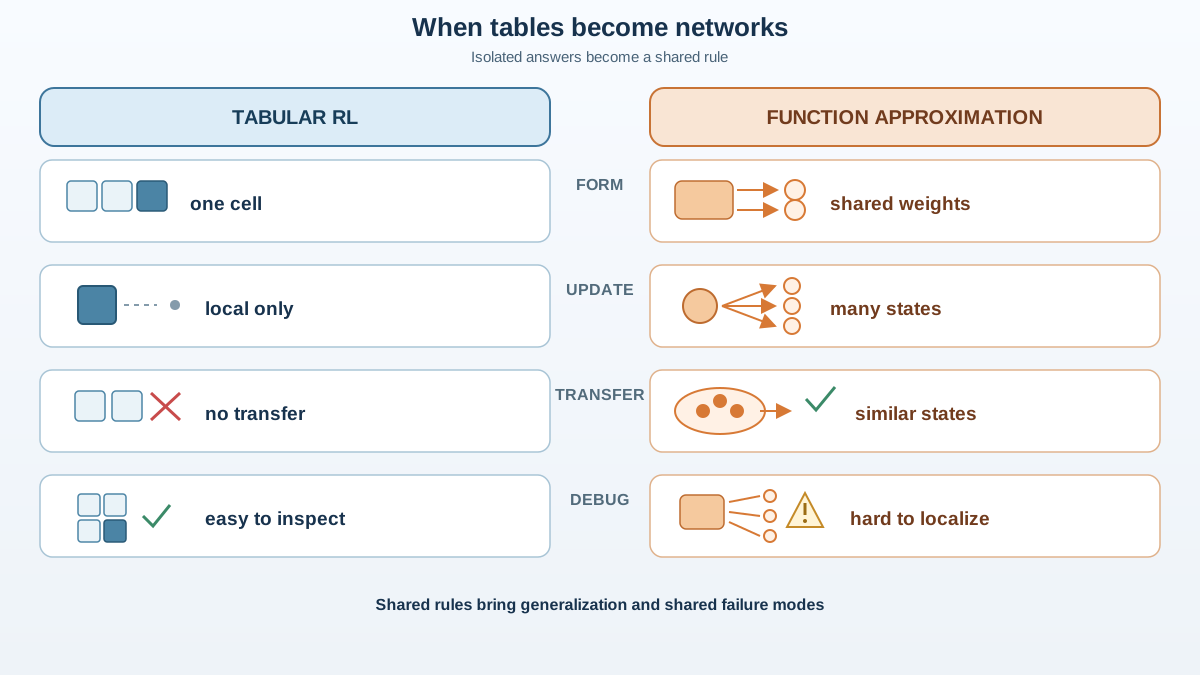
| Tabular RL | Function Approximation RL | |
|---|---|---|
| Representation | One stored value per state-action pair | Shared parameters mapping features to values |
| Memory | Grows with every state; infeasible for large spaces | Fixed parameter count regardless of state space size |
| Generalization | None—unvisited states stay at initial values | Automatic—updates transfer to similar states |
| Update locality | Each update touches one isolated cell | Every update ripples through all shared parameters |
| Failure modes | Slow learning in large spaces | Correlated data and moving targets |
| Debugging | Read any value; trace any belief | Opaque; divergence is hard to localize |
| Best use case | Small, enumerable state spaces; learning the RL loop | Continuous or high-dimensional states; transfer learning |
The Mental Model That Survives the Transition
When you move from tables to networks, you are not upgrading the table. You are changing what kind of object learns.
A table stores independent answers. A network stores a shared rule. Sharing is both the power and the danger: it lets the agent generalize to unseen states, and it lets every bad update contaminate the whole value function.
Before you train a deep agent, ask two questions. First, what does the network share across states—which features will cause knowledge to transfer usefully, and which will cause it to bleed destructively? Second, which failure mode must you engineer around—correlated experience from your data stream, or moving targets from your own bootstrapping updates?
The stabilization mechanisms you will meet next—replay buffers, target networks, and their relatives—exist precisely because of the two failure modes named here. They are not optional accessories. They are the engineering response to what happens when a lookup table becomes a learned rule. Understand the failure, and the fixes stop feeling like magic and start feeling like necessity.
Knowledge check
Final check
Finish the article by checking the ideas you just learned.
References
Research updated Sep 9, 2026


