
Value-Based vs Policy-Based Reinforcement Learning
The real question is not which family of algorithms is better. It is which one fits the structure of your problem—your action space, your data budget, and…

Key topics
The real question is not which family of algorithms is better. It is which one fits the structure of your problem—your action space, your data budget, and what you need the agent to output.
Two Answers to the Same Question
Imagine teaching a robot to navigate a small grid. In one corner sits a reward. The robot can move up, down, left, or right. How should it learn?
A value-based approach answers a question about the world: How good is each action in each state? The robot learns that moving right from the start cell is worth 0.7, moving down is worth 0.4, and so on. Once it has those estimates, the decision rule is simple: pick the action with the highest value.
A policy-based approach skips the evaluation step. Instead of learning how good actions are, it learns a policy directly—a mapping from states to action probabilities. The robot starts with roughly equal probabilities for each move, then adjusts those probabilities over time: actions that lead to reward become more likely, actions that lead to failure become less likely.
Both families end at the same destination: a policy that tells the agent what to do. The difference is what they learn along the way.
If you have worked through Q-learning, you have already seen a value-based method in action. If you have studied policy gradients, you have seen the policy-based alternative. This article is about choosing between them for a new problem.
What Each Family Actually Learns
The representational difference matters more than it first appears.
Value-based reinforcement learning learns a value estimate: Q(s, a), the expected return from taking action a in state s, or V(s), the expected return from being in state s. The policy is derived from these values. In the simplest case, the agent takes the argmax—the action with the highest estimated value. In practice, it might use a softmax over values to encourage exploration, which introduces a temperature parameter that controls how greedy the policy is.
Policy-based reinforcement learning learns πθ(a|s) directly: a parameterized probability distribution over actions for each state. The policy is the learned object itself. There is no separate step to convert values into decisions.
This difference gives each family a distinct strength. Value-based methods can answer a question you might care about beyond decision-making: How good is this action? That estimate is useful for planning, for comparing strategies, and for understanding why the agent behaves the way it does. Policy-based methods answer a narrower question: What should I do here? In their pure form, they do not maintain a representation of how much reward each action is expected to produce—they represent actions in terms of which should be taken and which should be avoided.
Think of it this way. A value-based agent is a critic that learns to score moves, then acts on its own scores. A policy-based agent is a player that learns which moves feel right, without ever assigning them a score.
One boundary worth keeping in mind: pure policy-gradient methods learn only the policy, while actor-critic methods add a value estimator to guide the policy update. The "policy-based" label covers both, which is why you will see the term used loosely.
Knowledge check
Check your understanding
Answer this question before you continue.
The Action-Space Test
Here is the first practical decision rule: look at your action space.
Value-based methods evaluate every action to find the best one. That works beautifully when actions are few and discrete. A game with four moves, a menu with ten options, a recommendation system with a handful of choices—these are natural value-based problems. The argmax operation is cheap because you can enumerate every possibility.
Continuous action spaces break this mechanism. Imagine a robotic arm where the action is the torque applied to a joint—a real number between -1 and 1. How do you take the argmax over an infinite set of actions? You cannot enumerate them. You could discretize the range into bins, but precision suffers, and the number of bins grows quickly as the action dimension increases.
Policy-based methods sidestep this problem entirely. Instead of evaluating every action, they sample from a parameterized distribution. The policy might be a Gaussian over torque values, with the network outputting a mean and variance. To act, the agent samples from that distribution. To improve, it adjusts the parameters so that actions leading to higher reward become more probable.
This is why continuous action reinforcement learning usually points toward policy-based or actor-critic methods. It is not that value-based methods are fundamentally broken on continuous problems—it is that the argmax over an infinite action set has no natural implementation.
Common mistake: Assuming value-based methods "don't work" on continuous problems. The real issue is the argmax. If your action space is discrete but enormous—say, a million possible moves—value-based methods also struggle, because evaluating every action at every decision point becomes computationally prohibitive.
Knowledge check
Check your understanding
Answer this question before you continue.
Data Behavior: Off-Policy vs On-Policy
The second decision rule concerns your data.
Value-based methods are naturally off-policy. Q-learning can learn from any trajectory sampled from the environment, regardless of which policy produced it. That means you can reuse old experience, learn from expert demonstrations, or train on data collected by a completely different agent. This makes value-based methods more sample-efficient: every piece of experience can be used many times.
Policy-based methods are typically on-policy. The gradient estimate is tied to the current policy—it answers the question, "Given the way I am currently behaving, which direction should I adjust my parameters?" If you try to update the policy using data collected from an older version of itself, the estimate becomes biased. The mismatch invalidates the gradient. In practice, this means the basic policy-gradient methods need fresh rollouts from the current policy for every update, and those samples are discarded after use.
The tradeoff is real, but it is not a simple good-versus-bad split. Value-based methods reuse data but can fight instability. Policy-based methods avoid some of that instability but burn samples. Neither family guarantees smooth training.
Common mistake: Assuming policy-based methods are "better" because they are newer or more fashionable. If you have a limited data budget—say, a real-world environment where collecting experience is expensive—the sample efficiency of value-based methods can matter more than any other factor.
Knowledge check
Check your understanding
Answer this question before you continue.
Stability and Optimization Tradeoffs
The third difference lives in the optimization itself.
Policy-based methods directly optimize the objective you actually care about: expected return. Conceptually, this is clean. The gradient tells you which direction to push your policy parameters to increase expected reward. The problem is that this gradient is estimated from sampled rollouts, and those estimates can have high variance. One lucky episode can make a bad action look good; one unlucky episode can hide a good action. This is why policy gradients need variance reduction techniques—baselines, advantage estimates, and careful trust-region constraints—to work reliably.
Value-based methods optimize indirectly. They learn to predict values through bootstrapping: updating a state's value estimate using the estimated values of subsequent states. This approach has lower variance per update because each target is partially based on existing estimates rather than a single noisy rollout. But bootstrapping with function approximation introduces its own instability: the target keeps moving as the value estimates change, and the whole system can oscillate or diverge. In plain terms, the agent is chasing a target that shifts every time it learns something new.
Actor-critic methods exist precisely to bridge this gap. The critic—a value estimate—reduces the variance of the policy gradient by providing a baseline. The actor—the policy—maintains the direct optimization of the objective. The cost is some bias, but the variance reduction usually more than compensates.
Modern algorithms are engineering responses to these respective weaknesses. DQN is a value-based method with a battery of stabilization tricks: experience replay, target networks, and careful reward scaling. PPO is a policy-based method with clipping and trust-region constraints to keep updates from destroying the policy. Neither represents a fundamentally new family—they are both attempts to make their respective family work in practice.
Knowledge check
Check your understanding
Answer this question before you continue.
When to Start With Each Family
Here is the decision rule I use when starting a new problem.
Start with value-based methods when:
- Your action space is discrete and small enough to enumerate
- You have a limited data budget or want sample efficiency
- You can reuse off-policy data, including old experience or demonstrations
- You want to know how good actions are, not just what to do
Start with policy-based methods when:
- Your action space is continuous or very high-dimensional
- You need a stochastic policy—one that deliberately randomizes actions
- You want to optimize a specific objective directly
- You can afford the sample cost of on-policy rollouts
| Consideration | Value-Based | Policy-Based |
|---|---|---|
| Action space | Discrete, small | Continuous or large |
| Policy representation | Derived from values (argmax, softmax) | Learned directly as πθ(a|s) |
| Data usage | Off-policy, reusable | Typically on-policy, fresh rollouts |
| Sample efficiency | Higher | Lower |
| Stability with function approximation | Can diverge, needs tuning | High-variance updates, needs its own tuning |
| Gradient variance | Lower (bootstrapping) | Higher (sampled rollouts) |
| Stochastic policies | Indirect, via temperature | Natural, direct |
| Typical use cases | Games, discrete control, recommendation | Robotics, continuous control, LLM alignment |
Common mistake: Choosing a method because a tutorial or benchmark used it, rather than because your problem structure demands it. A benchmark result on Atari games tells you nothing about whether the method will work for your continuous control problem.
A Practical Way to Decide
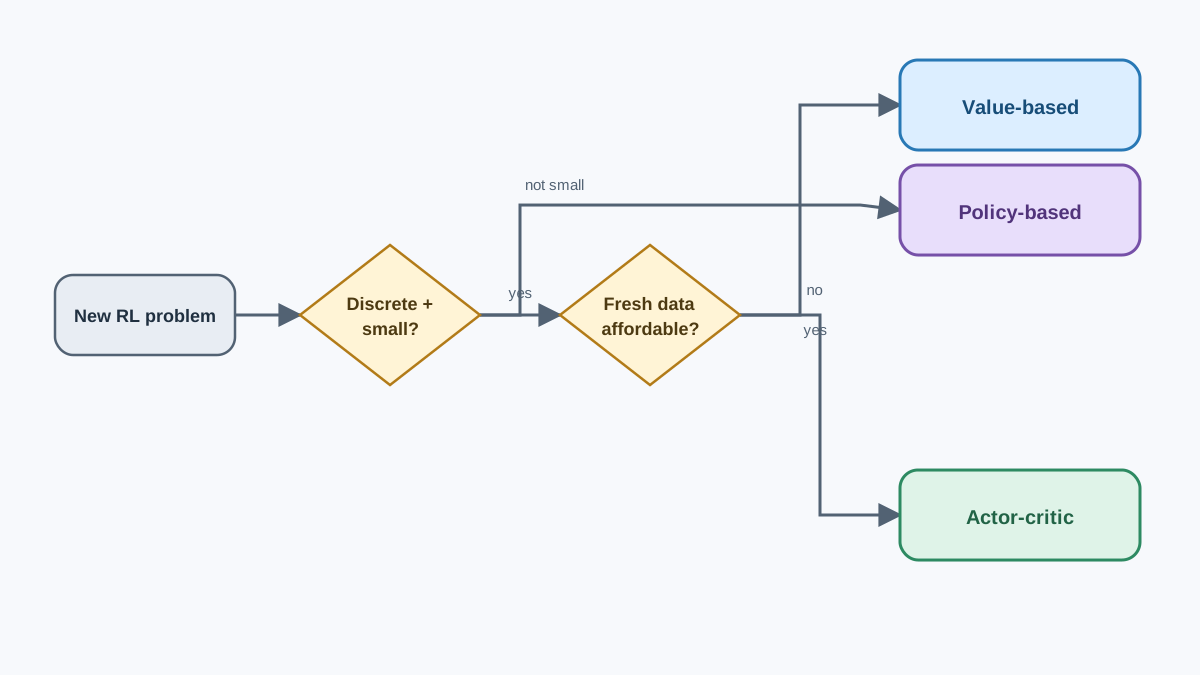
Before committing to a full implementation, run a quick mental checklist.
Three questions to ask:
-
Is my action space discrete and small? If yes, value-based methods are viable. If continuous or enormous, policy-based methods are the practical default.
-
Can I afford fresh on-policy data? If collecting experience is cheap and unlimited—say, a simulator—policy-based methods are fine. If data is expensive or scarce, value-based methods' sample efficiency becomes decisive.
-
Do I need a stochastic policy? Some problems require deliberate randomization—games against an opponent who can exploit predictable patterns, or tasks where the optimal behavior is genuinely probabilistic. Policy-based methods produce stochastic policies naturally.
Here is where the criteria can conflict. Consider a discrete-action recommendation system where you have a large fixed log of past user interactions but cannot run live experiments cheaply. The action space is enumerable, which points toward value-based methods. But the real constraint is the data: you have one fixed dataset and no budget for fresh rollouts. That data regime overrides the action-space test. An off-policy value-based method is the right starting point, because an on-policy policy-gradient method would demand data you cannot collect.
Now flip the scenario. You have a continuous robot-control task in a fast simulator where you can generate unlimited experience. The action space points toward policy-based methods, and the cheap data removes the usual objection. This is the clean case: start with a policy-based or actor-critic method and let the simulator absorb the sample cost.
A minimal sanity check: if your problem has a discrete action space and you can generate or reuse data freely, try a simple value-based method first. Q-learning with a small table or a simple function approximator will tell you quickly whether the problem is tractable. If your action space is continuous, start with a policy-based or actor-critic method—you will save yourself the pain of fighting the argmax problem.
This is a decision heuristic, not a law. Real problems often blur the line. Many practical systems use actor-critic methods that combine both families, and some problems that look continuous can be discretized effectively. But starting with the right family—based on your problem structure, not on algorithm fashion—will save you weeks of fighting the wrong abstraction.
Once you have picked a family, the next step is understanding the specific algorithm's update mechanics. If you chose value-based, dig into how Q-learning actually updates its estimates. If you chose policy-based, study how policy gradients push probabilities around. And when you are ready to combine both, actor-critic methods will show you why policies need a baseline.
Knowledge check
Final check
Finish the article by checking the ideas you just learned.
References
Research updated Sep 9, 2026


