
When Deep Reinforcement Learning Is the Wrong Tool
Deep RL is not the destination of reinforcement learning. It is a specialized tool with a steep cost profile, and most learners reach for it before they…

Key topics
Deep RL is not the destination of reinforcement learning. It is a specialized tool with a steep cost profile, and most learners reach for it before they know whether their problem actually needs a learned function approximator.
The recurring pattern is familiar: you hear about DQN beating Atari games, PPO controlling robots, and AlphaGo defeating world champions. So when you face a sequential decision problem, you reach for a neural network. Anything simpler feels like a stepping stone to rush past on the way to the "real" thing.
That instinct will cost you weeks. The better question is not "how do I apply deep RL to this?" but "what is the cheapest method that will answer my question?"
The Default Trap: Reaching for a Neural Network First
Here is the mental model that gets learners into trouble: deep RL is treated as advanced RL, and tabular or simple methods are treated as beginner RL. The implication is that sophistication is the goal.
It is not. Deep RL is a specific tool for problems where the state space defeats manual or tabular representation. When your states are enumerable, when your interactions are expensive, or when you already have a model of the environment, a neural network is not an upgrade. It is overhead.
Choosing a simpler method is a sign of good engineering judgment, not a lack of ambition. The builders I respect most are the ones who can solve a problem with the least machinery that works, then add complexity only when the problem proves it needs more.
Before you write a single line of deep RL code, run your problem through six decision criteria: state size, data cost, observability, action space, baseline availability, and debugging burden. This article walks through each one.
What Deep RL Actually Buys You (and What It Costs)
If you have read about what neural networks add to RL, you know the core idea: deep RL uses a neural network as the function approximator for a value function, a policy, or a model of the environment.
What does the network actually buy you? Automatic feature representation. When your state space is large, high-dimensional, or continuous—raw pixels, sensor streams, high-dimensional physical states—you cannot hand-design features or store a value per state. The network learns the representation for you.
That is a real capability. It is also expensive.
The costs are plain:
- Sample hunger. A neural network has millions of parameters. Learning them requires millions of interactions with the environment.
- Hyperparameter sensitivity. Learning rates, network architectures, exploration schedules, and discount factors all interact in ways that are hard to predict in advance.
- Run-to-run variance. Change the random seed and you can get a dramatically different result. You need multiple runs to know whether your algorithm actually works.
- Wall-clock time. Training runs take hours or days, not minutes.
- Debugging burden. When the agent fails, you cannot easily tell whether the problem is the reward, the exploration, the network architecture, or the environment itself.
Consider the shortest-path problem. You have a graph, and you want the shortest route between two nodes. This is a sequential decision problem: state is the current node, actions are the edges you can follow, and the reward is the negative of the edge cost.
Would you use deep RL for this? Of course not. You would use Dijkstra's algorithm or dynamic programming. The state space is enumerable, the transition model is known, and the problem is solved exactly in milliseconds.
Deep RL would be slower, less reliable, and less accurate. The same logic applies to many problems that look more impressive than shortest-path but are still fundamentally small enough for simpler methods.
Decision Criterion 1: Can You Enumerate the State Space?
Here is the first and most decisive filter: if you can enumerate the states and store a value or policy per state, deep RL is almost certainly overkill.
A small grid-world, a board game with bounded states, a simple inventory problem—these all fit in a table. You can inspect the value of every state directly. You can see exactly what the agent learned and where it is confused. Tabular Q-learning or dynamic programming will converge faster and more reliably than any deep RL approach.
The boundary where enumeration breaks is combinatorial or continuous state spaces. When the number of states explodes—a raw-pixel observation space, a continuous control problem with many degrees of freedom—a table becomes impossible. That is where a neural network earns its keep.
But here is the trap: many learners overestimate their state-space size. They see a problem with a few continuous variables and assume they need a network. In practice, if your state is a handful of numbers with known ranges, a linear function approximator, tile coding, or even a coarse discretization may work fine.
Common mistake: Assuming "continuous state space" means "needs deep RL." Continuous does not mean high-dimensional. A cart-pole problem has four continuous state variables. You can solve it with a table or a simple linear approximator. Deep RL is justified when the state is genuinely high-dimensional or the features are hard to specify by hand.
The spectrum looks like this: enumerable states on one end, high-dimensional raw observations on the other. Deep RL lives in the zone where hand-designed features and tables both fail. If you are not in that zone, you are paying for machinery you do not need.
Knowledge check
Check your understanding
Answer this question before you continue.
Decision Criterion 2: How Expensive Is Each Interaction?
Deep RL learns by trial and error. The network's many parameters demand far more experience than a table or a simple model. This is the sample-efficiency reality: deep RL is hungry, and the hunger is not optional.
The question you must ask is simple: can you afford millions of interactions?
If you have a fast simulator, the answer might be yes. A game environment that runs thousands of steps per second makes deep RL feasible. You can throw millions of interactions at the problem and wait.
If your environment is a real robot, a live system, or a costly physical process, the answer changes. Each interaction is slow, expensive, or risky. You cannot crash a plane to learn how to fly it. You cannot let a robot arm smash itself against a table a million times to learn coordination.
When interaction is scarce, deep RL becomes painful. Model-based methods or planning that exploit known dynamics become the better call. If you know the transition and reward structure, dynamic programming or search can find a good policy without any interaction at all.
Tip: Before choosing deep RL, estimate your interaction budget. How many environment steps can you realistically collect? If the answer is "a few thousand," deep RL will not work. If the answer is "millions, cheaply," deep RL becomes viable.
Knowledge check
Check your understanding
Answer this question before you continue.
Decision Criterion 3: Do You Actually Need to Learn from Interaction?
Here is a question that surprises many learners: is this even a reinforcement learning problem?
RL is for sequential decision making under uncertainty, where you must learn from interaction because you do not know the consequences of your actions in advance. But many problems that look like RL problems are actually supervised learning or planning problems in disguise.
If you already have a dataset of good decisions—labeled demonstrations from an expert, a collection of successful state-action pairs—you may not need trial-and-error learning at all. Imitation learning or straightforward supervised learning can map states to actions directly. This is often faster, more stable, and easier to debug than any RL approach.
If you know the transition and reward structure of your environment, you do not need to learn from interaction either. You can plan. Dynamic programming, search, and model-based methods use your knowledge of the environment to compute a good policy directly.
The blunt version: if you knew the outcome of every decision you could make, you would not need deep reinforcement learning. You would write an algorithm that tells you which decision to make.
There is a caveat. Pure imitation has a compounding-error problem: small mistakes push the agent into states it never saw in the training data, and errors accumulate. When the task truly requires exploration—when you need to discover behaviors that are not in your dataset—imitation alone will fail. That is a genuine signal that RL, possibly deep RL, is warranted.
Knowledge check
Check your understanding
Answer this question before you continue.
Decision Criterion 4: Can You Debug What the Network Learned?
Deep RL failures are notoriously hard to isolate. Results vary from run to run. Performance depends on hyperparameters in ways that are difficult to predict. And the network's reasoning is hidden inside millions of weights.
When your agent fails, can you tell why? With a tabular method, you can inspect the value of every state. You can see exactly where the agent thinks it is doing well and where it is confused. The reasoning is visible.
With a neural network, the reasoning is opaque. You see the agent's behavior, but you cannot easily trace it back to a specific value estimate or policy decision. You are debugging a black box that also happens to be nondeterministic.
This is why the baseline-first discipline matters. Before you add a network, get a simple method working and inspectable. A random-action baseline tells you whether your environment is even wired correctly. A shaped reward and a simplified version of your problem tell you whether the learning signal is usable. A tabular or linear method gives you something to compare against when the deep RL agent inevitably misbehaves.
Tip: Start with a random-action baseline. If random actions cannot produce any reward signal, your environment or reward function is broken, and no amount of deep RL will fix it. Debug the environment before you debug the algorithm.
Knowledge check
Check your understanding
Answer this question before you continue.
A Decision Checklist Before You Choose Deep RL
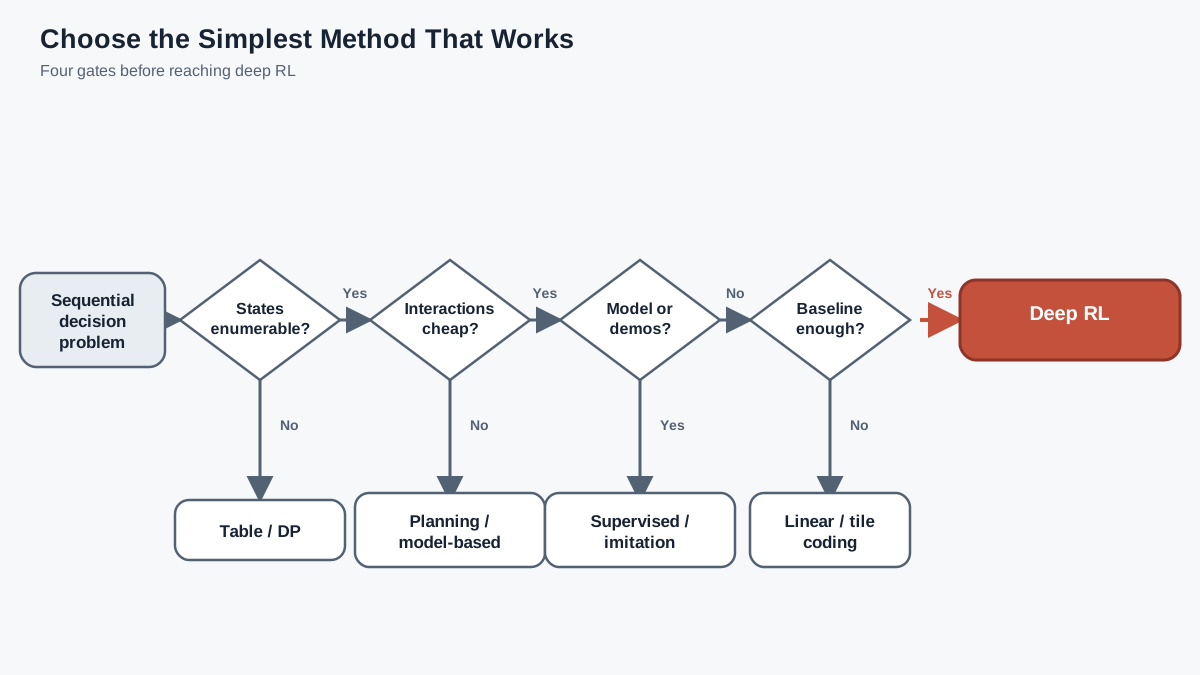
When you face a new sequential decision problem, run through these questions in order:
- Can I enumerate the states? If yes, use a table or a simple method. Deep RL is overkill.
- Can I afford the interactions? If each interaction is slow, costly, or risky, prefer model-based methods or planning.
- Do I have a model or dataset? If you know the dynamics or have good demonstrations, planning or supervised learning may answer the question directly.
- Can I debug the result? If you need to inspect what the agent learned, prefer methods with visible value estimates.
- What does my action space look like? Continuous actions push toward policy-based methods; discrete actions toward value-based methods. But neither question is answered by "use deep RL."
The comparison table below summarizes the decision logic:
| Problem condition | Recommended starting method |
|---|---|
| Enumerable states, known dynamics | Dynamic programming or tabular RL |
| Enumerable states, unknown dynamics | Tabular Q-learning |
| Known dynamics, large state space | Planning or model-based methods |
| Dataset of good demonstrations | Imitation or supervised learning |
| Low-dimensional continuous state | Linear approximator or tile coding |
| High-dimensional observations, cheap interactions | Deep RL |
| Expensive interactions, complex dynamics | Model-based RL with careful sample use |
The honest guidance is this: when the answer to several questions points away from deep RL, start with the simplest method that can produce a signal. Get something working. Measure it. Then ask whether the problem actually requires more.
The builder's rule applies here: the goal is the fastest reliable answer, not the most impressive algorithm. Deep RL is a powerful tool, but it is one tool among many. Knowing when not to use it is part of mastering it.
Before you write any deep RL code, run your own problem through this checklist. Commit to the simplest method that can produce a measurable signal. Add a network only when the baseline provably cannot represent or scale to the problem. That discipline will save you weeks of debugging and give you a stronger foundation when you do finally need deep RL.
Knowledge check
Final check
Finish the article by checking the ideas you just learned.
References
Research updated Sep 9, 2026


