
Dyna-Style Reinforcement Learning: Mixing Real and Imagined Experience
Every real transition in a Dyna-style agent does two jobs at once: it teaches the value learner and it teaches the model. Then the model becomes a second…

Key topics
Every real transition in a Dyna-style agent does two jobs at once: it teaches the value learner and it teaches the model. Then the model becomes a second teacher—one that never touches the environment but never stops talking. The catch is that imagined experience is reuse, not discovery. It amplifies what the model already believes, errors included.
The One Transition, Two Teachers Problem
You already know how a learned model gets built: collect transitions, fit a dynamics function, then plan inside that approximation. You also know how model error compounds when you roll out imagined trajectories over multiple steps. Dyna reinforcement learning sits at a different point in that design space, and it forces you to confront a question the other approaches let you postpone: what happens when the same transition feeds both the value learner and the model, and the model's output then feeds the value learner again?
Here is the architectural move that defines Dyna. When the agent takes action a in state s and observes next state s′ with reward r, that single tuple (s, a, r, s′) is dispatched to two learners simultaneously. The first is whatever value or Q-learning rule you would use in a purely model-free method. The second is the model cache, which records the transition so it can be replayed later.
The model then generates additional transitions internally. The agent samples a previously experienced state-action pair, asks the model what happens next, and applies the same value update rule to that imagined tuple as it did to the real one. Real experience trains the value function directly and trains the model indirectly. The model's output trains the value function again, without any new environment interaction.
That sounds like a free lunch. It is not. Imagined experience contains no new ground-truth information about the environment—it only redistributes information the model has already cached. If the model is accurate, planning amplifies genuine learning signal. If the model is wrong, planning amplifies the error with the same enthusiasm. This is a model-based and model-free hybrid in the most literal sense: one loop, two sources of experience, and a single value-update rule that cannot tell which source produced the tuple it is learning from.
Note: The distinction matters. A model-generated sample can expose what the model currently represents—including its uncertainty—but it cannot correct the model. Only a real environment sample carries ground-truth evidence that can repair a wrong belief.
Knowledge check
Check your understanding
Answer this question before you continue.
What Dyna Actually Does: The Shared Loop
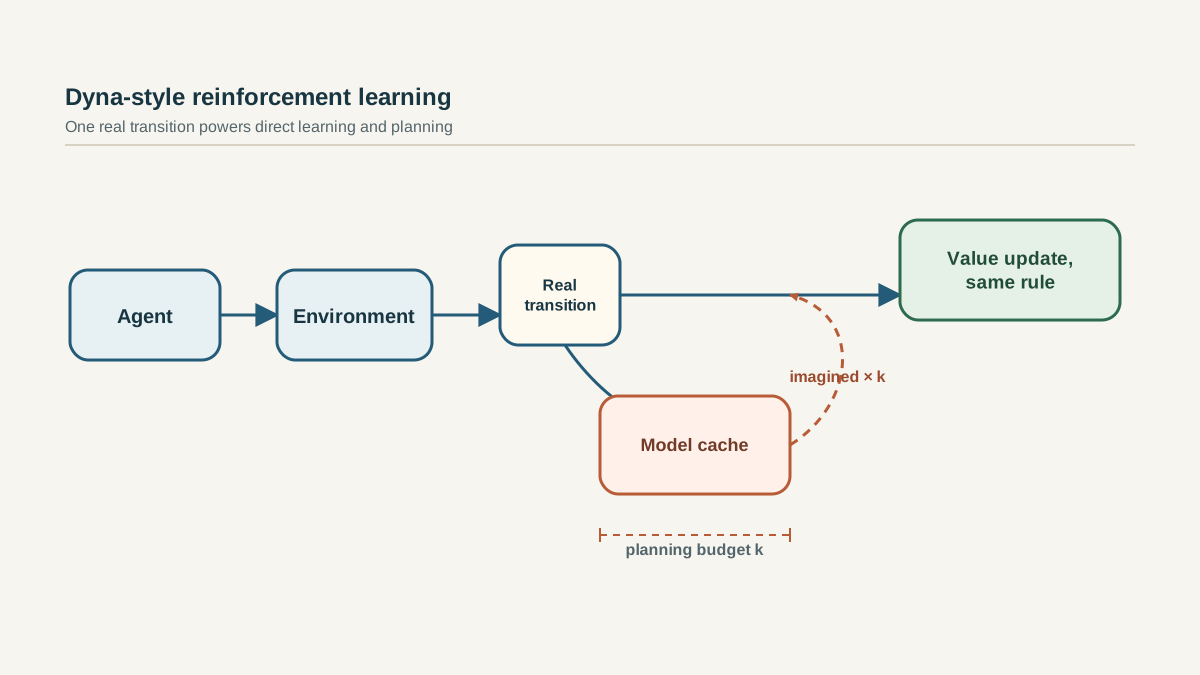
The concrete workflow this article traces is tabular Dyna-Q: a deterministic environment, a cache as the model, and one-step imagined transitions. "Dyna-style" is the broader architectural pattern—any loop that alternates real interaction with model-generated updates. Keep that boundary in mind as the components generalize later.
The Dyna loop is best understood as a numbered workflow, because the ordering of operations determines what the agent learns and when.
- Act. In the current state, select an action using the current policy (for example, ε-greedy with respect to Q).
- Observe. Execute the action and receive the real next state and reward.
- Learn directly. Apply your value-update rule to the real transition.
- Update the model. Record the transition in the model cache.
- Plan. Repeat k times: sample a previously experienced state-action pair, ask the model to produce the next state and reward, and apply the same value-update rule to this imagined transition.
The critical detail is step 5: the planning update uses the identical update rule as the direct learning in step 3. The imagined transition is just another (s, a, r, s′) tuple from the value learner's perspective. The agent does not tag tuples with their origin, and it does not need to—the update rule is agnostic to whether the transition came from the environment or the model.
The k parameter is the planning budget. It controls how many imagined updates happen per real step. Setting k to zero collapses Dyna into plain Q-learning. Increasing k makes the agent spend more computation on internal experience and less on waiting for the environment. Tuning k is a statement about how much you trust the model relative to the cost of real interaction.
In the tabular setting, the model takes a deliberately simple form: a cache that stores the observed outcome for each state-action pair. After the agent experiences (s, a) → (s′, r), the model records that exact outcome and returns it whenever planning samples that pair. This only makes sense when the environment is deterministic. If the same state-action pair can lead to different outcomes, a single cached transition misrepresents the distribution—a point that matters more than it seems at first glance.
Diagram opportunity: Draw a single loop. Real experience flows from the environment into two boxes labeled "value update" and "model update." The model box then feeds imagined transitions back into the value-update box. The value learner cannot tell which arrow fed it.
Knowledge check
Check your understanding
Answer this question before you continue.
Why Imagined Experience Is Not Free
The phrase "imagined experience" suggests something weightless, like rehearsal in a dream. The mechanism is closer to photocopying: the model produces a faithful copy of what it has cached, and every copy inherits the quality of the original.
Real transitions carry new information. Each one is a sample from the true environment dynamics, and even a single unexpected outcome can correct a wrong belief. Imagined transitions carry no new ground-truth information. They only replay what the model already knows, which makes them useful for consolidation—spreading cached knowledge across the value function more densely than real experience alone would allow—but useless for correction.
The amplification mechanism is worth stating precisely. Suppose the model caches a wrong transition: the agent took action a in state s, the environment actually produced s′₁, but the model recorded s′₂. Every planning step that samples (s, a) will replay that wrong outcome into the value function. With a planning budget of k per real step, a single bad cache entry can be replayed dozens or hundreds of times before real experience ever revisits that state-action pair and corrects the record.
This is a different failure mode from the compounding model error you see in multi-step rollouts. In Dyna, the error does not need to accumulate across a long imagined trajectory. A single wrong cached transition, replayed repeatedly, injects the same error into the value function over and over. The repetition is the amplifier.
The deterministic-cache assumption makes this worse in stochastic environments. If the true dynamics are probabilistic—action a in state s leads to s′₁ with probability 0.7 and s′₂ with probability 0.3—a cache that stores only the first observed outcome treats a distribution as if it were a single fact. The model is not slightly wrong; it is categorically wrong about the structure of the environment.
Knowledge check
Check your understanding
Answer this question before you continue.
When Dyna Wins and When It Drifts
Dyna-style reinforcement learning is not universally better than pure model-free or pure model-based approaches. It occupies a specific niche, and knowing where that niche ends is more valuable than knowing where it begins.
Dyna helps when:
- Real interaction is sparse or expensive. If each environment step costs time, money, or physical wear, converting one real transition into k internal updates is a direct sample-efficiency win.
- Dynamics are deterministic or near-deterministic. The cache model is exact when the same action in the same state always produces the same outcome.
- The model is cheap to query. The planning step should cost far less than a real environment step, or the computational overhead eats the sample-efficiency gain.
Dyna hurts when:
- The environment is stochastic. A cached single outcome misrepresents a distribution, and planning replays that misrepresentation confidently.
- Dynamics change over time. Cached transitions from early exploration can go stale as the environment shifts, and the agent keeps replaying beliefs that no longer describe the world.
- Model error is large. If the model is wrong, planning does not just fail to help—it actively trains the value function toward incorrect targets.
The stale-experience failure mode deserves special attention. In early exploration, the agent visits states and actions that its later, improved policy would never choose. Those early transitions get cached. If planning samples uniformly from all cached state-action pairs, it will keep replaying outdated transitions long after the policy has moved on. The value function gets pulled toward beliefs about parts of the state space the agent no longer visits, and those beliefs can be arbitrarily wrong because they were collected under a policy that did not know what it was doing.
Research on Dyna-style methods has examined these limits directly. Recent work has shown that the "free lunch" framing is misleading—model-generated data can actively degrade learning in ways that are not captured by simple model-accuracy metrics. The practical guidance I take from this line of work is straightforward: treat the model's confidence as a first-class signal. If you know which cached transitions are uncertain, do not replay them with the same weight as confident ones.
The coupling between k and model accuracy is the lever you should internalize. Raising k amplifies both sides of the tradeoff. A good model becomes more valuable because its correct predictions get replayed more often. A bad model becomes more damaging because its errors get replayed more often. The planning budget is not a free performance knob—it is a confidence bet on the model.
Common mistake: Tuning k upward to improve sample efficiency without checking whether the model is accurate enough to justify the additional imagined updates. You are not adding learning signal; you are adding repetitions of the signal you already have.
Knowledge check
Check your understanding
Answer this question before you continue.
The Decision Rule Beneath the Budget
When you set k, you are really answering two questions. First: does an imagined update cost less than obtaining comparable real evidence? If the environment is cheap and fast, the answer may be no, and planning is overhead. Second: is the model trustworthy for the state-action pairs being replayed? A model can be accurate overall yet wrong exactly where the policy needs guidance—and uniform sampling from the cache may never surface the pairs that matter.
That second question is why the sampling distribution matters as much as the budget. If planning draws uniformly from all cached transitions, it spends imagined updates on states the policy has already mastered. The value of planning depends on whether the imagined updates reach decision-relevant state-action pairs—the ones where the policy is still uncertain or the value estimate is still shifting. A cheap but irrelevant model wastes computation. An expensive model can still pay off when real interaction is costly enough and the replayed pairs actually shape future decisions.
From Dyna to Modern Hybrids
The Dyna pattern—alternate real interaction with model-generated updates—did not stay confined to tabular gridworlds. It reappears throughout modern model-based reinforcement learning, and recognizing the pattern helps you read those methods as variations on a single design question rather than unrelated inventions.
Modern variants generalize the cache in several directions. Learned neural dynamics models replace the tabular lookup table. Ensembles of models represent uncertainty instead of a single cached outcome. Bidirectional rollouts and prioritized sampling replace uniform random sampling of cached state-action pairs, so the agent plans about states that matter rather than states it happened to visit.
Each generalization changes one component of the loop, and each introduces its own failure mode:
| Component | Tabular Dyna-Q | Modern generalization | New failure mode |
|---|---|---|---|
| Model representation | Exact cache of observed outcomes | Learned neural dynamics model | Function-approximation error in the model itself |
| Model uncertainty | None—every cached entry is treated as fact | Ensembles or probabilistic models | Mis-calibrated confidence can still over-weight bad predictions |
| Sampling distribution | Uniform over visited state-action pairs | Prioritized or bidirectional sampling | Bias toward recently visited or high-error regions |
| Rollout depth | One-step imagined transitions | Multi-step imagined rollouts | Compounding model error across steps |
But every variant faces the same question Dyna posed in 1991: how much should the agent trust imagined experience against real experience? The answer determines the planning budget, the model architecture, the replay distribution, and ultimately whether the hybrid beats either pure approach.
The through-line is that Dyna-style planning is a reusable architectural pattern, not a single algorithm. Once you see the loop—real experience feeds both learners, and the model feeds the value learner again—you can recognize it in methods that look very different on the surface.
The Experiment That Makes It Visible
The gap between understanding this tradeoff and feeling it is best closed by watching it happen. Implement tabular Dyna-Q on a small deterministic gridworld. You need a handful of states, a few actions, one goal state with a reward, and a Q-learning update you already know how to write.
Run it three times.
First, set k to zero. You have plain Q-learning. Measure how many episodes it takes to reach a good policy.
Second, set k to a modest value like five or ten. Watch the agent converge in fewer episodes. This is the sample-efficiency win, and it is real.
Third, deliberately corrupt one cached transition. Pick a state-action pair the agent visits early, and change the recorded next state to point somewhere wrong—ideally, somewhere that looks rewarding but is not. Keep k at the same value. Watch the imagined replay propagate that error into the value function. The agent will start avoiding or seeking states based on a belief that no real transition ever confirmed.
To make the third run diagnostic rather than just unstable, log a few specific values:
- Sampling frequency. How often does planning select the corrupted state-action pair? This tells you how much repetition is doing the damage.
- Model versus reality. Print the cached next state and the real next state for that pair side by side. The discrepancy is the lie the model keeps telling.
- Q-value trajectory. Record the Q value for the corrupted pair before and after each planning phase. Watch it drift toward the wrong target with every imagined replay.
That third run is the lesson. The same mechanism that made the second run faster made the third run wrong. Dyna reinforcement learning does not create information. It spends the information you have more efficiently—and it spends your model's mistakes just as efficiently as its insights.
Your next step: take the corrupted-cache experiment and add a confidence filter. Track how often each cached transition has been confirmed by real experience, and skip imagined updates for pairs with low confirmation counts. Watch whether the agent resists the planted error. That small change turns the failure mode you just observed into a design principle you can carry into any Dyna-style system.
Knowledge check
Final check
Finish the article by checking the ideas you just learned.
References
Research updated Sep 9, 2026


