
Evaluating Multi-Agent Policies: Partners, Opponents, and Exploitability
A policy that crushes its self-play twin can still collapse against a slightly different opponent. That single blind spot is why multi-agent reinforcement…

Key topics
A policy that crushes its self-play twin can still collapse against a slightly different opponent. That single blind spot is why multi-agent reinforcement learning evaluation is a population question, not a head-to-head question.
Why One Opponent Is Never Enough
Here is the failure mode that should keep you up at night. You train a competitive agent through self-play. It reaches a 95% win rate against its own checkpointed twin. You deploy it. A different opponent—same task, same reward structure, slightly different strategy—beats it nine times out of ten.
What went wrong?
The core issue is that a policy's value is not intrinsic. It is defined against the policies it interacts with, because in multi-agent settings, other agents are part of the environment. Your policy's "quality" only exists relative to whoever it is playing against. A self-play win rate measures performance against one specific policy, not robustness across the space of possible opponents.
Self-play evaluation rewards policies that overfit their training partner. The policy learns to exploit the particular patterns, tendencies, and blind spots of its twin. Against that exact opponent, it looks dominant. Against a shifted opponent—one that plays slightly differently, explores different strategies, or simply got different random seeds during training—those exploited patterns disappear, and the policy has nothing left.
The same policy can look dominant against its self-play copy and exploitable against a shifted opponent. A single number cannot certify quality because it measures one point in policy space, not a region.
Treat "beats its self-play copy" as necessary but nowhere near sufficient. It is the anchor criterion that hides brittleness. The self-play win rate tells you the policy learned something about the game. It tells you almost nothing about whether that something generalizes.
This connects directly to the non-stationarity and cycling problems you already know from self-play training. The same dynamics that make training unstable—opponents that keep moving, strategies that chase each other in circles—are exactly why evaluation against a single frozen opponent is structurally inadequate.
Knowledge check
Check your understanding
Answer this question before you continue.
Exploitability: The Policy's Blind Spot
If win rate against a fixed opponent is too weak a test, what is stronger?
Exploitability is the gap between a policy's value and the value a best-responding adversary can force against it. In plain terms: imagine an adversary who knows your policy completely and can adapt their strategy specifically to beat it. How much value can they extract? That gap is your policy's exploitability.
This is a property of the policy itself, not of a particular matchup. A head-to-head result against one opponent conflates skill with matchup luck. Exploitability strips away the luck. It asks: against the worst possible adversary for this policy, how badly do we lose?
Consider a rock-paper-scissors agent that always plays rock. Against another always-rock agent, it ties every round. A self-play evaluation might report a 50% win rate and call it balanced. But the exploitability is total: any adversary who plays paper wins every round. The win rate against one specific opponent hid a structural vulnerability that a best-response probe exposes instantly.
Exploitability is the sharper diagnostic because it searches for the policy's blind spot rather than sampling whatever matchup you happened to choose.
There are important boundaries on where exploitability applies. It is well-defined in two-player zero-sum games, where one agent's loss is exactly the other's gain. In cooperative or general-sum settings, the concept becomes ambiguous. What does "best response" even mean when agents share rewards? The notion of exploiting a partner is incoherent. So use exploitability where it is defined—competitive and adversarial settings—and do not over-apply it to cooperative problems.
The practical cost is real. Measuring exploitability requires searching for a best response, which means training an adversary specifically to beat your policy. That is a computational investment, not a free metric. But it is the difference between asking "did we win?" and asking "can we be beaten?"
Knowledge check
Check your understanding
Answer this question before you continue.
Partners vs. Opponents: Evaluation Depends on Incentives
The evaluation protocol must match the incentive structure of your problem. Cooperative, competitive, and mixed-motive settings each have different failure modes, and therefore different evaluation emphases.
In cooperative settings, the question is whether your policy coordinates with unseen partners. A policy that works beautifully with its training teammate may fail completely with a partner that has a different communication style, timing, or division of labor. Evaluation needs a pool of diverse teammate policies, not one fixed partner.
In competitive settings, the question is whether your policy survives unseen adversaries. Evaluation needs opponent diversity plus exploitability-style probing to expose structural weaknesses.
In mixed-motive settings, both failure modes apply. Your policy can be brittle to partners, opponents, or both, and evaluation must test each axis separately.
| Incentive Structure | Evaluation Focus | Primary Failure Mode | Key Metric |
|---|---|---|---|
| Cooperative | Partner diversity, coordination tests | Overfitting to one teammate's style | Team return across partner pool |
| Competitive | Opponent diversity, exploitability checks | Structural blind spots against best response | Exploitability, worst-case win rate |
| Mixed-motive | Both axes independently | Brittleness to partners or opponents | Profile across both pools |
The classification itself—cooperative versus competitive versus mixed—you already know. What matters here is that each class demands a different evaluation emphasis. Do not evaluate a cooperative agent as if it were a competitive one, and do not assume a competitive agent's win rate tells you anything about its coordination ability.
Knowledge check
Check your understanding
Answer this question before you continue.
Population Testing: Sampling the Policy Space
A population is a set of reference policies that spans the relevant region of policy space. Instead of testing against one opponent, you test against many. Instead of one partner, you test with many.
What belongs in a population? Three categories matter most:
Historical checkpoints. Policies saved at different points during training. These catch forgetting and cycling. A policy that beats the final checkpoint but loses to an earlier version reveals that training regressed through a strategy space it used to handle. A single current opponent misses this entirely.
Heuristic baselines. Simple, hand-crafted strategies that cover basic behavioral modes. They are cheap to run and often expose failures that learned opponents never trigger because they learned similar blind spots.
Trained adversaries. Policies trained specifically to provide diverse challenges, including best-response probes for exploitability measurement.
Diversity beats raw count. A population of fifty near-identical strong policies tests one point in policy space fifty times. A spread of ten weaker but varied policies exposes more failure modes because each one probes a different region of the strategy space. The goal is coverage, not volume.
How do you read the results? Aggregate into a profile, not a scalar. Report the mean, the distribution, and crucially the worst case. For deployment decisions, worst-case often matters more than average. A policy that wins 90% of matchups but loses catastrophically to one common strategy is a liability, not a success.
The principle behind population testing is that one agent's behavior constitutes another agent's environment. Evaluation suites built on this idea generate diverse test scenarios by varying the agents your policy interacts with, revealing weaknesses that training performance alone never surfaces. The same logic applies whether you build a formal suite or a small custom population: the other agents are the environment, so you must sample that environment broadly.
Knowledge check
Check your understanding
Answer this question before you continue.
Seeds, Variance, and the Confounder You Cannot See
Underneath every multi-agent evaluation sits a layer of stochasticity that can silently invalidate your results.
Multi-agent evaluation compounds two sources of variance. First, environment stochasticity: the randomness in transitions and rewards that exists in any RL problem. Second, the stochasticity of the policies being evaluated. Your policy is stochastic. Your opponent is stochastic. Your partner is stochastic. Every interaction samples from all of those distributions simultaneously.
Single runs are near-meaningless. The variance is simply too high for one episode, or even one hundred episodes, to tell you anything reliable about the underlying quality of the policy.
Seed effects can look like algorithm differences. Two runs of the same training procedure with different seeds can produce policies that perform differently against the same opponent pool—not because one is better, but because the stochastic exploration during training landed in different regions of policy space. In single-agent RL, you already know to run multiple seeds before trusting a learning curve. In multi-agent settings, this is amplified because the interacting policies compound the variance.
The practical protocol has three parts:
- Multiple seeds for the evaluated policy. Train several instances from different random seeds.
- Multiple seeds for each partner or opponent. If your opponent pool contains trained policies, train each one multiple times and test against all variants.
- Enough episodes per matchup. Separate signal from noise by collecting enough samples that the confidence intervals around your win rate or return are meaningful.
Reporting one learning curve from one seed is not just weak evidence. In multi-agent settings, it can actively mislead. The curve might look great because that particular seed produced a policy that happens to match up well against the particular opponent seeds you chose. Change either seed and the picture inverts.
Building an Evaluation Protocol That Survives Contact
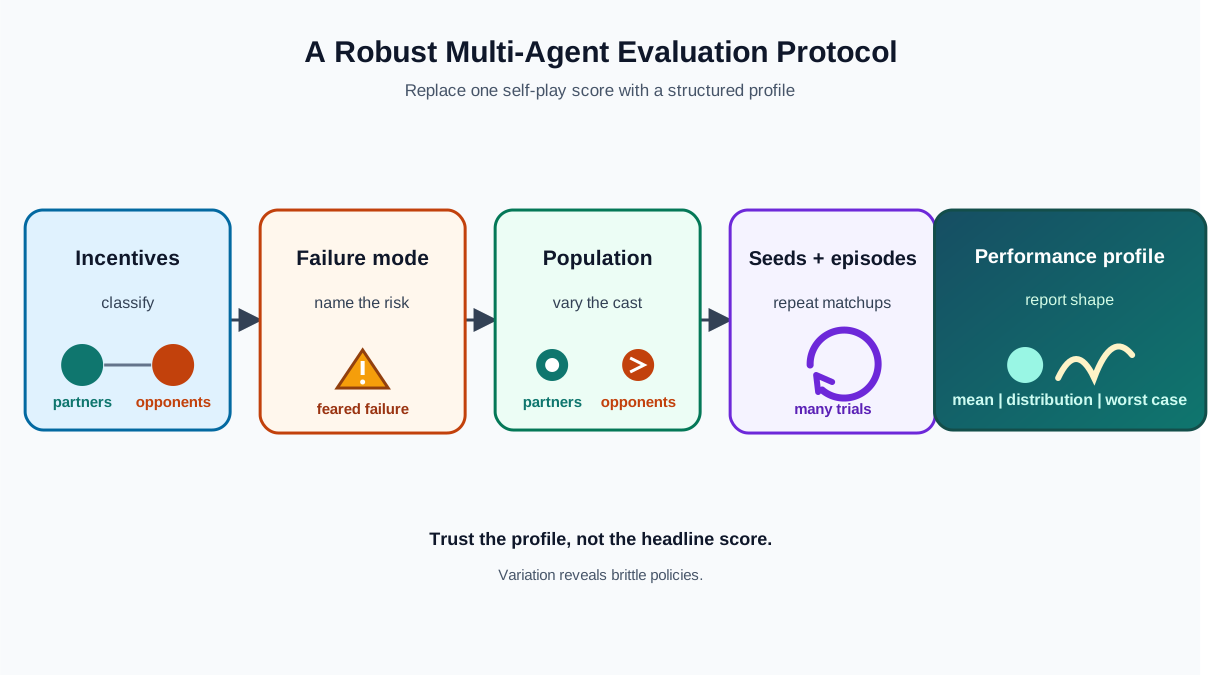
Here is a concrete, ordered protocol you can apply to your next multi-agent evaluation.
Step 1: Classify the incentive structure. Is this cooperative, competitive, or mixed-motive? Your answer determines everything downstream.
Step 2: Name the failure mode you fear most. Are you worried about coordination failure with unseen partners? Structural exploitation by an adversary? Both? The failure mode you fear determines what you test.
Step 3: Assemble a diverse population. Include historical checkpoints from training, heuristic baselines, and trained adversaries or partners. Prioritize diversity over count. If you are evaluating a competitive agent, include at least one best-response probe to measure exploitability.
Step 4: Run enough seeds and episodes. Multiple seeds for the evaluated policy, multiple seeds for each population member, enough episodes per matchup to produce stable estimates.
Step 5: Report a profile, not a scalar. Mean performance, distribution across the population, and worst-case results. For deployment decisions, weight the worst case heavily.
When is this overkill? If you are evaluating a simple, low-stakes, fully cooperative agent that will always work with a fixed partner, a small population and modest seed count may suffice. The protocol should scale with the stakes of the deployment decision. If the policy will face unknown agents in production, population and seed testing is mandatory, not optional.
The cost tradeoff is honest: population and seed testing is expensive. Training best-response adversaries is computationally heavy. Running hundreds of matchups across diverse populations takes time. But the cost of deploying a brittle policy—one that looked great against its self-play twin and fails against the real world—is almost always higher.
A worked scenario. You are evaluating a competitive agent for a game-playing system. You train it through self-play and it reaches a 92% win rate against its final checkpoint. Instead of stopping there, you assemble a population: three historical checkpoints from earlier training, two heuristic baselines (an aggressive rush strategy and a defensive counter-strategy), and one best-response adversary trained specifically to exploit your policy. You train each population member with three seeds and run 500 episodes per matchup.
The results surprise you. Against the historical checkpoints, your policy wins 88% of the time—good. Against the heuristic baselines, it wins 95%—excellent. Against the best-response adversary, it wins 12%. The adversary found a structural weakness that none of your other opponents exposed. Your self-play win rate of 92% was real but irrelevant. The exploitability check revealed the truth: against an adversary that adapts to your specific strategy, your policy collapses.
That is the value of the protocol. It does not certify your policy as good. It tells you against which policies your policy stays good, and under which variation it breaks.
The durable mental model: evaluation is not asking "is my policy good?" It is asking "against which policies, and under which variation, does my policy stay good?"
A multi-agent policy is only as trustworthy as the population it survived. Make population testing a continuous habit, not a final certification. Run your current policy against a small diverse population—including a historical checkpoint and a best-response probe—before you trust any single score. Then do it again after every significant training update. The population is your early warning system. Use it.
Knowledge check
Final check
Finish the article by checking the ideas you just learned.
References
Research updated Sep 9, 2026


