
Communication and Coordination in Multi-Agent RL
More communication is not automatically better coordination. In cooperative multi-agent reinforcement learning, a naive message-passing channel can inject…

Key topics
More communication is not automatically better coordination. In cooperative multi-agent reinforcement learning, a naive message-passing channel can inject noise, burn bandwidth, and destabilize convergence just as easily as it can align teammate decisions. The real design problem is not how to let agents talk—it is how to make each message earn its bandwidth.
Why Local Views Need a Channel
Decentralized execution is the constraint you inherit from centralized training with decentralized execution (CTDE): at decision time, each agent selects actions from its own local observation, with no access to the centralized information that shaped its training. Value decomposition methods respect the same boundary—they factor team value into agent-wise components precisely so that local action selection remains possible.
Partial observability is what breaks this arrangement. When no single agent sees the full state, coordination fails exactly when two agents must act on complementary hidden information. Agent A sees the left half of the problem; Agent B sees the right half. Neither can act correctly alone, and no amount of clever value factorization repairs the missing information at execution time.
Communication widens the local view at execution time. It is a distinct mechanism from the training-time information flows you already know: instead of a centralized critic that vanishes after training, communication is a channel that persists during deployment. Agents exchange signals, fuse them with their own observations, and act on a view that is wider than any single sensor.
That raises the central design question this article traces: what should an agent say, to whom, and when? The answer determines whether your channel produces genuine coordination or merely adds a second source of noise.
Knowledge check
Check your understanding
Answer this question before you continue.
Explicit vs. Implicit Communication
Coordination signals fall into two families, and the distinction matters before you write any code.
Explicit communication uses a dedicated message channel. Agents broadcast or target messages to specific teammates, and the content is a learned artifact—a vector, a discrete symbol, or a compressed observation. This is the dominant paradigm in communication multi-agent reinforcement learning research: end-to-end differentiable channels that learn what to say through gradient descent.
Implicit communication has no separate channel. Agents embed signals in their actions or by modifying the environment state, and teammates learn to read those cues. The comparison to social insects is apt: ants deposit pheromones, and other ants adjust their behavior in response. No one sends a message; the environment itself becomes the medium.
| Dimension | Explicit | Implicit |
|---|---|---|
| Channel cost | Dedicated bandwidth required | Near zero |
| Expressiveness | High; learned content | Limited by action space |
| Learning difficulty | Straightforward end-to-end | Harder; cues must emerge |
| Typical failure | Bandwidth saturation | Degrades under severe partial observability |
The decision rule follows from the trade-offs. Choose implicit signaling when bandwidth is effectively zero and actions are observable by teammates. Choose explicit messaging when hidden information is large and a channel is affordable. A middle path exists: some frameworks generate a consensus from local observations and disable communication when that consensus is confident, reserving the channel for genuinely uncertain moments.
Knowledge check
Check your understanding
Answer this question before you continue.
From Observation to Message: The Learned Channel
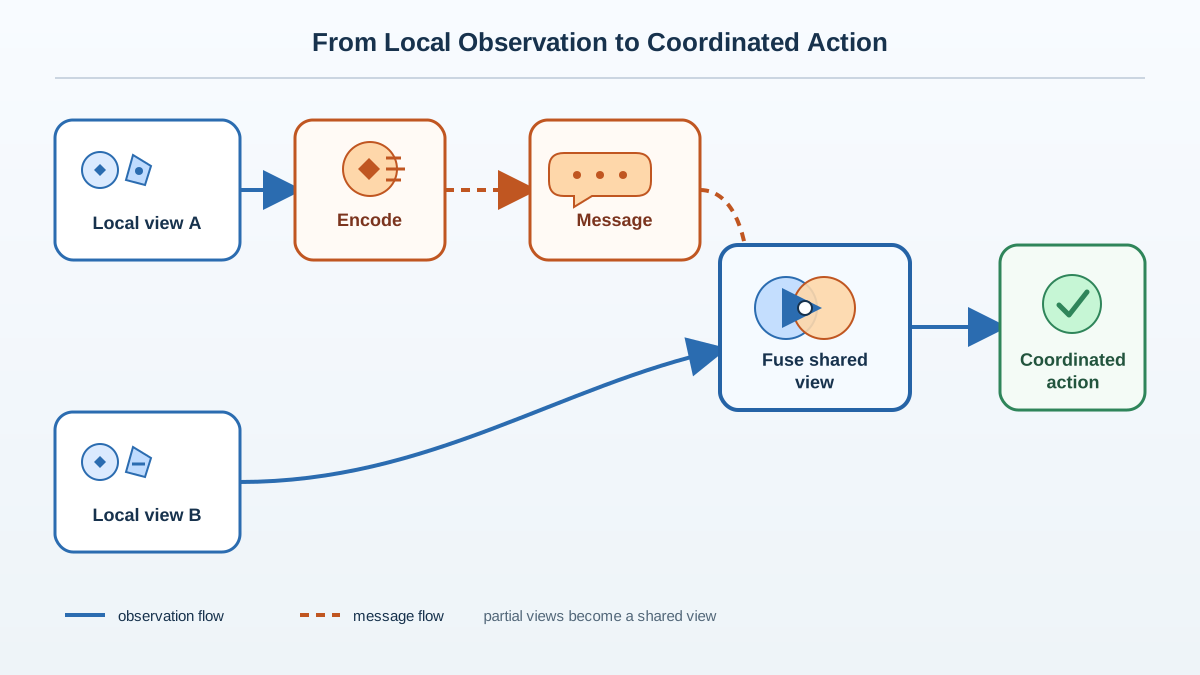
The pipeline that turns a local observation into a coordinated action has three stages.
Encode. Each agent passes its local observation through an encoder network, producing a latent representation. This representation compresses what the agent sees into a form suitable for sharing.
Message. A message function transforms that latent representation into a signal addressed to one, some, or all teammates. The addressing scheme is a design choice: broadcast to everyone, target specific agents, or let the receiver decide what matters.
Fuse and act. The receiving agent combines incoming messages with its own observation before selecting an action. The fusion can be a simple concatenation or an attention-weighted aggregation that filters redundant signals.
A critical property distinguishes this channel from ordinary data transmission: the message is not a fact about the world. It is a learned artifact whose only job is to improve the receiver's decision. It may encode intent, uncertainty, or a compressed observation—whatever the training signal rewards. This is what makes learned communication agents genuinely different from hand-designed protocols.
The message representation introduces a training trade-off. Continuous messages allow gradients to flow through the channel during training, which makes end-to-end learning straightforward. Discrete messages satisfy real-world bandwidth limits but break gradient flow; they require reinforcement learning or a relaxation technique such as Gumbel-Softmax to train. A practical compromise: train with continuous messages, then discretize at execution time to meet channel constraints.
Knowledge check
Check your understanding
Answer this question before you continue.
Who Talks to Whom: Topologies and Attention
The naive baseline is fully connected broadcast: every agent hears every message. It is simple and works for small teams, but message volume grows quadratically with team size, and most of those messages are irrelevant to any given receiver.
Attention-based routing fixes the receiver side. Instead of treating all incoming messages equally, an agent weights each message by its relevance to the current decision. Messages from teammates with complementary information get high weight; redundant or irrelevant signals get suppressed. This is selective listening, and it often matters as much as selective speaking.
Hard attention or gating goes further by deciding whether communication is needed at all. An agent evaluates its own confidence from local observations and initiates communication only when the local view is insufficient. This dynamically forms sparse local groups instead of a dense graph—a topology that emerges from the situation rather than being fixed in advance.
Structural alternatives restrict the graph by design. Graph-based communication limits exchanges to defined neighbor relationships. Hierarchical or role-based structures route messages through designated coordinators or proxies, trading latency and expressiveness for a predictable, scalable pattern.
The failure mode to watch: redundant messages do not merely waste bandwidth. They add noise to the receiver's state and can actively impair convergence. Dense topology suits small teams with cheap bandwidth; sparse, gated, or role-structured communication becomes necessary as teams grow or the channel tightens.
Knowledge check
Check your understanding
Answer this question before you continue.
The Cost of Talking: Bandwidth and Message Budgets
Bandwidth cost has three levers: how many agents talk, how often they talk, and how large each message is. Treat communication as a budgeted resource and ask whether each bit improves the team's expected return.
Message variance is a hidden cost that deserves special attention. Noisy messages carry little signal, and that noise propagates into the receiver's policy. Limiting message variance during training can cut communication overhead substantially while preserving the useful content—a simple technique that outperforms more elaborate schemes on several benchmarks.
Event-triggered communication addresses the frequency lever. An agent stays silent when its local decision is already reliable and speaks only when confidence drops below a threshold. This converts continuous chatter into occasional, high-value messages.
Discretization addresses the size lever. Continuous messages during training preserve gradient flow; discrete messages at execution time satisfy real-world channel limits. The training-time and execution-time representations can differ without harming performance.
The deeper point is that over-communication is not a harmless inefficiency. It actively hurts learning by injecting noise into the receiver's state. A channel that carries everything effectively carries nothing useful.
When Communication Fails: Failure Modes and Evaluation
Learned channels fail in recognizable patterns, and recognizing them early saves debugging time.
Message collapse. Agents converge on a degenerate signal that carries no information—a fixed vector, a constant symbol, or a message that the receiver learns to ignore. The channel exists but does no work. This often appears as a communication-enabled agent performing identically to its no-communication baseline.
Bandwidth saturation. The channel cost outweighs the coordination gain. The team coordinates slightly better, but the price in bandwidth, latency, or compute exceeds the value of that improvement. This is a deployment failure rather than a learning failure.
Brittle protocols. A learned channel overfits to training teammates. The protocol works because it exploits the specific quirks of the agents it trained with; when the team changes—a new teammate, a different role assignment—the channel breaks. This is the communication analog of overfitting to a fixed opponent.
Evaluation discipline protects you from all three. Compare your communication-enabled team against two reference points: a no-communication baseline and a fully-observable upper bound. The gap between baseline and full observability is the coordination opportunity; the gap your channel closes is its actual contribution. If removing the channel does not measurably hurt team return, the communication is not earning its bandwidth.
Ablation guidance matters here. A communication method bundles several design choices—topology, message size, gating mechanism, fusion function. Each is a separate claim. Isolate each choice by swapping it out or removing it entirely, and attribute the benefit correctly rather than crediting the whole bundle. Measure everything: cumulative reward, episode length, message volume, and the variance of exchanged messages. Watch recorded episodes; silent failures are common in multi-agent systems, where the code runs without error while coordination quietly never emerges.
The Evaluation Discipline
Communication in multi-agent RL is a budgeted, learned resource. It earns its place only when it closes a measurable portion of the coordination gap between what agents can do alone and what they could do with perfect information.
The concrete next step: run an ablation on your own cooperative task. Train three versions—no communication, learned communication, and a fully-observable oracle. Compare team return across all three. If your channel does not move the metric, the problem is not the channel's capacity; it is the message's content, the topology's structure, or the fusion function's ability to use what it receives. Find which link in the observation-to-message-to-action pipeline is silent, and fix that.
Knowledge check
Final check
Finish the article by checking the ideas you just learned.
References
- Communication Methods in Multi-Agent Reinforcement Learning
- Efficient Communication in Multi-Agent Reinforcement Learning via Variance Based Control
- Efficient Communication in Multi-Agent Reinforcement ...
- A survey of multi-agent deep reinforcement learning with ...
- Competitive Multi-Agent Reinforcement Learning (DDPG) with TorchRL Tutorial
- Spinning Up as a Deep RL Researcher — Spinning Up documentation
Research updated Sep 9, 2026


