
Markov State Sufficiency in Reinforcement Learning: When Is State Enough?
Two situations look identical to your agent. It takes the same action. One time the world rewards it; the next time the world punishes it. You blame the…

Key topics
Two situations look identical to your agent. It takes the same action. One time the world rewards it; the next time the world punishes it. You blame the environment, then the learning rate, then the seed. The real culprit is usually the state itself: it is not wrong, it is insufficient.
This article is a test, not a definition to memorize. By the end you will be able to take a proposed state representation, run a sufficiency check on it, and decide whether to repair it or change your method class.
The Symptom: Same State, Different Future
Picture a cart on a track. Your state records only its position. The cart is at position 3, moving right. Later, the cart is at position 3, moving left. Your state calls both of these s = 3.
From s = 3, the agent pushes right. In the first case, the cart keeps rolling right and hits a reward. In the second, it brakes, reverses, and hits a wall. Same state, same action, opposite outcomes.
This is what a history-dependent state representation looks like in practice. The state is a function of the true situation, but it throws away information the future still depends on. The dynamics are not noisy. They are conditional on something your state cannot see.
The cost shows up everywhere downstream:
- Value estimates bounce because the same
(s, a)pair genuinely produces different returns. - The environment looks non-stationary even when it is not.
- No stationary policy can be optimal, because the best action at
s = 3depends on a fact the state erased.
If you already know the MDP tuple and the agent-environment loop, you have the vocabulary to name this. The rest of the article turns the intuition into a condition you can check.
Knowledge check
Check your understanding
Answer this question before you continue.
Notation and the Sufficiency Condition
Fix the symbols first.
- : the state at time .
- : the action taken at time .
- : the next state.
- : the reward received after the transition.
- : the full history up to and including the current state.
A state representation is Markov sufficient when the current state and action are all you need to predict what comes next. Formally, for every history and every action :
Read that in plain causal language: once you know the current state and the action, the past adds no predictive information. The history is redundant. This is the conditional independence MDP assumption stated as a testable claim—the next state and reward are conditionally independent of the past given .
Two assumptions sit underneath this test, and you should name them out loud.
First, every action is available in every state. If action availability itself depends on history, the sufficiency test has to account for that too. We assume it away, as is common, so the test stays focused on transitions and rewards.
Second, sufficiency for prediction is what makes sufficiency for control possible. A stationary, state-dependent optimal policy only makes sense if the state is a sufficient statistic. If the best action depends on hidden history, no function of the current state can be optimal. That is the real reason the Markov property in reinforcement learning matters—not as a definition to recite, but as the precondition for the algorithms you are about to run.
Knowledge check
Check your understanding
Answer this question before you continue.
A Compact Process to Test the Condition
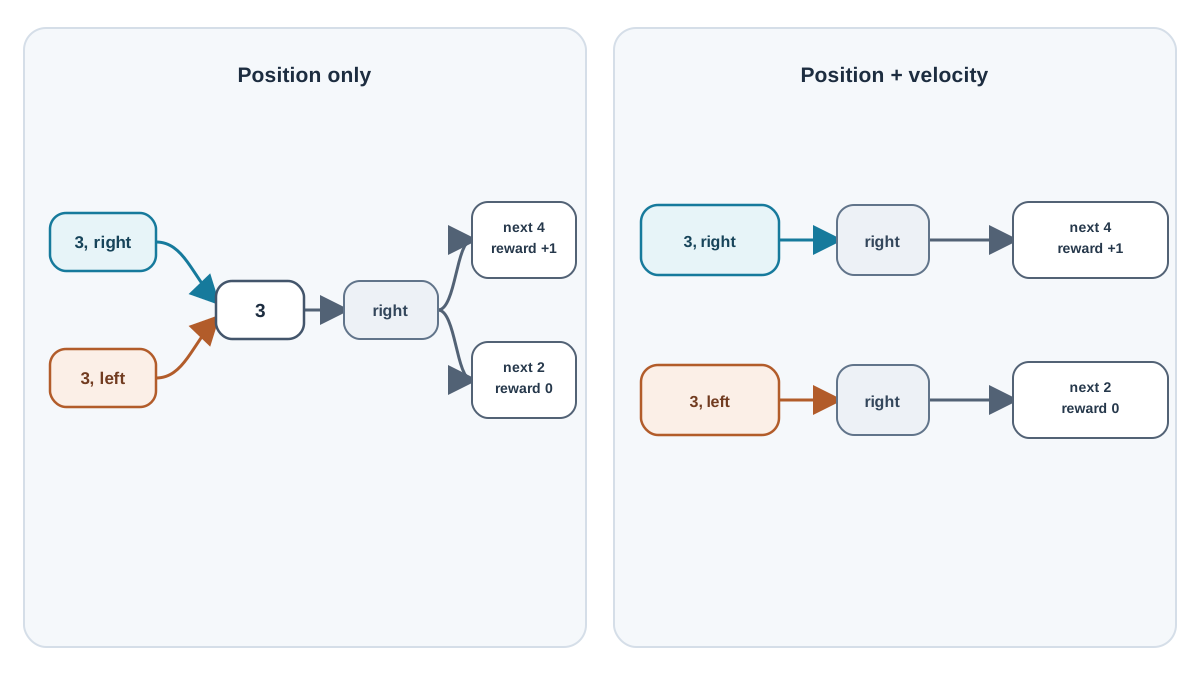
Here is a small process you can check by hand. It is deliberately minimal so the failure is provable, not a matter of degree.
The environment. A cart moves on a line of five positions, through . At each step the agent chooses left or right. The cart has a velocity: it moves one position in the direction of its current velocity, and the chosen action sets the velocity for the next step. At the edges the cart stays put. The agent receives reward when it reaches position , and otherwise.
The reduced state. Your representation records only position: . It does not record velocity.
Now pick a state and action and compare two histories that both land in it.
- History A: the cart moved right into position 3, so its velocity is right.
- History B: the cart moved left into position 3, so its velocity is left.
Both histories produce . Take action right.
Under History A, the action sets velocity to right, so the cart moves to position 4 and collects :
Under History B, the action also sets velocity to right, but the cart's prior velocity was left, so it first decelerates and moves to position 2:
The two distributions disagree for the same pair. That is the falsification. The position-only state fails the sufficiency test, and the failure is binary—it either holds for all histories or it does not.
Note: This is a sufficiency check on a representation, not a general treatment of partial observability. We are asking one narrow question: does this state carry enough information to support standard MDP reasoning?
Knowledge check
Check your understanding
Answer this question before you continue.
Repair by Augmenting State
The fix is constructive. Find the omitted variable that caused the divergence, add it to the state, and re-run the same test.
In the cart example, the missing variable is velocity. Position alone cannot distinguish "moving right" from "moving left," but the transition depends on exactly that. So augment the state:
Now recompute. History A and History B no longer map to the same state—they map to and . Condition on and action right: the next state is always , reward always . Condition on and action right: next state is always , reward always . The distributions now agree across all histories that share the augmented state. The condition holds.
This is state augmentation in reinforcement learning in its simplest form: add the minimal variable that restores the conditional independence you need.
The tradeoff is real. A larger state space costs memory and sample efficiency—every extra dimension multiplies the number of states the agent must visit to learn reliable estimates. So augment minimally. Add the one variable that resolves the divergence, re-test, and stop.
Common mistake: Augmenting with redundant or leaky features. Adding a timestamp that correlates with the missing variable, or a feature derived from the reward, inflates the state without restoring sufficiency. The test is not "does the state look richer?" It is "do the conditional distributions now agree?"
Knowledge check
Check your understanding
Answer this question before you continue.
When the Condition Fails and You Cannot Fully Repair It
Sometimes the missing information is unobservable or unbounded. A robot with a hidden battery state, a dialogue agent whose reward depends on a conversation from ten turns ago, a game whose rules change based on an unseen flag—these do not yield to a clean augmentation.
Two honest options remain.
Accept a near-Markov approximation. In practice, states that are almost sufficient often work. The agent averages over the residual ambiguity and still learns useful behavior. This buys you a working system, but you should know you are paying for it: value estimates will be biased, and the bias will not shrink with more data if the ambiguity is structural.
Change the method class. When augmentation is infeasible, switch to methods that tolerate partial observability—recurrent policies, stacked observations, or belief-state methods. These do not pretend the state is Markov; they carry history explicitly.
Here is the decision rule I would use:
- Test sufficiency first.
- If it fails, augment minimally and re-test.
- If augmentation is infeasible, change the method class.
Warning: Silently assuming Markov sufficiency is the most expensive shortcut in an RL pipeline. It does not fail loudly. It fails as slow, confusing underperformance that you will misattribute to hyperparameters for weeks.
A Practical Checklist for Your Own State
Turn the criterion into a procedure you can run before training.
- List the candidate variables. Ask which ones the next-state and reward distributions actually depend on. Write them down.
- Group trajectories by . Collect real transitions and bucket them by the state-action pair your representation produces.
- Compare empirical distributions. Within each bucket, look at the spread of next states and rewards. If they disagree across histories, the state is insufficient.
- Name the missing variable and add it. Augment minimally, then re-run steps 2 and 3.
- Re-check after any change to the observation pipeline. A previously sufficient state can become insufficient when you add noise, downsample, or drop a sensor.
That last point matters more than it sounds. Sufficiency is a property of your representation relative to your environment, and both can change. A state that passed the test last month may fail after a refactor.
The payoff connects directly to value estimation. A sufficient state is what makes and well-defined predictions rather than averages over hidden conditions. When the state is insufficient, your Bellman backups are quietly averaging over futures that should have been distinguished—and no amount of training will fix a target that was never well-defined.
Before you trust any value estimate or policy, run the sufficiency test on your state. If it fails, augment minimally and re-test. If it cannot be repaired, change the method class instead of hoping the agent averages out the ambiguity. The next step is to see how value functions and Bellman backups depend on exactly this assumption—because once you know what a sufficient state buys you, the reason those backups converge stops being a mystery.
Knowledge check
Final check
Finish the article by checking the ideas you just learned.
References
Build a stronger RL mental model
Use structured resources to connect equations, algorithms, and observable agent behavior.


