
Value vs Q-Value vs Advantage in Reinforcement Learning
You're reading an actor-critic explanation and you hit three symbols: V, Q, and A. The critic estimates V. The policy gradient weights updates by A.…

Key topics
You're reading an actor-critic explanation and you hit three symbols: V, Q, and A. The critic estimates V. The policy gradient weights updates by A. Somewhere a Q-learning variant updates Q. They all predict future reward, so why do algorithms need three different quantities?
Here's the core insight: V, Q, and A are not three separate ideas. They are one idea—the expected discounted return—viewed at three zoom levels. State, action, and action-relative-to-baseline. And the advantage is literally the difference between the other two:
A(s,a) = Q(s,a) − V(s)
One qualification before we go further: all three are defined with respect to a specific policy. V^π, Q^π, and A^π describe what happens when the agent follows policy π. Change the policy and every value changes. Also, the identity above is exact for the true mathematical quantities; in practice, algorithms work with learned estimates that only approximate these ideals.
Once you see that identity as a relationship rather than a definition to memorize, the symbols stop being interchangeable and start answering three different questions.
Why V, Q, and A keep appearing together
If you've worked through value functions and Bellman reasoning, you already know the foundation: an agent predicts discounted future reward to compare consequences rather than reacting only to immediate rewards. V and Q are both such predictions. The confusion starts when algorithms use them in different roles.
The recurring situation looks like this. In an actor-critic setup, a critic network estimates V(s) to evaluate how good the current state is. In PPO, you compute advantages to decide which actions to reinforce. In dueling network architectures, a model splits its output into a value stream and an advantage stream, then combines them to reconstruct Q.
Each quantity earns its place because each answers a different question:
- V(s) asks: how good is this state, on average, under the current policy?
- Q(s,a) asks: how good is this specific action from this state?
- A(s,a) asks: how much better is this action than what the policy typically does from this state?
The decision rule that follows: V judges a state, Q judges an action from a state, and A judges an action against the state's typical outcome.
Knowledge check
Check your understanding
Answer this question before you continue.
V(s): how good is this state, on average
The state value function V(s) is the expected discounted return starting from state s and following the policy from there onward. The key phrase is on average—V averages over every action the policy might choose.
That averaging is both the strength and the limitation. V tells you whether a situation is good, but it deliberately ignores which action got you there or which action you should take next.
Picture a chess position. A strong position might have a high V because the policy, on average, wins from here. But V cannot tell you the best move. Two positions can have identical values while offering very different tactical opportunities, because V has already blended those opportunities into a single number.
This makes V the natural baseline. It represents what the policy typically achieves from this state—the reference point against which individual actions should be measured. When an algorithm needs to know "is this situation good or bad," V is the quantity it reaches for.
Knowledge check
Check your understanding
Answer this question before you continue.
Q(s,a): how good is this action from this state
The action value function Q(s,a) is the expected discounted return from taking action a in state s, then following the policy afterward. Where V averages over actions, Q conditions on one specific action.
That single difference changes what you can do with it. Because Q isolates an action, it can rank competing actions in the same state. V tells you the position is strong; Q tells you which move is best.
Return to the chess example. V says the position is winning. Q evaluates each candidate move and finds that one sacrifice leads to a forced mate while the quiet alternative only maintains the advantage. The ranking comes from Q, not V.
This is why value-based control methods like Q-learning optimize Q directly. If you want to select actions by their expected consequences, you need a quantity that distinguishes between actions. The greedy policy picks the action with the highest Q, and the Bellman optimality equation for Q backs that choice into the learning update.
One boundary worth naming: Q^π evaluates an action while following π afterward, but many control algorithms aim for a different target—Q*, the optimal action-value function. Greedy action selection is appropriate when the learned Q is intended to approximate that control target. Not every Q estimate you encounter is meant to be acted on greedily.
The relationship between V and Q is worth stating precisely: V(s) is the expectation of Q(s,a) over actions sampled from the policy. In other words, V is the policy-weighted average of Q values in that state.
Knowledge check
Check your understanding
Answer this question before you continue.
A(s,a): how much better this action is than the policy's default
The advantage function subtracts the state baseline from the action value:
A(s,a) = Q(s,a) − V(s)
Advantage asks a relative question: does this action beat what the policy typically achieves from this state? Not whether the outcome is absolutely large, but whether it is large compared to the alternatives available here.
That relativity matters more than it first appears. The goodness of a move always depends on the available alternatives. Getting a modest reward feels great only if the alternative was worse. A state with high V might make a mediocre action look acceptable in absolute terms, but the advantage reveals that the policy could have done much better. Conversely, an action in a terrible state might produce a low absolute return yet still be a strong improvement over the policy's usual behavior there.
A worked example makes the relationship concrete
Let's make this tangible with one state, two actions, and a stated policy. Suppose you're in state s with two possible actions:
- Action a₁ has Q(s,a₁) = 10
- Action a₂ has Q(s,a₂) = 4
Your current policy π picks a₁ with probability 0.75 and a₂ with probability 0.25. Then:
V(s) = 0.75 × 10 + 0.25 × 4 = 8.5
Now compute the advantages:
A(s,a₁) = 10 − 8.5 = +1.5 A(s,a₂) = 4 − 8.5 = −4.5
Notice what happened. Q ranked a₁ above a₂, and advantage agrees. But advantage also tells you how much each action deviates from the policy's baseline. Action a₁ beats the state's typical outcome by 1.5; action a₂ falls 4.5 short. And because V is the policy-weighted average of Q, the policy-weighted advantages sum to zero: 0.75 × 1.5 + 0.25 × (−4.5) = 0.
This is the mechanism behind the "centered" signal that policy-gradient methods want. In a policy-gradient update, a positive advantage tells the policy to make that action more likely; a negative advantage tells it to pull back. Advantage is a training signal, not a final action-selection rule—you wouldn't use A to pick actions directly the way you would with Q.
The deeper reason advantage matters for learning: it separates two signals that otherwise get tangled together. "This state is good" and "this action is good within this state" are different claims. If you weight a policy update by raw return, you might reinforce an action simply because it happened in a good state. Advantage subtracts the state's contribution, leaving only the action's relative contribution.
Knowledge check
Check your understanding
Answer this question before you continue.
How the three quantities relate: one identity, three questions
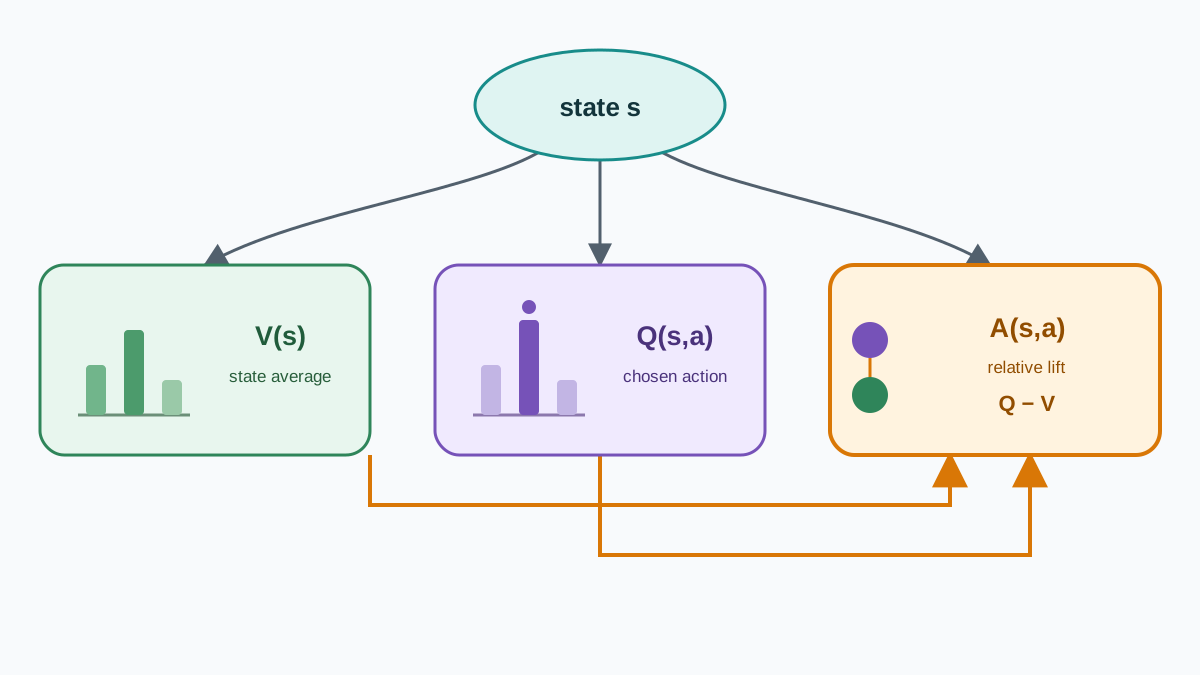
The identity A = Q − V means knowing any two of the three gives you the third. That is not a mathematical curiosity—it is the design principle behind architectures that estimate some quantities and derive others.
| Quantity | Measures | Answers | Conditions on | Typical role |
|---|---|---|---|---|
| V(s) | Expected return from a state | How good is this situation? | The state | Baseline, critic signal |
| Q(s,a) | Expected return from an action | How good is this action? | State and action | Action selection, value-based control |
| A(s,a) | Action value minus state baseline | How much better is this action than the policy's default? | State and action, relative to policy average | Policy-gradient weighting, variance reduction |
The zoom metaphor helps: V is the wide shot of the state. Q is the close-up of one action. A is the close-up measured against the wide shot—the action's value with the state's typical outcome subtracted out.
One boundary case clarifies the relationship. For the best action under a deterministic policy, Q equals V and the advantage is zero. The action merely matches what the state already promises. Advantage only becomes nonzero when an action deviates from the policy's expectation, for better or worse.
When to reach for each quantity
Choosing the right quantity is a matter of asking which question you need answered.
Use V when you need a baseline or a critic signal. If you want to judge how good a situation is, predict expected return, or reduce variance in policy gradients, V is your quantity. Actor-critic methods train a critic network to estimate V, then use those estimates to evaluate whether the policy's recent behavior was better or worse than expected.
Use Q when you need to rank or select actions directly. Value-based control, greedy action choice, and off-policy learning all require action-level distinctions. Q-learning updates Q values and extracts a policy by taking the argmax over actions. If your algorithm must decide between actions in the same state, Q is the quantity that supports that decision.
Use A when you need to know whether an action beat the policy's expectation. Policy-gradient weighting, actor-critic updates, and variance reduction all benefit from the relative signal. PPO and similar methods compute advantage estimates—often through Generalized Advantage Estimation—to decide which actions to reinforce and which to suppress in the policy update.
There is also a when-not-to-use for each. V cannot pick actions; it has already averaged over them. Q can be noisy as a policy-gradient weight because it carries the state's value along with the action's contribution. A requires a value estimate to subtract, so it adds the cost of learning or predicting V.
Common mistakes that come from notation-only learning
Most confusion about V, Q, and A comes from memorizing symbols without attaching them to the questions they answer. The failure modes are predictable.
Mistake 1: treating V and Q as interchangeable. Both predict reward, but V averages over the policy's action choices while Q conditions on one action. If you blur that distinction, you will reach for V when you need to rank actions, and wonder why it cannot help.
Mistake 2: assuming advantage is a separately learned quantity. A is derived—it is the difference between Q and V. Some architectures learn V and A separately and combine them to recover Q, but the definitional relationship always holds. Advantage is not a third independent prediction; it is a comparison.
Mistake 3: confusing "this state is good" with "this action is good." When debugging training curves or reading algorithm outputs, a high V in a state does not mean the last action was good. The action might have been worse than the policy's average. Advantage exists precisely to catch that case.
Mistake 4: forgetting that all three are policy-dependent. Change the policy and every value changes. V, Q, and A are all defined with respect to a particular policy's behavior. This is why off-policy learning and policy updates require care—the values you estimated describe the old policy, not the new one.
Here is a diagnostic that catches all four: if your mental model produces the wrong question, you will reach for the wrong quantity. The fix is not to memorize more definitions. It is to ask which question you actually need answered.
The decision rule to carry forward
When you next read an algorithm explanation, do not try to remember what V, Q, and A stand for. Ask which question each term is answering:
- How good is this state? → V
- How good is this action from this state? → Q
- How much better is this action than the policy's baseline? → A
Let the question pick the quantity. Then trace how the algorithm uses it. In an actor-critic, the critic estimates V to provide the baseline. In PPO, the advantage weights the policy update. In dueling networks, separate value and advantage streams recombine into Q for action selection.
The symbols will stop blurring together once each one has a question attached to it. That attachment—not the notation—is what makes the quantities useful.
Knowledge check
Final check
Finish the article by checking the ideas you just learned.
References
Research updated Sep 9, 2026


