
When Hierarchical Reinforcement Learning Helps: Subgoals, Skills, and Horizon
A flat agent that learns the easy part of a long task and then stalls is not asking for a hierarchy. It is asking for a diagnosis.

Key topics
A flat agent that learns the easy part of a long task and then stalls is not asking for a hierarchy. It is asking for a diagnosis.
You have probably seen the pattern. The reward is sparse, the episode runs for hundreds or thousands of primitive steps, and the value function spends most of its life propagating a signal that arrives too late to shape anything useful. The tempting fix is to bolt on a hierarchy: a high-level policy picks subgoals, a low-level policy executes them, and suddenly the effective horizon looks short. That story is real, but it is incomplete. Hierarchy is not a free speedup. It is a second learning problem stacked on top of the first, with its own failure modes, its own non-stationarity, and its own debugging cost.
This article is a decision procedure, not a tour of HRL algorithms. The question is narrow: given a long-horizon problem that trains slowly, how do you decide whether hierarchy is likely to simplify it or just add a harder problem on top? Four criteria do most of the work — horizon, repetition, compositionality, and subgoal reliability. They do not carry equal weight. Horizon creates the opportunity, subgoal reliability decides feasibility, and repetition and compositionality determine whether the investment compounds. Before any of them apply, you need to know what problem you actually have.
Why Long Horizons Break Flat Agents
Long horizon means the number of primitive decisions between an action and its consequence grows. Credit spreads thin. A value estimate has to propagate backward across many steps before it can distinguish a good early decision from a mediocre one, and every intermediate step adds noise to that propagation.
Two problems get conflated here, and separating them is the first useful move. Sparse reward is a signal problem: the environment rarely tells you anything. Long horizon is a propagation problem: the signal exists, but it has to travel a long way. They often co-occur, which is why they get blamed together, but hierarchy addresses the second one. It does not manufacture reward where none exists. If your reward is sparse and your horizon is short, a hierarchy will not save you; reward shaping or a better exploration strategy will.
A flat agent can also solve genuinely long tasks when the reward is dense enough or when the state representation already compresses the relevant history. A well-chosen state that summarizes "am I on track" collapses a long trajectory into a short decision problem without any hierarchy at all. That is a representation win, and it is usually cheaper than a hierarchy.
So the diagnostic question is not "is my task long?" It is "is my failure a horizon problem, a representation problem, or a reward-design problem?" Hierarchy only helps the first. If a flat agent with better features or better-shaped reward already works, you are about to add structure you do not need.
Common mistake: Treating hierarchy as a general fix for slow training. It compresses decision sequences. It does not fix missing signal or a state that hides the information the agent needs.
Knowledge check
Check your understanding
Answer this question before you continue.
What Hierarchy Actually Changes
A hierarchy changes the decision process, not the environment. A higher level selects temporally extended actions — options, skills, or subgoals — and a lower level executes them. The higher level then operates over a semi-Markov decision process: its decisions are fewer and longer, and the time between them is variable.
The compression is the whole point. If the high level makes N decisions where the flat agent made T primitive steps, the effective horizon shrinks by roughly the option length. A task that required propagating value across a thousand steps might now require propagating it across twenty high-level choices. That is a real and often decisive reduction.
But notice what did not happen. The lower-level problem did not disappear; it moved. The low level still has to learn to reach the subgoals it is handed, and that learning problem can be just as hard as the original one. A two-level stack is not one hard problem replaced by an easy one. It is one hard problem replaced by two problems that must be solved together, with an interface between them that has to be designed correctly.
Picture the stack: primitive actions at the bottom, a set of option or skill policies in the middle, and a high-level policy on top selecting among them. Beside it, picture the semi-MDP the high level actually sees — same environment, coarser clock, fewer decisions. The gap between those two pictures is where hierarchies succeed and where they quietly fail.
Criterion 1: Horizon Length and Effective Decision Count
Turn horizon from a feeling into a number. Estimate the primitive steps between meaningful reward events, not just the episode length. A thousand-step episode with a reward signal every fifty steps is a fifty-step credit assignment problem wearing a thousand-step costume.
Now estimate the compression. If a reasonable option lasted k steps, how many decisions would the high level make? The ratio between the flat horizon and the high-level horizon is the reduction you are buying. If a task has a horizon of forty steps and your options last five, you have cut the high-level problem to eight decisions — meaningful, but not transformative. If the horizon is two thousand and options last fifty, you have cut it to forty. That is the regime where hierarchy earns its overhead.
When the ratio is small, hierarchy adds coordination cost for little compression. You pay for two policies, an interface, and the non-stationarity that comes from one level changing under the other, and you get back a modest shortening of a problem that was not that long.
Discounting interacts with all of this. A high discount factor makes long-horizon credit assignment harder, because the effective weight on distant reward stays large and the value function has to be accurate far into the future. That same high discount factor makes the compression argument stronger: the longer your effective horizon, the more a hierarchy has to gain by shortening it.
Knowledge check
Check your understanding
Answer this question before you continue.
Criterion 2: Repetition and Reuse
The strongest signal that hierarchy will pay off is not length. It is repetition.
Hierarchy pays when the same sub-behavior appears in many contexts, so that learning it once amortizes across the task. "Navigate to a location," "grasp an object," "dock with a target" — these are behaviors you will invoke again and again, in different states, toward different ends. Learn the skill once and the high level gets a reusable asset instead of a task-specific detour.
This is where skill learning in reinforcement learning earns its keep. A skill is worth the trouble of learning when it is a building block, not a one-off. The test is simple: can you name a sub-behavior that recurs across multiple parts of the task or across multiple tasks? If yes, a hierarchy has something to amortize.
But repetition is an amplifier, not a prerequisite. A task-specific decomposition can still compress the high-level decision horizon even if the skill never transfers anywhere else. The distinction matters: temporal abstraction reduces the number of decisions the high level must make, while reusable skills add a second payoff — the same learned behavior serves new contexts or new tasks. If your sub-behavior recurs, you get both. If it does not, you may still get the compression, but you should expect less return on the added structure.
Counterexample: A task with a single long, unique trajectory and no repeated sub-structure gains little from a hierarchy. You would be paying the full cost of two-level learning to compress a sequence that never repeats.
Knowledge check
Check your understanding
Answer this question before you continue.
Criterion 3: Compositionality
Compositionality means the same sub-policies can be recombined to form new behaviors or solve new tasks. It is the difference between a hierarchy that generalizes and one that merely partitions.
A decomposition is only useful if the subproblems are more learnable than the whole and their interfaces are well defined. The interface is the subgoal space and the termination condition: what does the high level ask for, and when does the low level declare it done? Get that interface wrong and the levels fight each other. The high level proposes subgoals the low level cannot reach; the low level terminates early to collect its own reward; the two objectives drift apart.
A bad decomposition can be worse than no decomposition. It creates conflicting objectives between levels and can lock the agent into a hierarchy-constrained solution that is worse than what a flat agent would have found.
That last point is a boundary worth stating plainly: a hierarchical solution is optimal within the constraints of the hierarchy, not necessarily optimal for the original problem. The hierarchy restricts the space of behaviors the agent can express. If the optimal behavior for your task does not respect your decomposition, the hierarchy will cap your performance, and no amount of training will break through the ceiling.
Knowledge check
Check your understanding
Answer this question before you continue.
Criterion 4: Subgoal Reliability
Here is the failure mode that stalls more hierarchies than any other: the low level cannot reliably reach the subgoals the high level proposes.
The high level's value estimates are only as good as the low level's ability to hit the targets it is given. If the low level reaches a subgoal eighty percent of the time, the high level's action space is a noisy, non-stationary one — the same action sometimes works and sometimes does not, and the failure pattern shifts as the low level keeps learning. That is a common cause of stalled high-level learning, and it looks like a high-level bug when it is really a low-level one.
Subgoal representation matters enormously. Subgoals in a learnable, reachable space are far easier than abstract or unreachable ones. If your subgoals live in a space the low level cannot reliably navigate — too abstract, too fine-grained, or outside the reachable set — no amount of high-level training will fix it.
Diagnostic: If the low level cannot reach a fixed subgoal reliably in isolation, fix that before adding a high level. Train the low level against a single fixed subgoal, measure its success rate, and only build the hierarchy once that number is high and stable.
When Hierarchy Hurts
The when-not-to-use side is not generic caution. It is a specific list of costs you take on the moment you add a second level.
Extra failure modes. Non-stationarity from a changing low level, subgoal drift where the high level's targets wander, and coordination overhead between levels. Each of these can stall training on its own.
Sample-efficiency cost. Two policies to train, more hyperparameters, and off-policy corrections when the low level changes under the high level. The off-policy correction problem is real: when the low-level behavior shifts, the high level's action space shifts with it, and the high level's experience becomes stale. Methods that address this exist, but they add machinery and their own tuning burden.
Debugging cost. A stalled hierarchy is harder to diagnose than a stalled flat agent because the failure can live at either level, or in the interface between them. You have to isolate which level is broken before you can fix anything.
If a flat agent with better reward shaping, a better state representation, or a shorter effective horizon already works, hierarchy is overkill. Reach for it when those cheaper fixes have been tried and the horizon is still the binding constraint.
A Decision Checklist
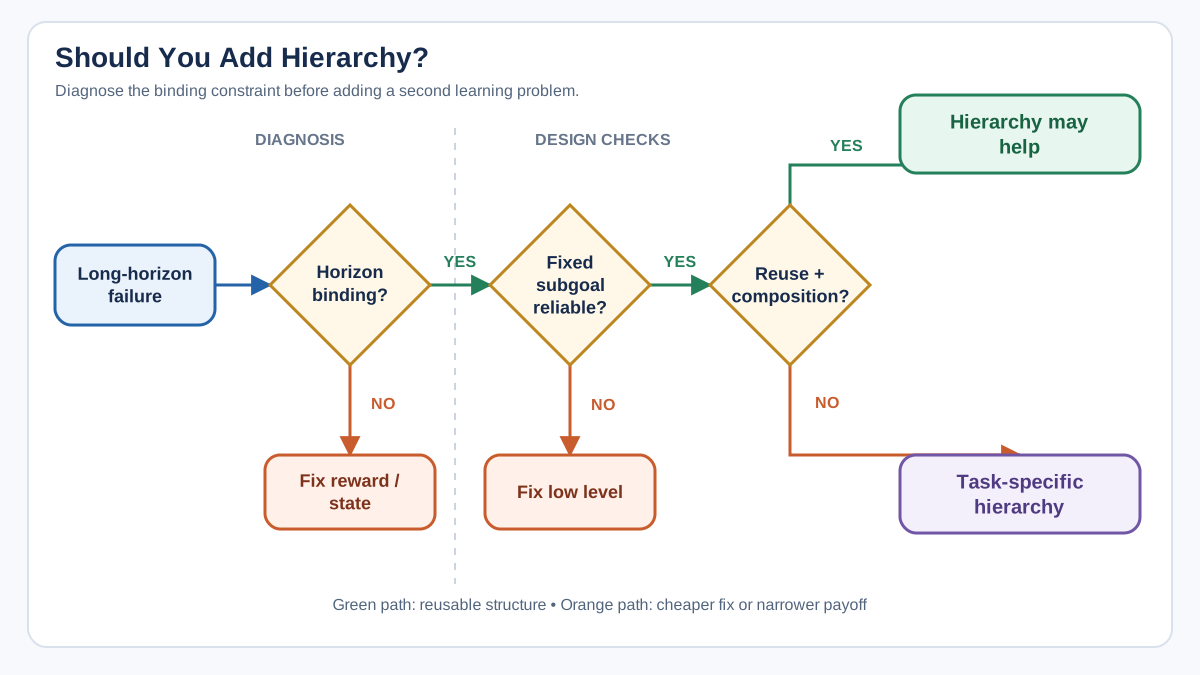
Run your problem through these four steps before you write a single line of hierarchical code.
Step 1: Measure the effective horizon. Count the primitive steps between meaningful reward events. Estimate the compression a reasonable option length would buy. If the ratio is small, stop here.
Step 2: Check for genuine repetition. Can you name sub-behaviors that recur across contexts or tasks? If the only long thing is the task itself, hierarchy has nothing to amortize.
Step 3: Check compositionality. Does the task decompose into combinable pieces with clean interfaces — a defined subgoal space and a defined termination condition? If the pieces fight each other, the decomposition will cost more than it saves.
Step 4: Verify subgoal reliability. Can a single low-level policy reach one candidate subgoal reliably in isolation? If not, fix that first. The high level is only as trustworthy as the low level beneath it.
| Criterion | Hierarchy helps when… | Hierarchy hurts when… |
|---|---|---|
| Horizon | Effective horizon is long; options buy large compression | Horizon is short; compression is marginal |
| Repetition | Sub-behaviors recur across contexts or tasks | One long unique trajectory, no reuse |
| Compositionality | Clean decomposition with well-defined interfaces | Conflicting objectives, no clean subgoal space |
| Subgoal reliability | Low level reaches fixed subgoals reliably | Low level is noisy or subgoals are unreachable |
The decision rule: horizon creates the opportunity, subgoal reliability determines feasibility, and repetition and compositionality determine whether the investment compounds. When the horizon is short, stop. When the low level cannot reach fixed subgoals, fix that before adding a high level. When the horizon is long and the interface holds, hierarchy is likely to help — and repetition and compositionality tell you how much it will pay back.
What to Do Next
Treat hierarchy as a compression bet. It pays off only when the horizon is long enough to justify the overhead and the interface is reliable enough to hold — and it costs you a second learning problem whether or not it pays.
So before you build anything, do two measurements. First, measure your effective horizon: the primitive steps between meaningful reward events, not the episode length. Second, take one candidate subgoal and train a single low-level policy to reach it in isolation. Choose a subgoal that is representative of the interface you intend to use, and test it from the range of starting states the high level will actually encounter — not just the easiest one. Watch both whether the low level reaches the target and how it terminates. If that policy converges reliably, you have evidence that the interface can hold. If it does not, you have found the real bottleneck, and it is not the high level.
Once you have both numbers, the next question is whether the added structure actually improved sample efficiency — not whether it runs, but whether it learns more from the same number of environment interactions than the flat baseline did. That comparison is the only honest test of whether the hierarchy earned its place.
Knowledge check
Final check
Finish the article by checking the ideas you just learned.
References
Research updated Sep 9, 2026


