
Double Q-Learning Explained: Separate Action Selection From Evaluation
Your Q-table has a favorite action. It picked that action because its estimate was highest, and now it is about to use that same estimate to decide how…

Key topics
Your Q-table has a favorite action. It picked that action because its estimate was highest, and now it is about to use that same estimate to decide how good the action really is. One number, two jobs: choosing and judging. That is the crack Double Q-learning was built to fill.
If you have already worked through the Q-learning update and seen how the max operator can inflate action values, you have the prerequisite. This article picks up exactly there. We will not re-derive overestimation from scratch. Instead, we will take the mechanism apart, watch it fail, and then rebuild it with two tables instead of one.
The Problem in One Line: One Table Doing Two Jobs
Recall the Q-learning target in plain words: look at the next state, pick the action with the highest estimated value, and use that same value as the target for the update. The agent selects with the max, then evaluates with the max.
That coupling is the whole problem.
When your estimates are noisy — and early in learning, they always are — the action that wins the comparison is often the action whose estimate got the luckiest noise bump. The max operator does not sample fairly. It reaches for the highest number, and the highest number is disproportionately likely to be an overestimate. Then the update writes that inflated value back into the table as if it were knowledge.
This is Q-learning overestimation bias: not random error that cancels out, but a systematic upward drift. The bootstrapped target carries the bias forward, state after state, and the policy starts chasing values that do not exist. The agent becomes confident about actions that are merely lucky.
The fix is not a better learning rate or more episodes. The fix is structural: stop letting one estimate both choose the action and score it.
Knowledge check
Check your understanding
Answer this question before you continue.
Split the Job: One Table Chooses, the Other Scores
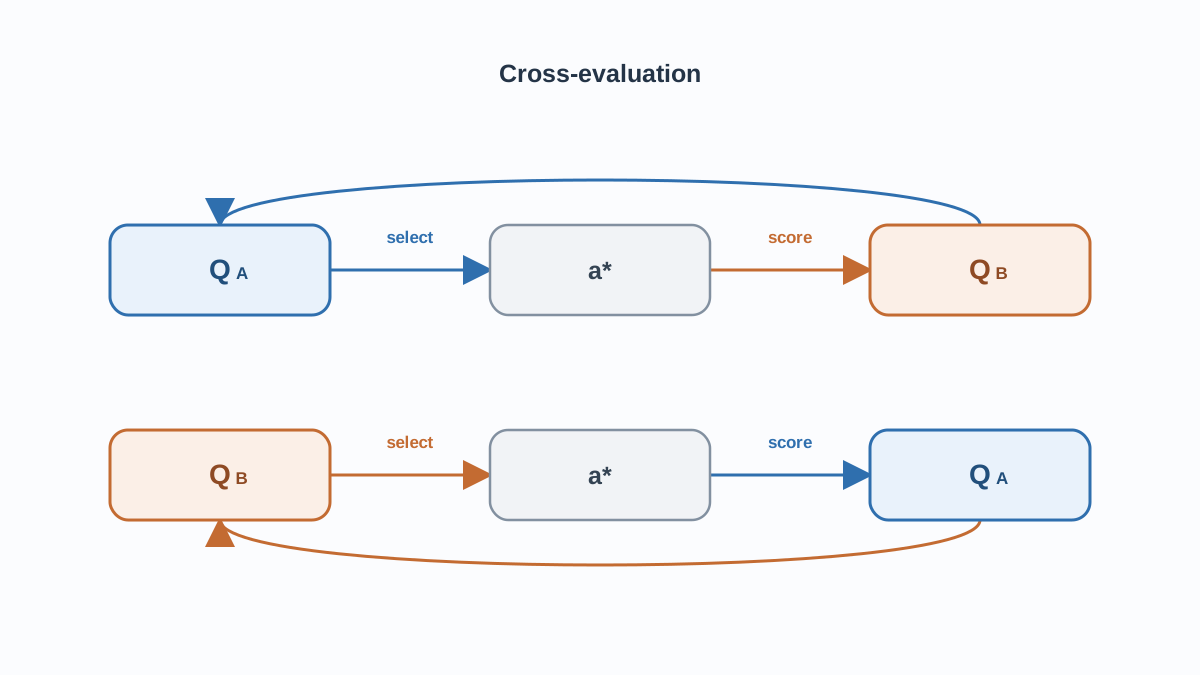
Double Q-learning keeps two value tables, call them Q^A and Q^B. Both learn the same problem. Both see the same environment. But they accumulate different sampled experience, so their estimates diverge in the details — and that divergence is the point.
The rule is simple:
- Table A picks the best next action.
- Table B prices that action.
- On the next update, swap roles.
When A's argmax selects an action, the target value comes from B's estimate of that same action. A's selection error and B's evaluation error no longer come from the same source. The lucky noise bump that fooled A into picking an action does not automatically inflate the score, because B is doing the scoring — and B never saw that bump.
Note: This is the double estimator idea in reinforcement learning. You are not averaging two answers. You are using one estimator to select and a different estimator to evaluate, which breaks the feedback loop that turns noise into bias.
A useful analogy: two appraisers who never see each other's notes. One decides which house is the best buy; the other tells you what that house is actually worth. Because their notes are separate, a single overenthusiastic appraisal cannot inflate both the choice and the price.
The analogy has a boundary, and it matters. Both appraisers are still learning from the same noisy market. They are not independent experts with fixed knowledge. They are two learners shaped by overlapping, limited experience — so their errors can still correlate. And the second appraiser's number is not automatically the sober one. It is simply a different estimate, drawn from a different sample. Keep that in mind when we get to limitations.
Picture two tables side by side. An arrow runs from A's argmax into B's lookup. Underneath, a mirrored arrow runs from B's argmax into A's lookup. Two directions, two jobs, one agent.
Knowledge check
Check your understanding
Answer this question before you continue.
The Double Q-Learning Update, Step by Step
Here is the Q-learning target you already know:
target = r + γ * max_a Q(s', a)
The max does the selecting and the evaluating at once. Now the Double Q-learning update, written as two symmetric rules:
Q^A(s, a) ← Q^A(s, a) + α * [ r + γ * Q^B(s', argmax_a Q^A(s', a)) - Q^A(s, a) ]

Q^B(s, a) ← Q^B(s, a) + α * [ r + γ * Q^A(s', argmax_a Q^B(s', a)) - Q^B(s, a) ]
Read the first line slowly. The argmax runs over Q^A — that is the selection. The value plugged into the target comes from Q^B — that is the evaluation. Compare it to the Q-learning target and only one term changed: the value lookup now comes from the other table.
Each step, you flip a coin to decide which table gets updated. This randomness is not decoration. If you always updated A from B and never the reverse, the two tables would drift into a fixed relationship and stop providing independent estimates. The coin flip keeps them mutually symmetric.
One numeric step
Suppose the agent is in state s, takes action a, receives reward r = 1, and lands in state s' with three possible actions. The current estimates are:
| Action | Q^A(s', a) | Q^B(s', a) |
|---|---|---|
| a1 | 2.0 | 1.8 |
| a2 | 2.4 | 1.5 |
| a3 | 1.9 | 2.1 |
The coin lands on updating Q^A. Selection uses Q^A: the argmax is a2 at 2.4. Evaluation uses Q^B at that same action: Q^B(s', a2) = 1.5.
With α = 0.1, γ = 0.9, and current Q^A(s, a) = 1.0:
target = 1 + 0.9 * 1.5 = 2.35
Q^A(s, a) ← 1.0 + 0.1 * (2.35 - 1.0) = 1.135
Notice what happened. Q^A wanted to believe a2 was worth 2.4, but the target pulled from Q^B's number instead. The update lands at 1.135 rather than the 1.26 it would have reached with plain Q-learning's 2.4 target. The two tables disagree, and the disagreement is what breaks the self-reinforcing loop.
What this example does not show is which table is closer to the true value of a2. Q^B's 1.5 is not automatically the sober estimate — it is just a different estimate, shaped by a different sample. The benefit is structural: selection noise and evaluation noise no longer come from the same source. On any single update, the cross-table value can still be too high or too low.
One more thing worth stating: the behavior policy is still separate from the learned policy. Double Q-learning remains off-policy value learning. You can explore with epsilon-greedy while the tables learn the greedy target. Splitting the estimator does not change that contract.
Knowledge check
Check your understanding
Answer this question before you continue.
Why It Helps — and Why It Is Not a Cure
Double Q-learning reduces overestimation. It does not eliminate bias. That distinction is where most secondhand summaries go wrong.
The double estimator can undershoot instead of overshoot. The bias changes sign rather than vanishing. In the original work, the claim is scoped carefully: Q-learning can perform poorly in some stochastic environments because of large overestimations, and Double Q-learning performs well in some of those settings. That is a narrower claim than "Double Q-learning is always better," and it is the honest one.
Three tradeoffs to hold onto:
Correlated errors remain. Both tables learn from the same limited, noisy experience. If the environment consistently misleads both estimators in the same direction, splitting them buys you less than you hoped.
Extra memory and compute. You now carry two tables. For the same number of environment steps, each table receives roughly half the updates, so each individual table learns more slowly even as the pair stays more accurate.
Slower early learning in easy problems. If the environment is nearly deterministic and plain Q-learning was never badly biased, the second table is overhead. You pay the cost without collecting the benefit.
Common mistake: Treating Double Q-learning as a strict upgrade. It is a targeted fix for maximization-driven overestimation in noisy, stochastic settings. Outside that setting, it can be a net drag.
Knowledge check
Check your understanding
Answer this question before you continue.
When to Reach for Double Q-Learning
Here is the decision rule I would use.
Reach for it when estimates are noisy and the action set is large enough for the max to cherry-pick overestimates. More actions means more chances for one lucky estimate to win the comparison. That is exactly the regime where the single-table version drifts upward.
Reach for it when a biased value estimate would distort the policy, not just the reported numbers. If the agent's behavior changes because it believes an action is better than it is, the bias has teeth.
Skip it when the environment is nearly deterministic and your single-table Q-learning already tracks values well. The extra machinery earns nothing there.
Tip: The same decoupling idea — one estimator selects, another evaluates — reappears in deep value methods, where selection and evaluation live in different networks. The tabular version you are learning here is the conceptual root of that family. We will stay tabular; the deep adaptation is its own topic.
And correct one misconception now, before it settles in: Double Q-learning is not two agents voting. It is one agent holding two estimators. There is no committee, no majority rule, no negotiation. There is one decision, made by one table, priced by the other.
Where to Take This Next
If your Q-values drift upward and your policy keeps chasing them, split selection from evaluation before you reach for a bigger model. That is the whole lesson compressed into one move.
The next step is concrete: take the small tabular environment you already built and run the two-table update on it. Watch the two tables diverge. Watch the coin flip decide which one learns. Then compare the value trajectories against your single-table run and see whether the upward drift actually shrinks.
That experiment will teach you more than any summary — including this one. The mechanism is small enough to hold in your head, and small enough to break on purpose. Break it, inspect the output, and let the numbers tell you whether the double estimator earned its second table.
Knowledge check
Final check
Finish the article by checking the ideas you just learned.
References
Build a stronger RL mental model
Use structured resources to connect equations, algorithms, and observable agent behavior.


