
Q-Learning Overestimation Bias: Why the Max Can Fool the Agent
Your agent's Q-values are climbing. Its actual performance is flatlining. And the gap between what the agent believes and what it achieves keeps widening.

Key topics
Your agent's Q-values are climbing. Its actual performance is flatlining. And the gap between what the agent believes and what it achieves keeps widening.
This is not simply a learning-rate problem or an exploration problem. It is something stranger: the agent is systematically fooling itself about the value of its best actions. The culprit is the very operator that makes Q-learning work—the max in the update target.
The Symptom: Confident Values, Mediocre Behavior
Run a Q-learning agent in an environment with stochastic rewards and watch its learning curves. Early optimism is normal. A fresh agent has noisy estimates, and those estimates will overshoot before they settle. That self-corrects.
The pattern you are looking for is different: values that keep inflating long after the agent should have calibrated them, with no corresponding improvement in behavior. The agent observes the same environment you do and applies the same update rule. Yet it ends up believing its best action is worth more than it is—and acting on that belief.
To see why, recall the shape of a Q-learning update. The target for a state-action pair is the observed reward plus the discounted value of the best action in the next state: r + γ max Q(s', a'). That max is the bridge from one step to the next, and it is also where the trouble begins.
Why the Max Selects for Overestimates
Every Q(s', a') is an estimate, not a fact. Early in training—and always, when you use function approximation—those estimates carry error. Some are too high. Some are too low. If the errors are symmetric, you might expect them to cancel out.
They do not. The max operator does not average the candidates. It selects the largest one. And when you select the largest value from a noisy set, you are far more likely to land on an overestimate than an underestimate.
Imagine three actions in a state. Their true values are 1.0, 1.5, and 1.2. The agent's estimates carry noise: 1.1, 1.9, and 0.9. The true best action is worth 1.5, but the max picks the estimate of 1.9—an inflated value that belongs to the second-best action. The update target inherits that inflation, and the agent learns to trust a number that no real policy can deliver.
This is not a bug in any particular implementation. It is a property of the math itself. When you approximate a maximum of expected values by taking the maximum of approximations, you introduce a systematic positive bias. The formal name is maximization bias, and it appears in reinforcement learning whenever noisy estimates meet a max.
Knowledge check
Check your understanding
Answer this question before you continue.
Why the Bias Compounds Instead of Averaging Out
You might still hope that many updates will wash the error away. After all, noise averages out over enough samples—that is the law of large numbers, and it works for Monte Carlo returns.
The max breaks that logic. Averaging and selecting are different operations. An average lets high and low errors cancel. A selection throws away everything except the highest value, and the highest value in a noisy set is biased upward by construction. More sampling can shrink the noise in each estimate, but the selection step still favors whatever residual error remains. The bias shrinks as estimates improve, but it does not vanish the way averaged noise does.
Worse, the bias feeds on itself. Once the agent overestimates an action, its policy starts choosing that action more often. The inflated action gets updated more frequently, which entrenches its inflated value. And because Q-learning bootstraps—each target uses the next state's value—the error propagates backward through time. An overestimate in one state contaminates the targets of every state that leads to it.
The result is a compounding loop: the max inflates an estimate, the policy exploits the inflated action, and the bootstrap carries the error backward until the agent's entire value landscape is distorted.
Knowledge check
Check your understanding
Answer this question before you continue.
Recognizing Overestimation in Your Own Agent
How do you know maximization bias is your problem and not something else? Look for three signals together:
- Values far above plausible returns. If your agent's Q-values exceed any return the environment can physically produce, something is inflating them.
- Performance plateauing while values keep rising. The agent looks more confident without behaving better.
- Sensitivity to reward noise. A stochastic environment triggers the bias; a deterministic twin does not.
That last point gives you a useful diagnostic, but treat it as evidence, not proof. A deterministic version of your environment changes more than reward noise: visitation patterns shift, the target distribution changes, and function approximation may behave differently. If you run this comparison, hold everything else as constant as you can—same seed protocol, same evaluation conditions, same network or table structure—and compare the gap between estimated values and measured performance across matched runs.
A second check: compare learned Q-values against empirical returns. Let your trained agent roll out episodes and record the actual discounted returns it receives. Then compare those returns to what the Q-function claims. One episode proves nothing; stochastic rewards guarantee variance. Instead, evaluate the same state-action pairs or starting states repeatedly, average the discounted returns, and compare that average with the corresponding Q estimate. A persistent gap across many rollouts—values systematically higher than measured returns—is evidence worth investigating.
Do not confuse this with other failure modes. Aggressive exploration can look like instability, but it produces erratic behavior, not systematically inflated values. Learning-rate problems produce slow or oscillating learning, not a confident climb into fantasy territory. Target-network issues create moving-target instability, which has its own signature of values chasing a shifting goal.
Knowledge check
Check your understanding
Answer this question before you continue.
The Fix in One Idea: Decouple Selection From Estimation
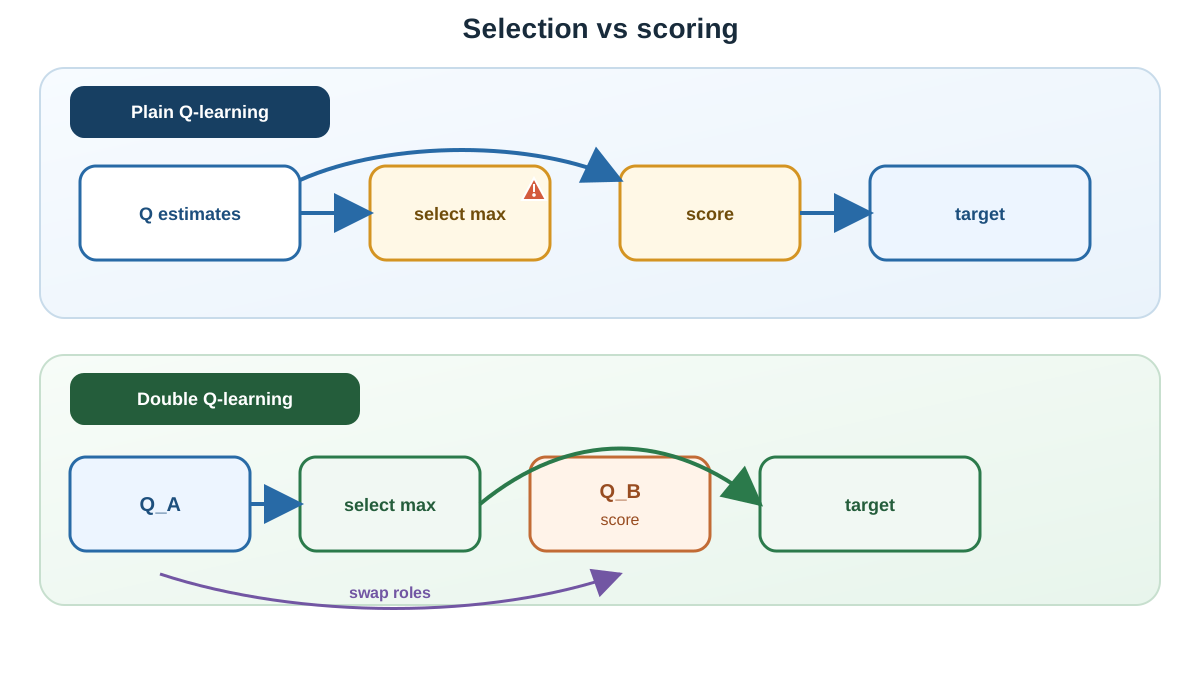
The bias exists because Q-learning uses the same estimate for two different jobs. It uses Q(s', a') to decide which action is best, and it uses that same value to score how good the best action is.
Those jobs have different vulnerabilities. Selection only needs the actions ranked correctly. Scoring needs the chosen action's value to be accurate. When one noisy estimate performs both jobs, the selection step corrupts the scoring step.
Double Q-learning separates them. Keep two independent Q-functions, Q_A and Q_B. To form a target, let Q_A select the best action in the next state, then use Q_B's estimate of that action's value. The next update, swap the roles.
Why does this help? The estimator doing the scoring was not the one maximized over. If Q_A has an inflated estimate for some action, Q_A might select that action—but Q_B scores it, and Q_B's error is independent. The selection bias does not transfer to the score.
The tradeoff is real. Double Q-learning can swing toward underestimation, and in low-noise environments it may converge more slowly than plain Q-learning. You are trading a systematic overestimate for a smaller, less destructive underestimate.
One boundary worth keeping straight: the two value functions in tabular Double Q-learning are genuinely independent because they are updated on alternating experiences. Deep RL variants like Double DQN reuse the same idea more loosely—the online network selects the action, the target network scores it—but those networks are not statistically independent. And clipped double-Q methods in continuous control take the minimum of two critics to fend off overestimation. The shared principle across all of them is decoupling selection from scoring, not a guarantee of independence.
When Overestimation Is Not Your Problem
Maximization bias is not the cause of every unstable run, and Double Q-learning is not a universal cure.
In deterministic, low-noise environments, the bias is small. Estimates have little noise to exploit, so the max has little to inflate. Adding Double Q-learning here buys little and may slow convergence.
A touch of overestimation can even help. In environments where high-reward regions are noisy, a mildly optimistic agent is more willing to explore them. Optimism bias is not always destructive—it depends on whether the inflated regions are actually worth visiting.
And sometimes the real problem is elsewhere. Replay buffers, target networks, reward scaling, and network architecture all affect stability. If your values are not systematically too high—if they oscillate, collapse, or fail to rise—blame something other than maximization bias.
My rule: suspect overestimation when values are consistently above any plausible return and your environment has genuine reward noise. Test it with a controlled deterministic comparison and a matched rollout check. Then try the decoupling fix and watch whether the gap shrinks.
Knowledge check
Check your understanding
Answer this question before you continue.
The Mental Model That Sticks
The max does not average noise. It selects for it. Every time you take the maximum over noisy estimates, you are choosing the most optimistic error in the set—and then treating that error as truth.
That is why the fix is not simply more data or better tuning. It is structural. Any correction must separate the estimator that chooses from the estimator that scores. Build that separation, and the agent stops fooling itself about the value of its best actions.
Next time you see confident values with mediocre behavior, do not reach for a new learning rate first. Ask which estimator is doing the choosing, which one is doing the scoring, and whether the same noisy number is doing both.
Knowledge check
Final check
Finish the article by checking the ideas you just learned.
References
Research updated Sep 9, 2026


