
TD3 Explained: Twin Critics and Delayed Updates for Continuous Control
DDPG doesn't fail because its policy is weak. It fails because its critic quietly starts lying, and the policy trusts every word.

Key topics
DDPG doesn't fail because its policy is weak. It fails because its critic quietly starts lying, and the policy trusts every word.
The mechanism is insidious. The critic learns from targets that include its own maximization over noisy estimates. That maximization injects a positive bias—the familiar overestimation problem from Q-learning—and the deterministic policy gradient amplifies it. The actor climbs the critic's gradient, so wherever the critic is inflated, the policy leans harder into that direction. The critic sees the policy visiting those actions, confirms its own bias, and the loop tightens until the value estimates detach from reality and the policy breaks.
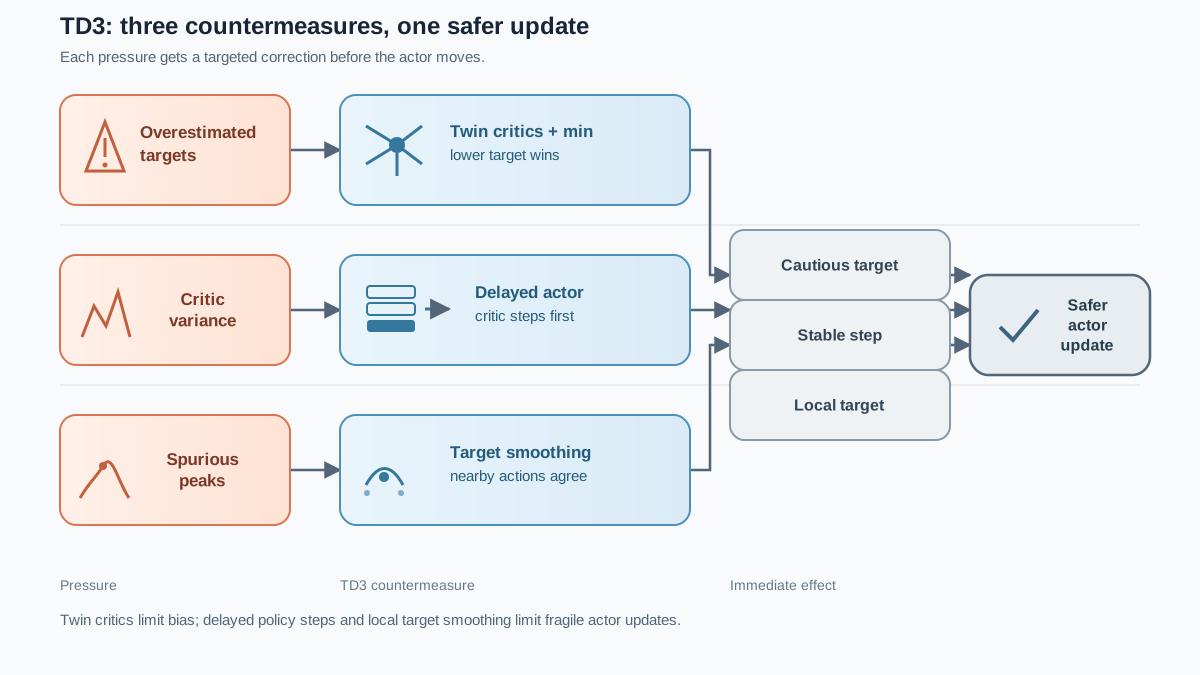
TD3 is not a new algorithm so much as three surgical countermeasures aimed at three named pressures. Understanding it means understanding which pressure each trick targets, and where the fix introduces its own cost.
Why DDPG Breaks: The Overestimation Loop
Start with the deterministic policy gradient update. The actor updates by ascending the critic's gradient with respect to actions: it moves toward actions the critic believes are more valuable. That is the whole mechanism, and it is also the vulnerability. The actor inherits every error the critic makes, with no sampling distribution to average them out.
Now add the overestimation bias. The critic's target evaluates the deterministic policy's chosen action using a target network whose approximation error is nonzero. When you maximize over noise—even the implicit maximization of following the policy toward the critic's most favored actions—you select the noise's positive tail. The target is biased high, the critic learns to predict high, and the actor exploits the inflation.
The compounding loop has three beats:
- The critic's targets are biased upward by maximization over approximation error.
- The actor climbs the critic's gradient and moves toward actions the critic wrongly favors.
- The policy's behavior confirms the critic's bias, the error grows, and the next target is worse.
Two distinct pressures emerge from this loop, and TD3 targets them separately. The first is bias: the critic's targets are systematically overestimated. The second is variance: the actor updates on gradients from a critic that is still noisy, producing unstable policy steps. Fix only one and the other still breaks training. That is why TD3 ships three tricks, not one.
Knowledge check
Check your understanding
Answer this question before you continue.
Trick One: Clipped Double Q-Learning
A single critic cannot detect its own inflation because the error is baked into the target it trains against. The critic updates toward a number that is already too high, and nothing in the loss function signals the problem.
Two critics change the game. Train two Q-functions on the same transitions, but with independent initialization. Their approximation errors drift apart—each network has different random starting points, so they develop different blind spots. When both critics agree, the estimate is probably trustworthy. When they disagree, at least one of them is wrong.
TD3 exploits that disagreement with a simple operator: the target uses the minimum of the two critics.
y = r + γ * min(Q₁(s', a'), Q₂(s', a'))
The smaller estimate sets the ceiling. If one critic spikes optimistically, the min clips the spike. This is the "clipped" in clipped double Q-learning.
The design choice matters. Classic Double Q-learning decouples action selection from action evaluation—one network picks the action, the other scores it—which removes the maximization bias without systematically underestimating. TD3 instead takes the min, which converts a positive bias into a mild negative one. That is a deliberate trade: underestimation biases the policy toward caution rather than toward reckless exploitation of phantom value. In practice, a conservative critic is safer than an optimistic one, because the actor cannot chase rewards that do not exist.
The cost is real. The min operator makes the critic systematically pessimistic, and if the two critics drift too far apart, the policy becomes overly timid. But between a policy that under-explores and one that chases hallucinations, TD3 chooses the former.
Knowledge check
Check your understanding
Answer this question before you continue.
Trick Two: Delayed Policy Updates
The actor update is only as good as the critic gradient it climbs. Early in training, the critic is extremely noisy—it has seen a handful of transitions and its value estimates swing wildly. Updating the actor on every step means the policy chases a moving target that has not settled.
TD3's second trick is to let the critic train several times before the actor consumes its gradients. The paper's default cadence is one actor update for every two critic updates. The policy delay parameter controls this ratio.
Think of it as a two-timescale separation. The critic runs ahead, accumulating experience and reducing its error. The actor follows at a safer pace, only taking a step once the value function has had a chance to stabilize. The critics get more gradient steps per unit of experience, so their estimates are less noisy when the actor finally uses them.
Delay alone is not sufficient. A stable but biased critic still misleads the actor, which is why clipped double Q-learning must run alongside it. And a stable critic with sharp spurious peaks still invites exploitation, which is where the third trick comes in.
Knowledge check
Check your understanding
Answer this question before you continue.
Trick Three: Target Policy Smoothing
A deterministic policy has a dangerous ability: it can find actions where the critic's approximation has a sharp, false peak. The Q-function is a neural network, and neural networks produce artifacts. If the actor discovers a narrow ridge of erroneously high value, it will climb straight to the top and sit there.
Target policy smoothing makes that harder. When computing the target action, TD3 adds small clipped noise to the target policy's output:
a' = clip(μ_target(s') + clip(ε, -c, c), a_low, a_high)
where ε is Gaussian noise scaled by a parameter typically around 0.2, and the clip bound c is typically 0.5.
Here is the precise mechanism: each target calculation perturbs the target action once, then evaluates the critics at that single noisy action. The target does not average over a batch of perturbed actions in one update. Instead, the noise changes which nearby action gets evaluated on every target computation. Over many updates, the critic repeatedly trains against targets drawn from a small neighborhood around the policy's choice. That repeated perturbation is what imposes local smoothness pressure: a narrow spurious peak is unlikely to be sampled consistently, while a broad region of genuine value keeps showing up in targets. The intuition of "averaging over a neighborhood" is useful, but the implementation is better described as many single-point evaluations scattered around the policy's action.
Two parameters control the smoothing. The noise scale determines how far the perturbed action can wander from the policy's choice. The clip bound limits that wander, preventing the target from evaluating actions far from the policy's intent. Too much smoothing blurs real differences between actions; too little leaves the sharp peaks intact.
Do not confuse this with exploration noise. Training-time exploration noise is added to the behavior policy's actions to collect diverse experience. Target policy smoothing noise is added to the target action during the critic update to regularize the value estimate. They serve different jobs: one gathers data, the other stabilizes learning.
Knowledge check
Check your understanding
Answer this question before you continue.
How the Three Tricks Interlock
The full TD3 update loop weaves all three together:
- Sample a batch of transitions from the replay buffer.
- Compute the target action using the target policy, with clipped smoothing noise added.
- Evaluate both target critics on the smoothed target action.
- Take the min of the two target values to form the target.
- Update both critics toward that target.
- Every N steps (typically every 2), update the actor using the deterministic policy gradient, then soft-update the target networks via Polyak averaging.
Each trick covers a gap the others leave open. The min handles bias—the systematic overestimation from maximization over noise. The delay handles variance—the noisy policy steps from an unsettled critic. The smoothing handles exploitation of approximation error—the actor's ability to find and climb spurious peaks in the Q-function.
One qualification keeps the model honest: delay limits how often the actor reacts to critic error, but it does not by itself make the critic stable. Critic stability comes from replay, target networks, learning rates, and enough gradient steps. If your critics diverge, the delay is one diagnostic hypothesis, not the automatic fix.
TD3 inherits the supporting machinery of deep actor-critic learning: a replay buffer for off-policy training, target networks with Polyak averaging to reduce moving-target instability, and the deterministic policy gradient itself. The three tricks are modifications on top of that foundation, not replacements for it.
One architectural constraint follows from the deterministic policy: TD3 only works in continuous action spaces. The actor needs a differentiable action to climb the critic's gradient, which requires actions to be continuous values rather than discrete choices. That is not a limitation so much as a boundary—it defines the territory TD3 was built to handle.
TD3 vs DDPG and SAC: Where the Tradeoffs Land
| DDPG | TD3 | SAC | |
|---|---|---|---|
| Critics | Single | Twin, min target | Twin (or single), min target |
| Policy | Deterministic | Deterministic | Stochastic, entropy-regularized |
| Actor update | Every step | Delayed | Every step |
| Target smoothing | None | Clipped noise | None (stochastic policy provides smoothing) |
| Exploration | Action noise | Action noise | Entropy term in objective |
| Primary failure mode | Overestimation, brittle | Underestimation, conservative | Entropy temperature and stochastic exploration require their own tuning |
The comparison with DDPG is straightforward: TD3 is DDPG with the three failure pressures addressed. The comparison with SAC is more interesting because SAC solves a different problem. SAC's entropy term keeps the policy stochastic, which provides natural smoothing—the policy averages over its own action distribution rather than needing explicit target noise. SAC also tends to explore more aggressively because the entropy objective rewards action diversity.
TD3's underestimation bias makes it conservative. That is a feature when the task demands precision and reproducibility—deterministic control problems where you want a stable, repeatable policy and the cost of exploration is high. It is a liability when the task needs aggressive exploration to discover sparse rewards, or when the underestimation bias stalls learning by making the critic too pessimistic to guide the actor anywhere useful.
My rule of thumb: reach for TD3 when you have a deterministic continuous-control task, you want stability over exploration, and you can afford to tune a few hyperparameters. Reach for SAC when you need ongoing stochastic exploration, or when the task's reward structure punishes premature commitment to a narrow policy.
Common Failure Modes and Tuning Levers
TD3 is more robust than DDPG, but it is not immune to misconfiguration. The symptoms tell you which pressure is out of balance.
Overly conservative policy. If the agent learns slowly or settles for mediocre returns, the underestimation bias may be too strong. The min operator plus heavy target smoothing can make the critic so pessimistic that the actor sees no gradient worth following. Reduce the smoothing noise scale, or check whether the two critics have drifted too far apart.
Critic divergence. If the Q-values explode or oscillate, suspect a mismatch between how fast the critic learns and how often the actor reacts. Increase the policy delay, lower the critic learning rate relative to the actor, or check the replay buffer and target update rate. Treat this as a diagnostic hypothesis, not a guaranteed cure.
Poor late-training precision. The exploration noise scale is the main lever for coverage versus precision. Early in training you want broad noise to discover the task; late in training you want narrow noise so the policy can refine fine control. A fixed noise scale that is too large will keep perturbing the policy when it should be settling.
Smoothing that blurs real differences. The target noise scale and clip bound interact. Too much smoothing evaluates actions with genuinely different values, flattening the Q-function and making the actor insensitive to real distinctions. If the policy seems unable to discriminate between similar actions, reduce the noise scale or tighten the clip.
The deeper lesson is that TD3's hyperparameters are not independent knobs—they are diagnostics for which pressure is out of balance. The policy delay controls how often the actor reacts to critic error. The min operator and smoothing control bias and exploitation. The exploration noise controls data coverage. When training goes wrong, ask which pressure broke, then turn the corresponding knob.
The Decision Rule
Treat TD3 as a set of named pressures and their countermeasures, not a black box. Overestimation bias meets the min of twin critics. Noisy policy updates meet delayed actor steps. Exploitation of approximation artifacts meets target policy smoothing. Each fix has a cost, and each cost shows up as a symptom you can diagnose.
The best next step is to watch the mechanism move. Run TD3 and DDPG on the same continuous-control environment, and log two things: the critic's estimated Q-values and the realized discounted returns. Compare them across multiple seeds. The failure pattern to test for is a growing gap—DDPG's estimates inflating while its returns stagnate or collapse, with TD3's estimates staying closer to what the agent actually collects, sometimes pessimistically so. That gap between estimate and reality is the overestimation loop made visible. Once you have seen it, the three tricks stop being abstract patches and become what they are: a precise answer to a precise failure.
Knowledge check
Final check
Finish the article by checking the ideas you just learned.
References
Research updated Sep 9, 2026


