
Trust-Region Policy Optimization Explained: Why Policy Updates Need a Safe Step
You have trained a policy that works. The weights are tuned, the rewards are climbing, and the agent is finally doing something that looks like competence.…

Key topics
You have trained a policy that works. The weights are tuned, the rewards are climbing, and the agent is finally doing something that looks like competence. Then one more gradient step—a perfectly reasonable step, by every measure you track—and the whole thing falls apart. The policy you had is gone, and the policy you got collects rewards like a toddler pressing elevator buttons.
This is the failure mode trust region policy optimization exists to solve. The puzzle at its center is subtle: a step that looks small in parameter space can be enormous in behavior space. And in reinforcement learning, behavior is the only thing that matters.
The Problem: When a Small Step Breaks a Good Policy
Policy gradients push action probabilities in the direction of sampled advantage. If an action led to better-than-expected returns, the update makes it more likely; if worse, less likely. The update itself is straightforward: compute the gradient of expected reward with respect to the policy parameters, multiply by a learning rate, step.
The trouble is that parameters and behavior are not the same thing. A neural network policy can have regions where the output distribution is highly sensitive to small weight changes—where a tiny perturbation in parameter space produces a large shift in action probabilities. Step into one of those regions and your "small" update has just replaced a competent policy with a random one.
The damage then compounds. In reinforcement learning, the data is non-stationary: the next batch of trajectories is sampled from whatever policy you just produced. A bad update poisons the data collection, and the next update is computed from trajectories generated by the damaged policy. The error feeds on itself. This is why vanilla policy gradients can be so brittle—not because the gradient is wrong, but because nothing stops the policy from walking off a cliff between one update and the next.
The central question becomes: how do you limit change in behavior, not just in parameters? How do you take a step you can trust?
Knowledge check
Check your understanding
Answer this question before you continue.
The Fix: Optimize a Surrogate, Not the True Objective
The obvious way to improve a policy is to optimize the true objective directly: the expected return under the current policy. But there is a practical problem. Evaluating that objective for a candidate policy requires sampling trajectories from that policy. Every candidate policy you consider means a new round of environment interaction. That is not optimization; that is an expensive guessing game.
Trust region policy optimization sidesteps this with a surrogate objective. Instead of sampling from the new policy, TRPO reuses the trajectories collected from the old policy and reweights them using an importance-sampling ratio:
$$\frac{\pi_\theta(a|s)}{\pi_{\theta_{\text{old}}}(a|s)}$$
Multiply each advantage estimate by this ratio, and you get an estimate of how the new policy would have performed on the old policy's data. No new sampling required.
The surrogate has a crucial property: near the current policy, it matches the true objective to first order. The gradient of the surrogate at the current parameters is the same as the gradient of the true objective. Close to where it was built, the surrogate is trustworthy. Farther away, the approximation degrades, and the surrogate can confidently recommend steps that the true objective would never approve.
Think of the surrogate as a local map of the reward landscape. The map is accurate near where you surveyed it. Walk too far, and the terrain stops matching the cartography.
Note: The map tells you where the terrain is, not where the treasure is. The surrogate supplies the direction; KL divergence only measures how far the policy moved. A step that stays inside the trust region can still point toward worse returns if the advantage estimates are noisy or biased.
Knowledge check
Check your understanding
Answer this question before you continue.
The Trust Region: Constraining Behavior with KL Divergence
If the surrogate is only trustworthy locally, the optimization needs to stay local. The question is how to define "local" in a way that actually protects the policy.
Parameter distance will not do the job. Two policies can have parameters that are numerically close while producing very different action distributions—that is precisely the failure mode that started this article. What we need is a measure of behavioral distance: how much the action distributions of the old and new policies differ.
That measure is the KL divergence. For each state, the KL divergence between the old and new policies tells you how much the probability distribution over actions has shifted. A KL of zero means the policies behave identically; a large KL means the new policy is making decisions the old one would rarely make.
TRPO constrains the average KL divergence across the states the old policy actually visits. The constraint takes the form:
$$\mathbb{E}{s \sim \rho{\pi_{\text{old}}}}\left[ D_{\text{KL}}\left(\pi_{\text{old}}(\cdot|s) ,|, \pi_\theta(\cdot|s)\right) \right] \leq \delta$$
where δ is the trust-region radius—a hyperparameter that controls how much behavioral change you permit per update.
This constraint is what makes the approach adaptive in a way a fixed learning rate cannot be. A learning rate is a constant applied to every step, blind to the local geometry of the policy landscape. In flat regions, it creeps forward when it could sprint; in steep regions, it barrels ahead when it should tiptoe. The KL constraint reads the local terrain and enforces a bound on behavioral change regardless of how the parameter space happens to be shaped. The trust region is a bounded neighborhood in policy space, and the surrogate is maximized inside it.
Common mistake: Reading the average KL constraint as a per-state safety certificate. Because the bound is averaged over states weighted by the old policy's visitation frequencies, a state the policy rarely visits can change dramatically without moving the average much. The practical constraint is a useful update diagnostic, not a guarantee that no individual state's behavior shifted wildly.
Knowledge check
Check your understanding
Answer this question before you continue.
From Theory to Algorithm: The Approximations TRPO Makes
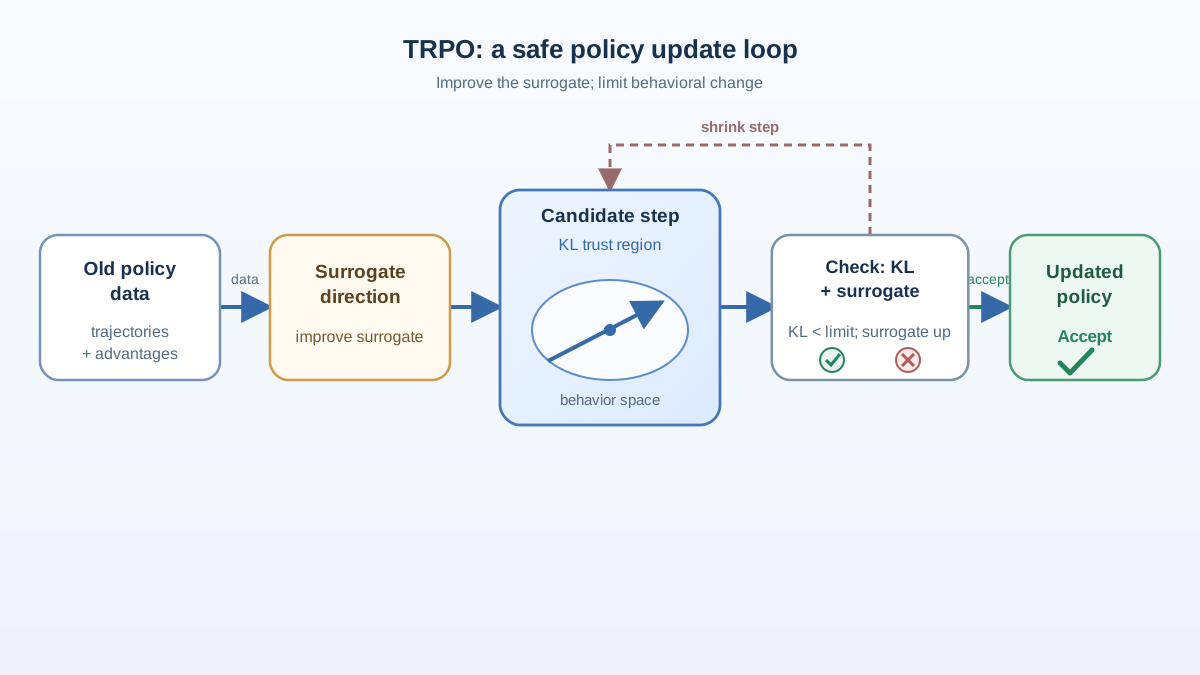
The theoretical foundation for TRPO comes from a guarantee: if you optimize a penalized objective with a worst-case KL bound, you can prove monotonic improvement. The penalty coefficient, however, is derived from a worst-case constant that is far too conservative for practical use. Following the theory literally would mean updates so small that learning would take an eternity.
TRPO's practical contribution is replacing the conservative penalty with a hard constraint and then approximating the resulting constrained optimization problem until it becomes tractable. The algorithm makes three approximations in sequence.
First, it linearizes the surrogate objective around the current policy parameters. Second, it approximates the KL constraint quadratically using the Fisher information matrix, which captures the local curvature of the policy distribution. The constrained problem becomes: maximize a linear objective subject to a quadratic constraint—a form with a known solution.
Third, TRPO never forms the full Fisher matrix, which would be prohibitively expensive for a neural network with millions of parameters. Instead, it uses the conjugate gradient method to solve for the search direction, computing Fisher-vector products on the fly through automatic differentiation.
Finally, the line search acts as the safety net. After computing a candidate step, TRPO checks whether the step actually improves the real surrogate objective and satisfies the real KL constraint. If not, it shrinks the step and checks again. This catches the cases where the linear-quadratic approximations have drifted from reality.
It is worth being honest about what the theory does and does not promise. The monotonic improvement guarantee holds under the idealized objective with a worst-case KL bound. The practical algorithm replaces that worst-case bound with an average constraint and then approximates the optimization itself. The guarantee is not literal. In practice, TRPO tends to improve reliably with little hyperparameter tuning—but the line search is what catches approximation error, not the theory.
Knowledge check
Check your understanding
Answer this question before you continue.
What TRPO Buys and What It Costs
TRPO's payoff is stability. On continuous-control tasks, it produces steady, monotonic-looking improvement where vanilla policy gradients oscillate or collapse. It is far less sensitive to learning-rate choice than first-order methods, because the trust region replaces the fragile learning-rate tuning that plagues them. And it answers a question that policy gradients leave open: how big a step should I take? The answer is principled—as large as the trust region allows, but no larger.
The cost is machinery. The conjugate gradient solve and Fisher-vector products add real computational overhead per update. The implementation complexity is substantially higher than a first-order method. For a learner or practitioner who just needs a working agent, that complexity is hard to justify.
This is why TRPO is rarely the default choice today. Proximal policy optimization approximates the same stability with a cheaper first-order update: instead of solving a constrained optimization problem with second-order methods, PPO clips the objective to penalize large policy ratios. The trust-region instinct survives, but the machinery is replaced by something far simpler.
The decision boundary is not about which algorithm is "better." It is about what you need. If you want a working agent with minimal implementation risk, PPO is the pragmatic pick. TRPO earns its complexity when you want the cleaner theoretical framing, need tighter control over step size, or are studying the family of constrained policy updates—because the trust-region pattern shows up far beyond TRPO itself.
Tip: When you run TRPO, log more than the return. Track the candidate step size before line search, the fraction of steps the line search rejects, the actual KL divergence after each update, and the surrogate improvement. If the line search repeatedly backtracks or the measured KL sits far below δ, your proposed steps are too aggressive and the trust region is doing the braking. If KL looks fine but returns still fall, suspect the advantage estimates or value baseline—not the trust-region radius.
Common Misconceptions About Trust Regions
"The trust region limits how much the parameters change." No. It limits behavioral change measured by KL divergence. Parameter distance is not the quantity being bounded, and the whole point is that parameter distance is a poor proxy for behavioral change.
"A smaller learning rate gives the same safety." A fixed learning rate cannot adapt to the local curvature of the policy landscape. The trust region's power is that it reads the geometry and enforces a behavioral bound regardless of how the parameter space is shaped. A smaller learning rate is a blunt instrument; the trust region is a calibrated one.
"TRPO guarantees monotonic improvement, so it never degrades." The guarantee holds only under the idealized objective with a worst-case bound. The practical algorithm relies on an average constraint and multiple approximations, and the line search—not the theory—is what catches the errors those approximations introduce.
"TRPO and PPO are the same idea." Both limit policy change, but through different mechanisms. TRPO enforces a hard KL constraint solved with second-order methods. PPO uses a first-order clipped objective that approximates the same goal more cheaply. Same instinct, different machinery.
The Pattern Beyond TRPO
Once you see the trust-region pattern, you will recognize it everywhere in policy optimization: any algorithm that explicitly bounds how far the new policy can drift from the old one is borrowing from this playbook. The surrogate objective, the behavioral constraint, the safety check—these are the reusable ideas.
The practical next step is to trace a TRPO update end to end on a small continuous-control task: collect trajectories, estimate advantages, build the surrogate, enforce the KL constraint, solve with conjugate gradient, and watch the line search reject a step that would have broken the policy. Or move straight to PPO and read its clipped objective as what it is: a cheaper, first-order approximation of the same safety goal, built with less machinery but the same underlying question—how do you take a step you can trust?
Knowledge check
Final check
Finish the article by checking the ideas you just learned.
References
Research updated Sep 9, 2026


